In 2009, Tahmina Watson founded Watson Immigration Law, a Seattle-based firm that provides immigration-related advice to, amongst others, startups. A former barrister in the UK, Tahmina moved to the US in 2005, and has donned a number of hats since then including that of an author, a talk-show host, and even a wildlife photographer.
I will come to immigration law in a bit, but just a little bit about you first – what got you to study law in the UK?
I was born and raised, for the most part, in London, UK to British-Bangladeshi parents. My father was a lawyer, as was my maternal grandfather and several other family members. I was inspired by the family and my mother’s support to become a lawyer too.
After relocating to the US in 2005, why did you choose to focus on immigration and naturalization law? Were there any specific instances that helped you realize that this was a field you could focus on?
At first, I was resistant to practicing US immigration law. I did not know it could be broad and impactful in business and the economy. However, I had first-hand experience with US immigration law when I moved to the United States to be with my husband.
So, I understood how important this area of law is for individuals and businesses. When I first started my practice, the US was in the midst of the 2008-2009 recession and many of my clients had been laid off. A disproportionate number of those laid off then were Indian citizens.
With each client that I was able to help, I realized the difference I was making in their lives.
The layoffs also helped me focus on the concept of a startup visa, which eventually led to writing several books and numerous articles on this subject.
Nearly two decades later, what have been some of the bigger “wins” in your journey as an immigration lawyer?
I have been lucky to have the privilege of serving thousands of people at this point in my career. It would be hard to list all of the wins. My books are definitely among the top highlights, especially my latest work, The Startup Visa: U.S. Immigration Visa Guide for Startups and Founders, which is a guide book on US visas. It was also recently translated into Spanish.
These will be my part of my legacy after I’m long gone.
Other highlights include each of my startup clients who have made an impact in their own industries, serving the economy and achieving their own personal American dreams. Many of my clients have become my friends. I love all of my advocacy work especially on the need to create a special visa for startup founders.
And finally, the lasting impact on each and every one of my client’s lives will be felt for generations to come. I live in gratitude for the rewarding work I do.
When it comes to immigration to the US, are there any first principles so to speak that you wish more applicants were aware of? Any mistakes that you see being repeated time and again?
One of the reasons I wrote my latest visa guidebook was exactly for this: to clear up myths and misconceptions about the US immigration process. For instance, many people, including those who have gone through the process, have the misconception that H-1B visas are the only work visas available.
Additionally, some people who already are here on H-1B visas are under the mistaken belief that they can’t launch their own startup company under their current visa. Another myth is that the EB-5 visa is the only way to obtain a green card in the US. There are many different misconceptions and I want to dispel them.
The biggest mistake is not to seek expert legal guidance when you create a solid plan for yourself – both for the short term and the long term.
One the fundamental tenets you refer to in your recent book is to have a strategy in place – how early do you think one should start planning this out?
You should set your strategy before you enter the US, if possible. Having a general idea of what you want to do in the US and how long you might want to stay will help guide your strategy. But I know that sometimes, getting your foot in the door is the biggest concern for people.
So, the next best thing is to ensure you have a plan in place at your earliest convenience. For example, if you are an international student, don’t wait until the year you graduate to have a plan to stay in the country.
Open-ended question here, but how do you think US immigration policies will change in the near future?
Having advocated for immigration reform for almost two decades, I am now resigning myself to the fact that immigration reform through Congress is unlikely to happen any time soon. This is a huge problem for the US because without reform, millions of lives are in limbo.
For Indian and Chinese citizens, green cards can take several decades to become a reality.
I write about various scenarios for why we need immigration reform in my Above the Law column and in my latest book. International student numbers are down, and other countries are actively creating pathways to lure high-skilled immigrant workers to their countries.
If we don’t act now, it will be too late.
For my children’s future, I want to see a prosperous country. And therefore, I circle back to my visa guidebook; it is my personal effort to demonstrate how talented, innovative people can still find a pathway to make their American dreams come true – in America.
Lastly, any words of advice to those who are trying to immigrate but find the laws and procedures quite intimidating?
Read my book! This book is not just for founders, it is for anyone who wants to understand the possible immigration avenues open to them without the legal language. The book demystifies the law.
We need your help in keeping this blog alive. If you feel that the content on this blog has helped you, please consider making a donation here.
Angela Mackie-Rutledge is an LL.M. graduate from George Mason University, a law clerk, and also a past participant on the UK quiz show, Mastermind. And that is just the beginning. For the past few months, Angela has been spending a substantial amount of time on the US LLM experience, be it through surveys, interviews or starting the 10 List Journal.
This is her interview.
Angela Mackie-Rutledge
Angela, you are doing such fascinating work! Can you tell me what keeps you motivated and spend the kind of time and energy you do on initiatives such as the 10 List, and Black Hair Big Law?
Thanks so much for giving me the opportunity to participate in this Q&A.
So what gives me the energy to work on these initiatives? I know this sounds a little bit cheesy but I do have a desire for the world to be a better place. On a very selfish level you know if I see something that doesn’t exist in the world and I think it should exist, then I feel that the impetus is on me to make it happen. The Black Hair Big Law Symposium was a massive undertaking.
And when I look back at working on it, I acknowledge that it took time away from my law studies. It took time away from studying for the bar exam. But what I got out of it was so much greater than what I put into it. I would suggest that every LLM student try organizing a symposium at their law school. It is the ultimate way to network.
I didn’t realize that when I started it but having done it I’m so glad!
The time issue is a whole other aspect. Do I have time to do all of this? I mean I don’t know I make the time somehow. But yeah it’s difficult it’s really difficult because I’m not just balancing law school I’m balancing a full-time job, three kids, a husband, having to be the breadwinner.
It’s not easy.
I think one thing that does fuel me, whether positive or negative this is just an aspect of my personality, is that I have very serious hardcore ADHD. So I get into these phases where I hyper-focus, where something has got my complete attention and I simply cannot move on from it until it’s complete and then I can go to the next thing.
That wreaks a certain amount of havoc in one’s life though.
You mentioned that when you were shortlisting law schools for your own LLM, the availability of career services was not something you paid much attention to. With hindsight, would you have done this differently? And if so, what is the kind of information that you would seek out to measure just how much support LLM candidates get from the law school?
Yes.
With hindsight I probably would have made career services an aspect of the law school that I picked but really there’s not good information out there. For example if you’re a JD, you can see the employment statistics of other JD’s that have gone through law school.
That’s part of the consumer information that law schools must provide as part of their ABA accreditation. That same thing doesn’t exist for LLM’s so prospective students are having to pick an LLM program without really knowing how things will end up, without having any clear insight as to what your path is going to be after graduation in a way that’s very different from JD’s.
So you know, would I have done it differently? I probably would have tried but I don’t think I would have been that successful because the information isn’t out there.
Recently I saw someone from Harvard Law School’s LLM class state that out of his cohort, only about 15% of people got jobs. That’s a horrible statistic!
That means if you’re going to Harvard Law School, you have an 85% chance of not getting work and having to go back to your home country. But you don’t know that at the point you’re applying to Harvard. No one really associates Harvard with struggling to find a job.
As a student or even a parent of a student, if I’m paying Harvard money you better believe I want a job when I leave there!
I think in some aspects it’s really up to the American Bar Association to require law schools to publish their statistics on LLM job placement within a year of graduation. Now I know that can be more tricky for LLM’s because we’re graduating at different times of the year but I think there’s a way to make it work if someone really put their mind to it.
The thing that frightens me is that if someone from Harvard, a very prestigious law school, has passed the bar exam – this particular person passed the exam with a 310 and struggling to find work – what does that mean for other LLMs? What does that mean for students who haven’t gone to the Harvards, the Yales, the Penns, etc. What about the ones who have gone to schools in a “lower” tier?
Do we have a hope in hell of finding an associate attorney position if someone from Harvard can’t?
Regarding what type of information would measure how law schools support their LLM students – this is a tough one. I don’t know that there is an answer for this. There is absolutely no way to measure this accurately. Because some of it’s subjective and LLM programs across the US are not standardized. Or at least they’re not standardized in the way that JD programs are.
So, there’s no way to quantify what makes one LLM program better than another unless you can speak with graduates of that law school. All of this requires the prospective student to do a heck of a lot of research on their own. And if English isn’t even the student’s first language, they might have trouble with this research.
But what I would suggest to foreign LLM students is that if there is a particular program you might be interested in, see if there’s anyone from your home country who has been through that program. Speak to them because they would probably have more useful information to tell you than the law school themselves could tell you.
But even that wouldn’t have helped me because for the LLM program I was in we were the inaugural class. So we were the Guinea pig cohort. There are things that happened since we have graduated that didn’t happen when we started. And I’m glad that the law school is learning from our experiences. But we had to take a leap of faith when enrolling.
And this is not just limited to jobs right, it is also about being included in law journals, participating in moot courts etc – why do you think LLMs tend to get less attention from law schools?
In terms of extracurricular activities such as moot court law journal clinics etc. LLM’s will most likely get a raw deal.
Part of this has to do with when the LLM starts their enrolment. So, if you’re an LLM the best thing you could probably do is to start school on the same schedule that the JDs start. JDs are starting school at end of August / beginning of September. So the moot court schedules the clinics, the law journals, they’re all going to go on a September to May academic schedule.
If you’re an LLM starting in January or May that really doesn’t help you much if you want to participate in those types of activities. And if you are a foreign LLM, you may not even know the importance of those activities. By the time you do figure out, you’re already halfway through your degree and you’re on an academic schedule that is out of sync with the JDs You’re just really, really, really out of luck.
Other factors make this hard too.
LLM’s generally have less time. An LLM is 12 months or less so there are only certain activities you can get in in that period of time. Whereas if you were a JD you have three years. And if you miss an opportunity one year, you might be able to do it the next year. But with the LLM if you miss an opportunity, you might not get that opportunity again.
If you’re an LLM and you are employed full-time, like me, then you just generally have less time to dedicate to these extra activities.
One of the most interesting things we discussed was how not pushing back, or demanding more from law school administration could just be a cultural practice for international students. Any advice on how this can be overcome? Or perhaps how one can navigate this process?
I think something that is interesting is that there’s this whole notion of being the ‘grateful immigrant’ and being so grateful to have been taken into your new country. That sentiment carries into law school. I’ve met so many foreign LLM students that are just so grateful to be here at the law school. And I understand that gratitude but in some ways I think that it can work to their disadvantage.
When you have this sense of gratitude and you’re feeling like “Wow, I’m just really lucky to be here.” You don’t wanna rock the boat. You don’t want to shake things up. And I had this in the reverse when I was in law school in the UK.
I was there on a full scholarship. There were things that were not going right for me academically, things that weren’t my fault like having my exam marked against the wrong set of exam answers, not providing me with my exam accommodations, or just giving me wrong information.
These were not only unfair but also totally out of my control.
I was reluctant to push back and complain because I was there on a full scholarship and I was grateful to be going to law school for free. I didn’t want to shake things up. And eventually, things came to a head where I was like “Alright I am going to have to complain and complain quite fiercely because I don’t agree with some of these things going on.”
I think there is a bit of that for LLMs in the US.
The first issue is that you don’t always know what you should be asking for. The second issue is that you don’t know who you should be asking for it. And the third is you don’t know how hard you should be pushing for it.
For me, being a foreign-educated American going to an American law school for an LLM, I could see the situation with a bit more clarity because I’ve been through university in the United States. I sort of know how things should go.
Now, I might not have been to a brick-and-mortar law school in the US but I’m reading up on other JDs’ experiences and I’m comparing them to mine. And I’m figuring out that there may be some discrepancies here.
I don’t have a problem pushing back when I feel that LLMs aren’t getting what we should be getting.
That being said, I do have a good relationship with the administration and faculty of my current law school. I don’t ever want to be in an adversarial position with them but I have been firm on what I think the LLM’s need.
I think to negotiate you need to figure out what you want from your LLM program, what the LLM program is offering and if there are any discrepancies between the two. Is there a way to get what you need from the law school or does that mean going someplace else?
In hindsight, I would have done a lot more research on LLMs in general and have spoken to other LLM students before applying.
I know the LLM survey is still underway but could you share any surprising findings you have made thus far?
I want to add some context here for your audience. I’m the editor-in-chief of the 10 list and Law Journal, the only law journal exclusively for LLM students. As part of the 10 list, our content will include results from the LLM Happiness Survey.
As far as I know it’s the first of its kind. This is a survey to gauge how happy LLM students and recent grads are with the LLM program they have completed. It’s only 10 questions. It will take you less than 3 minutes. But the data is extremely important.
I think one of the more interesting aspects, without revealing any of the law school names, is that there’s one particular law school that has split results. Half the students are totally satisfied and have loved the experience. And the other segment of students from that very same school are totally unsatisfied and feel that they’ve wasted their money. There is really no in-between.
I’m finding it very perplexing how there are vastly different outcomes for one law school with no middle ground. Maybe when we get more responses, this will give a clearer picture.
We’ve been reaching out to the heads of LLM and international departments at many, many different schools throughout the US. And what’s perplexing here is that they’re not exactly being supportive. I mean maybe they see this survey as a bit of fluff. But maybe they’re afraid of what the results will show.
And if administrations are afraid of what students have to say about their LLM education, then maybe that gives them some pause to think whether they are giving these students value for money.
One of the motivations behind the 10 List is to help elevate other LLM graduates and candidates – are there any other goals that you have for this initiative in particular?
There are auxiliary goals of raising the profile of the existence of LLM students and their capabilities and what they can contribute to the job market. With the 10 list I want to have an opportunity to really showcase the best LLMs in the US. I don’t know that there is an avenue where LLMs are given the opportunity to shine.
This is a project I have a lot of passion for.
I want to elevate the profile of these LLM students. I want hiring attorneys and legal recruiters from across the country to know what is so special about these 10 individual LLMs. I want their profiles to be known and for them to be able to get jobs on the back of that.
We are looking for submissions. You can find an application form on the10list.law
Final question – in your own experience, what do LLMs bring to the table that JD candidates might not?
I addressed a lot of this in the article I wrote: Top 10 reasons to hire LLMs. and one thing I didn’t put in the article was maturity. So, LLM students come to the table with maturity and previous experience that you don’t get from all JD’s.
I know some JD’s are nontraditional students, some have come from other backgrounds but for LLM’s it’s a bit different. We’ve already gone through law school. And many of us have practiced somewhere else. We’re not a KJD [kindergarten to JD student] who’s never had a serious legal job.
Also, the very real visceral thing that LLM students have to deal with is that there’s a lot at stake. When you put it in terms of, “Get a job or leave the country”, there is a lot riding on our success. And we have every reason to strive and be the best attorneys that we can be!
Thank you for giving me this opportunity to speak on my thoughts about LLMs, law school, and the 10 List. I am a passionate advocate for foreign LLM students. If there are any LLM’s out there who need a bit of advice, feel free to contact me on LinkedIn.
We need your help in keeping this blog alive. If you feel that the content on this blog has helped you, please consider making a donation here.
A law degree abroad, or any degree for that matter, can be an expensive affair with the expenses piling up before you even set foot on the campus of your dreams. Be it english proficiency tests, common application portals and their transcript evaluation services (we are looking at you LSAC), or even *cough* *cough* organisations that offer admission counselling.
All of these often add up to a substantial sum of money.
Keeping this in mind, here is a list of eleven free resources that can not only reduce the financial costs involved but also make the entire application process a less stressful exercise.
Comprehensive database of LLM programs offered by universities across the world. The discussion forum can be a useful feature to conenct with applicants
Useful database of interview of foreign trained lawyers who have made the most of their US LL.M. experience
11.
Mentorship
Individuals
Some individuals who you can consider contacting are Talha Abdul Rahman (a BCL graduate and practicing Indian lawyer), and Joshua Alter (the man behind Beyond JD)
In case you have any recommendations on what we should add to this list, please send them over to contact [at] amicuspartners [dot] co [dot] in
Earlier this year, Ashok Kumar became the first recipient of the Remala Family Scholarship, which covers 100% of the tuition to pursue an LLM at Seattle University School of Law. He completed his undergraduate law degree from the Institute of Law, Nirma University, where he was an IDIA Scholar.
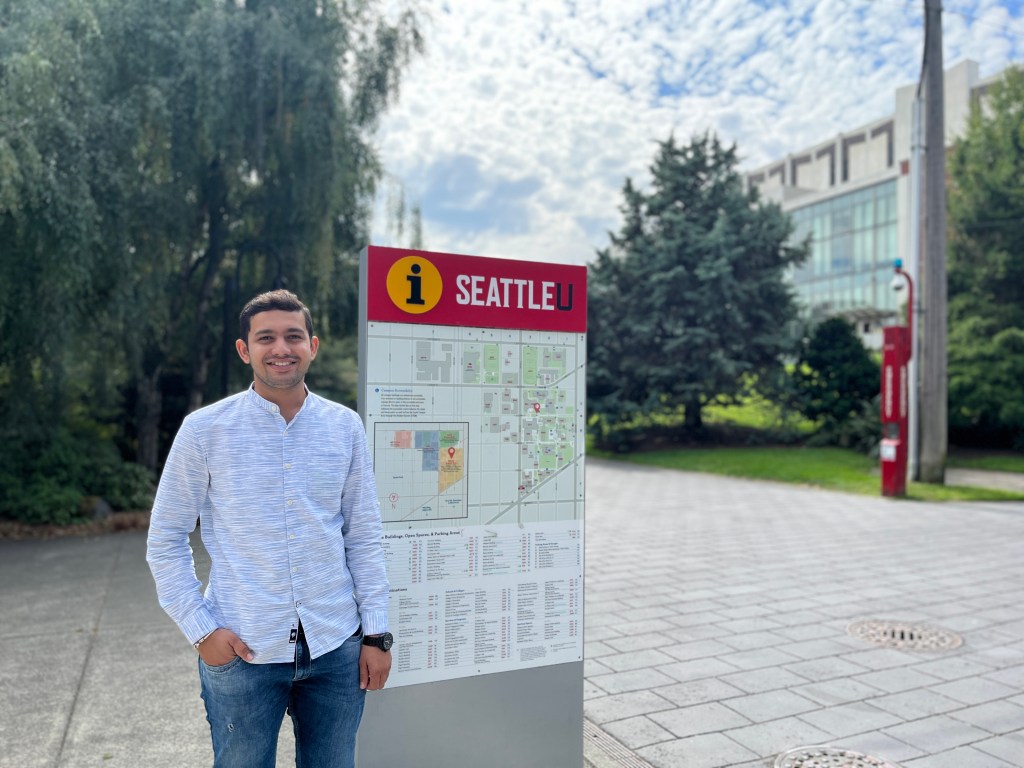
Ashok Kumar at the Seattle University campus
In this interview, he shares a few thoughts on the struggles of inclusivity, the importance of being authentic, and his journey thus far.
(Edited excerpts)
You once said that it might take a village to send someone to study law – was this a learning you made during your undergraduate days?
For my undergraduate degree, I was fortunate enough to get full support from IDIA. So, in one sense, I did not have to seek support elsewhere. Of course, without IDIA even my undergraduate degree would not have been possible, everyone at IDIA was always there to help me.
Here in the US, the financial stakes were very high. Financially it would not have been possible for me to come here without help. So, alongside IDIA’s support, I requested help from my community, from people who were well established.
I met them and told them about my plans, and the fact that I got the chance to study at Seattle University as the first ever recipient of the Remala Family scholarship.
Most of them were so pleased to hear this that they immediately pitched in to help me in my journey.
For me, this was a surreal experience – individuals whom I had never met in my entire life, people who my entire family has no connection with whatsoever, all of them came together to support my journey. I believe this collective effort underscores the growing recognition of the significance of equitable access to quality education.
Were you hesitant to ask for help?
Initially, yes. I thought I would take a loan and manage. But even that did not turn out to be possible. Seeking help was the only option I had. Otherwise, I would have to drop this scholarship, something I did not want to do.
You know, a lot of people’s expectations were also resting on me. The very day I was selected, so many people came to know that a farmer’s son from a remote village had been selected for a scholarship to pursue a masters from United States. The news was super viral on social media. At one level I was anxious whether it should become so viral or not. Politicians were calling me and congratulating me!
The thought of backing out and potentially disappointing not just myself but also the aspiring students who looked up to me was not an option. These young students believed that someone like them could make it this far, and I did not want to let them down. I did not want them to think that just because they did not have the financial resources, they would not make it.
I am glad to tell you that wherever I went, I was met with enthusiasm and support. People were so happy to hear about my journey, that it was almost as if they were supporting me for their own self-benefit. The thought was that if someone from our community is going forward, in the end it will benefit the entire community.
It was actually a wonderful experience for me to witness people standing by my side and supporting me without even personally knowing me.
Now that you are here, how has the experience been?
If you ask anyone in my family, I don’t think they will be able to actually realise how big a deal this is. I come from a very small village – for me to come to such a big city in such a different country is something I can’t believe myself!
I will be very honest in saying that even now there are times when I pinch myself in the night just to ensure that this is not a dream. That this is actually happening. It is all unbelievable for me.
Going back a year or two, when did you think about applying for an LLM?
I knew that I wanted to do an LLM but not right after my law degree. I wanted to get my finances in order first. While I was practicing in Delhi, I came across this opportunity through IDIA and thought that I would apply for it.
I think that if one can build expertise in a particular field of law, then one can gain some financial stability. And once you are financially stable, you can help a lot more people. I also knew that I could use my own practical experiences to help.
For instance, in my village I would often help my father run his ration store. Now, villagers are entitled to a certain quantity of free or subsidized rations. This is monitored via Aadhaar and would involve either biometric verification (via fingerprints) or a one-time password (OTP) on their mobile phones or both.
But there would be so many times when their fingerprints would just not be detected. Or their mobile phone number would not be updated to receive the OTP. So, they would have to go away on that day, and come back some other time. Again, they would try by rubbing oil on their fingers, but it would not always work. Instances like this made me realize that, often times, policies are made without realising the practical problems faced by the marginalized and underprivileged people.
Another example was while I was studying law and Covid struck. It was assumed that everyone had access to a working internet connection and hence online classes would work. But for me, I would have to run around my farm so that I could find a spot where the network is good. In order to get stable internet connection with my phone, I had to build a a chhappar (makeshift-shelter) to attend classes and complete my assignments.
Again, it is a problem of representation, of not having people who could offer practical insights.
You have been here for not too long now. What are the things that seem completely new and alien to you?
From an education perspective, some things are similar to my undergraduate days. I like that the classrooms are centered on class discussions. But academics apart, I find these other things more difficult to adapt to.
Honestly, for me everything feels like it is new. I struggle to use things like a microwave – never in my life have I used one of them. I have never used an oven. So, for any small thing, I have to look up YouTube and search for, “How to cook this in an oven” (laughs) or search for, “Can I keep utensils in the microwave?”
Secondly, the food. There are so many things that I don’t even know how to eat some of the foods. I have to Google, “How to eat bagel”. Or I look at how others are eating and I try and do the same.
When I joined Nirma University, I had a similar experience at first.
I still remember that my longest conversations in English would be with my IDIA leaders, “Yes ma’am, I come here” would be it. But at the orientation in Nirma, my batchmates were speaking such fluent English. This was a world I did not think was real.
Of course, I eventually realized that English was just a medium of communication (but is also very important in the legal profession) but that struggle resulted in a lot of questions to myself. Am I supposed to be here, do I belong here?
What is the answer?
For the first few months it was just about survival. I would try and do more than just attend classes. For instance, I would watch TED Talks and be more motivated to understand and learn English. Then I would ask my friends and seniors to help me.
Academically, I knew I was able to handle the course load. It is the other things that are more difficult.
At Nirma, it was the first time I ate pizza. I remember going with my friends and thinking, “This is such a large roti [Indian bread]” (laughs) I asked them “Where is the sabji [vegetables]?”
Slowly, I learned.
I am very proud to say that by the time I graduated, I was no different from my classmates. The main motto of IDIA to get people like me in the mainstream, and this was true in my case.
It is only then that you realize that you are supposed to be here. That the struggle was necessary. And that your presence was necessary.
For instance, in the classroom, you need people who have experiences like mine, people who have seen how things work in small villages. Think about caste discrimination – those who have come from big cities may have never seen this at all. They might know nothing about it. But when we speak from our experiences, we know that caste discrimination is still prevalent.
These kinds of different experiences are required for any good debate.
Will you continue working with IDIA?
Absolutely, I will continue to contribute to IDIA’s cause in whatever capacity I can. I am very much emotionally connected with IDIA, it has become like family to me now.
As an undergraduate student, I would participate in IDIA sensitization activities, and try to mentor some students. When one of these students would make it [to a law school], it would give me so much joy. The feeling of saying, “Apna bacha bhi select hua hai [One of our children has made it!]” was truly surreal.
How can law schools be more inclusive?
Administrative support is crucial. You need that moral support as well. For instance, when I was applying for the LLM, my university supported me during my LLM application process, helping me in any way that they could. They told me, “If you need any help whatsoever, we are there for you.”
Secondly, the IDIA team at Nirma really helped me, they are the reasons because of whom I was able to survive in law school. Some of the IDIA volunteers and scholars I would like to thank are Runjhun Pare, Prajoy Dutta, Kartikeya Singh, Lokesh Vyas, Danish Ghani, Namrata Dubey, Yash Mittal and Sajjan Singh. Of course, the complete list of names is very long to mention.
These people were my family in Nirma.
Law schools need to have people who can make people like me feel comfortable. Law schools need this to build and nurture a community like this in order to become truly inclusive.
Are you optimistic?
I am very optimistic. Life has been very kind to me and given me so much. If someone from my background can achieve what I have, then others can too. God has given me the right opportunities at the right time. So yes, I am filled with hope.
Any message you would like to give to current or future IDIA scholars?
Remember that people are always willing to support you, provided you ask in the right manner. People would randomly come to help me all the time.
Be yourself. Be confident. That is the most important aspect. If you will try to hide your identity then there is no point in being there. Be yourself, and be proud of who you are. And you will be able to do anything. Great things are waiting for you.
We need your help in keeping this blog alive. If you feel that the content on this blog has helped you, please consider making a donation here.
First Person Accounts (FPA’s) are meant to provide a first-hand account of law graduates who have pursued, or are pursuing, a post-graduate course (an LLM or otherwise) from different universities across the world.
Diksha Maheshwari
Diksha Maheshwari completed an LLM from Columbia Law School in 2022, and is currently working in Singapore. In this FPA, she shares her reasons for choosing Columbia, the LLM experience itself, and how foreign trained lawyers can increase their chances of finding employment.
I will get to the LLM in a bit, but could you tell me a bit more about how you made the move to Singapore? From what I understand, it is quite a small and competitive market to enter – any advice for foreign trained lawyers who are looking to make a similar move?
I started my career with an Indian law firm working on cross-border M&A transactions. I always enjoyed the ever-evolving regulatory and business environment in India and the way that can impact clients’ and lawyers’ approach to deal-making. Joining an international law firm which is renowned for their work in the APAC region seemed like a natural next step and I was fortunate to get a tremendous opportunity in Singapore.
Lawyers with experience of deal-making in India already possess skills which are easily transferable to the APAC region. Networking with lawyers who are experienced in this region can help you to gain better insight into the Singapore legal market – cold emails/ LinkedIn messages to people whose career trajectory resonates with you can be a great way to build connections or even find mentors. Lawyers can also leverage their existing network of peers or university alumni working in Singapore who can then connect them with their own network.
Alright, when it came to the LLM – what prompted you to apply for one? Was there any particular instance that made you realise that the time had come for you to apply?
There wasn’t one particular instance but a gradual realisation. Working on cross-border deals involved collaborating with counterparties and counsel from different jurisdictions, understanding the client’s commercial bottom-line and delivering a solution which is not only legally viable but also commercially feasible. And to add to this recipe, the regulatory jumble of foreign investment laws and host of other complex laws, the dynamic market environment, the legal excitement (and often, “nail-biting” negotiations with counterparts).
This prompted me to dive deeper into corporate and business laws from a more commercial perspective. My goal was to become a more commercial-minded advisor to clients. I wanted to build a though process which makes me better at analysing and solving for the commercial issues underlying a M&A deal.
Many LLM courses are taught by former general counsel of global PE houses, law firm partners or academic authorities in the field. I was quite keen to have this kind of intellectual exposure for my professional growth and the stars aligned to turn my plans into reality.
One of the trickier bits of applying is having law firms who might not want their lawyers to leave – how do you think one should approach this, especially since one does need professional recommendation letters?
I was quite fortunate to have worked with some really amazing (and needless to say, exceptionally smart) seniors and mentors. Before even deciding to pursue masters, I had quite lengthy conversations with them to get their advice and they all were very supportive.
While my experience with getting recommendation letters has been smooth-sailing, I think it might help to have a conversation with the partners/seniors about your professional and personal reasons for pursuing the LLM – a sharing of perspectives could help them better appreciate your decision.
Back to the LLM – what made you narrow down on Columbia? What were some of the other schools, if any, that you applied to?
I applied to few Ivy League schools in the US, and Oxford and Cambridge in the UK. I chose Columbia primarily for their course structure and faculty, and also the global appeal of a US education.
Out of the few Ivy League schools and UK schools that were happy to grant me an admission, I chose Columbia for two reasons: (i) their course curriculum was more aligned with my goals, such as their Deals workshops, Prof Goshen’s seminar on corporate governance, and the ability to cross-register for business school courses, (ii) the helpful (although not substantial) scholarship offered by Columbia.
On a lighter note, being in NYC meant I could feast on the famous New York style pizzas and bagels even at 2 am (which I definitely did and that too, very often).
With the benefit of hindsight, how has the LLM helped in your professional growth? And what have been some of the most rewarding aspects of the Columbia Law School LLM?
There are too many to count.
What sticks out for me is the platform of opportunities it presents for whatever is it that you decide to do. The LLM as a course lasts for less than a year, but the experiences and network you build through that last for much longer (and even for the lifetime).
I was learning not only in the classrooms but also from my interactions with my peers and alumni on a scale which was beyond what I could have imagined.
And most importantly, the LLM taught me how to be comfortable even out of my comfort zone – whether it was the new subjects or an unfamiliar city or the new friends (and of course, the very intimidating cold calls from the professors and the open-book exams).
Lastly, any advice for Indian lawyers who are considering a master’s abroad?
It helps to first think about what are the reasons and the ultimate goal to be achieved from pursuing the LLM. Once you have decided to go ahead with the LLM, it is absolutely critical to plan around financing the LLM and the path/prospects after the LLM (both best and worst case scenarios).
My advice on the financing aspect would be to research into the scholarships available and put the work in to secure scholarships – even a partial scholarship can prove to be very rewarding given the high cost of living in US especially after factoring in forex rates.
We need your help in keeping this blog alive. If you feel that the content on this blog has helped you, please consider making a donation here.



 Amicus Partners