The Admission Interviews, are meant to provide insights into LLM admissions right from the law school itself. The primary idea behind this series is to provide that little bit of extra information that may not be available on the law school’s website.
In this edition, I speak with Amber Featherstone, the Director of Graduate & International Programs at Wake Forest University School of Law. In this interview, Amber shares her thoughts on US legal recruitments, what an admissions office looks for in a personal statement, and a whole lot more.
What do you think are the benefits of an international LLM program that can’t be found in, say, a domestic postgraduate course?
International LLM programs allow students to be exposed to a new set of legal standards and theory. By becoming an expert in another system, these professionals will have the opportunity to advance in their careers with a set of skills and knowledge that sets them apart.
Our world is growing increasingly smaller and understanding international law is going to be a big requirement for practicing attorneys as more and more companies and firms work globally.
I know you have rolling admissions, but how long do you think an applicant should spend on the application itself?
Applicants should put a lot of thought into their application to each school. The components of the application are how a school gets to know the applicant and are the basis for deciding whether that applicant would be a successful student in the program.
Each law school in the U.S. is very different. Applicants should get to know the schools to which they apply and they should show in their application documents that they are the best fit for that school.
Any advice on how one should go about writing the personal statement?
Personal statements are the only piece of the application where an applicant gets to tell us about themselves in their own voice. The personal statement, some would argue, is the most important piece of the application package. Applicants should tell us their story – tell us who they are and why they are the best fit for our school.
Some applicants make the mistake of focusing on only one event in their personal statement. While it can be interesting to learn about that one piece of their journey, it doesn’t give us a lot of information on who the applicant is and how they will fit in at our school.
We recommend that applicants really focus on giving us a complete understanding of who they are and what they want to accomplish in the LLM program. An applicant’s personal statement should be different for every school to which they apply because the reasons they are a good fit for one school may not match our school!
“An applicant’s personal statement should be different for every school to which they apply because the reasons they are a good fit for one school may not match our school!”
This may be cultural, but a lot of Indian applicants struggle with pitching themselves as ideal candidates. Any advice on how they could overcome this?
Everyone struggles with pitching or selling themselves to others. It is hard to share your positive attributes without sounding like you are too confident. We really encourage applicants to try to push past this feeling.
We want to know all of the things they have done that make them an excellent applicant to our school. If they don’t tell us about them, we will never know. So, don’t be shy. Tell us why you’re the perfect student for our program.
“So, don’t be shy. Tell us why you’re the perfect student for our program.”
Do international LLM students participate in externships/internships? What has been the response towards international LLMs at events such as the NYU ISIP?
Externships and internships during the one-year LLM program can be challenging. There just is not enough time to fit them in during the school year. However, most LLM students seek work opportunities after they graduate.
During the academic year we focus on giving students the tools they need to be successful in the job hunt after they graduate.
Having an opportunity like the NYU ISIP is definitely a bonus. Students are able to apply to employers that are looking for candidates just like them – someone with a law degree from outside of the U.S. and an LLM from the U.S. Each year we have had students selected for these interviews and they have thoroughly enjoyed the experience.
A lot of Indian law graduates are viewing the LLM as a means to move to start practice in the US. But given how saturated the US legal market is, do you think this is a realistic goal?
I don’t view saturation of the US legal market as the biggest hurdle to finding more permanent employment in the U.S. The biggest challenge, in my opinion, is obtaining more permanent work authorization.
Students who complete their program can apply for 12 months of work authorization after graduation, but that authorization is not guaranteed after the initial time period. Most students have to apply to the visa lottery, which is truly a lottery where not everyone can win.
Finding employers who are willing to take a risk on an international student who is not guaranteed employment authorization after those 12 months is tricky. We work closely with our students to give them the tools they need to convince employers that they are the best candidate for the job – regardless of their visa status.
“Finding employers who are willing to take a risk on an international student who is not guaranteed employment authorization after those 12 months is tricky.”
Could you tell me a bit more about the two-year JD course? Is this an option for Indian law students as well?
The Two-Year JD for International Lawyers is an accelerated JD program that takes only two years to complete and earn a full Juris Doctor degree, which will allow a student to sit for the bar examination in any state.
We give students credit for their previous legal study to shorten the JD. This program is a great option for students who want to shorten their time and financial commitments to get the full first-degree in law here in the U.S. Any student with a Bachelor’s of Law is eligible to apply.
There are some law grads who are interested in academic careers. What advice would you have for them in terms of using the LLM as a stepping stone for the SJD?
For law grads wishing to follow an academic track, the LLM followed by the SJD is the best option.
The SJD is an academic PhD in law that focuses on scholarly writing and research. Students work one-on-one with a faculty advisor who is an expert in their area of research.
In order to complete the program, students must write and defend a dissertation, and present their findings to the public. Many students use this track of study to return to their home countries for law teaching and faculty positions.
The Amicus Interviewsare meant for broader discussions on legal education, and the legal profession. As I have mentioned earlier, one field that Amicus Partners is particularly interested is in legal academia, and what it means in the Indian context.
Amal Sethi
For this edition, our intern Aayushi Bindal, speaks with Amal Sethi, a graduate of Government Law College Mumbai (Class of ’15) who completed an LLM from the University of Pennsylvania Law School, and is currently a doctoral candidate working on his SJD.
In this interview, he talks about a host of things, including how to go about selecting the ideal law school for you, encouraging academic research in Indian law schools, and how to go about writing a good statement of purpose.
What made you pursue LLM right after graduation?
I started contemplating an LLM very early in my law school life. By the final year of law school, I knew why I wanted to do an LLM, and I felt ready to do one. Also, I felt work experience would not add too much to my skill set and thought process as ‘at that stage’ my interests (and reasons for pursuing an LLM) were quite academic. Therefore, I applied for LLM’s in my final year of law school.
I mention ‘at that stage’ because my interests and goals have significantly evolved over time and keep evolving with every passing day.
How did you go about selecting which law schools to apply to? And why did you narrow down on the University of Pennsylvania?
Which law school’s I applied to was not something I put a lot of thought into. My academic interests at that time were in public law and legal theory which pretty much all top law schools are very good at.
I applied to all the American Law Schools ranked 4 to 14 on the US News Ranking (I omitted the top 3 as I was not very confident of getting in and did not want to spend time tailoring any more applications.) I did not apply to the UK because the structure of their programs and their course offerings did not interest me back then.
On the other hand, selecting law schools was something I put a lot more time and thought into. This was compounded by the desirable dilemma that all law schools I applied to accepted me. I guess I dedicated almost two months to this process. I always knew I wanted to pursue a doctorate, so one important criterion for me was to attend a law school which:
Had about four to five young faculty members who I would like to work with and who had a track record of taking doctoral students.
Had a history of admitting students with similar background as me into their doctoral programs.
I did also consider, albeit to a lesser degree, the financial aid that I received and the final cost of attendance. Consequently, my process of selecting a law school involved a lot of research about individual faculty members and speaking to current doctoral students at the universities that I got into to (I found current students contact information off law schools’ websites and LinkedIn).
“Consequently, my process of selecting a law school involved a lot of research about individual faculty members and speaking to current doctoral students at the universities that I got into to.”
For example, very early into the deciding process, I eliminated NYU (which by the way is an amazing program and perhaps the best program if you want to study Public International Law or Tax Law) from my list of potential ‘law schools to attend’ because it did not give very positive signals on considering the above criterions. Eventually narrowing down was tough and I did give up seats in arguably a few law schools ranked higher than Penn as I felt that Penn was a better fit for my academic goals.
Any advice on how to go about writing the SoP for LLM applications?
Over the years at Penn, I have served on the LLM admission committee. So, this would prohibit me from directly giving out information on what the folks at Penn look for in applicants. However, the few general suggestions I have for SoP’s are:
Ensure that your SoP ties up with the remainder of your application.
Keep your SoP very crisp – do not add information that is not necessary.
Think of your SoP as the transcript of a hypothetical interview with the admissions committee.
Only add stuff you think you would have mentioned if someone from the admission committee physically asked you ‘Tell Us Whatever You Want to Tell Us in Support of Your Application.’
Do not do redundant emotional storytelling – it is fine if you do not have a touching or fancy story. Most of us do not. If you are thinking of doing a masters abroad, chances are you are a middle to upper-middle-class Indian with a decently privileged upbringing. THAT IS FINE. There is no shame in that.
“If you are thinking of doing a masters abroad, chances are you are a middle to upper-middle-class Indian with a decently privileged upbringing. THAT IS FINE. There is no shame in that.”
Do not make up stuff – it is very easy to ascertain if you are doing so. Admission officers read thousands of applications a year and have been doing it for decades. They know exactly when someone is lying.
Be clear in your reasons for pursuing a particular program.
Show that you are focused in your thinking and not all over the place.
Show colleges that you are genuinely interested in attending them and that you have spent time researching about them and their tenured/tenure track faculty.
Understand what the program you are applying to is, what it entails and what are the realistic outcomes from that program. Show that you understand all of this in your SoP. The respective program websites are an excellent resource for these questions.
Address the reasons for any apparent weakness in your application – low marks, low TOEFL, lack of work experience, a gap in studies, etc. For example, for every college’s application that signalled on their website that they prefer applicants with work experience I had mentioned in my SoP (1) why I am applying straight out of law school (2) why I am ready for the LLM (3) why any work experience would not add much to my application.
Do not use overtly convoluted grammar. Keep it simple.
Start working on your SoP as early as possible (often a year before applying).
Did you apply for any sort of financial aid?
I did. Both when it came to law schools’ own financial aid/scholarships and external Indian scholarships. I like to believe I had some decent luck with both. In hindsight, I credit my success in this department to the fact that my application had quite an academic and public law bent, something which is uncommon in most Indian applications.
One small piece of advice I would give to students reading this is that if they have the time they should pursue Indian scholarships/interest-free awards. Not only are these not extremely competitive, collectively they can help you out with a few lakhs. Most Indian scholarships/interest-free awards, in my opinion, are far less competitive than law schools’ own financial grants and/or scholarships.
“Most Indian scholarships/interest-free awards, in my opinion, are far less competitive than law schools’ own financial grants and/or scholarships.”
Nevertheless, I must admit the process for Indian scholarships is a bit tedious especially when we look at the amounts awarded (most scholarships have awards which are in the range of 1 to 5 lakhs). You would need a good number of awards to make a significant difference. Also, just a word of caution – while there is no hard and fast rule, yet both external and internal scholarships are often biased towards people with interests and work in the public or non-profit sector.
Looking back, what was the biggest positive of the LLM experience?
For me, the masters and doctorate were in some ways a collective experience. The LLM was all about getting into the doctoral program. The biggest positive of almost half a decade in an extremely academic setting is that it substantially improved my understanding of the law and my ability to research efficiently.
For example, I genuinely have confidence in my ability to develop a decent level of theoretical proficiency in any area of law within a week. Back when I was in law school in India, the idea of finishing one commentary on a subject in a week seemed terrifying (especially if the subject was out of my comfort zone), let alone developing fluency in that subject. This example also leads to another positive aspect of my experience – It helped me build a lot of confidence.
What many people do not realize about doctoral degrees is that their purpose is not to make you an expert in a small sub area of the field but rather to make you an expert in researching and writing.
“What many people do not realize about doctoral degrees is that their purpose is not to make you an expert in a small sub area of the field but rather to make you an expert in researching and writing.”
During your LLM, you were also the International Editor on the Penn Journal of International Law – how was this experience? And how do you think Indian law students can be encouraged to research and write?
Fascinating that you ask that – I’ll be honest, that is literally one of the least exciting things I have done at Penn or as a matter of fact during my time in the states.
I joined the Journal of International Law mainly to meet people who share similar interests with me. That purpose it served very well. On the work front, American Law Reviews are only about blue-booking and proofreading. I had done a LOT of that while in India as I was extensively involved with legal publications and legal writing during my undergraduate law school years. So, as an experience, it was as okayish as it gets, but as a social activity it was incredibly brilliant. I made a lot of friends with whom I till date discuss the law, legal developments, and doubts.
“As an experience, it was as okayish as it gets, but as a social activity it was incredibly brilliant. I made a lot of friends with whom I till date discuss the law, legal developments, and doubts.”
As for your second question, I am often asked about it and find myself really short of words.
I feel to encourage law students to research and write you need to get them:
Interested in the debates that are hot in legal academia, and
To think academically.
This boils down to the fact that the purpose of writing is to contribute meaningfully to the debates taking place in legal academia. I teach legal writing to LLM students at Penn and often find that a lot of students do not get this part. The current system in place at most law schools in India rarely makes students interested in anything let alone research and writing.
Further, the current system does quite a bad job of acquainting students with the debates in legal academia or getting them to think academically. Often law students in India get interested in things because of internships and moots (and/or similar competitions) or they stumble upon things randomly. In my own case, I randomly decided to give writing a try in my first year of law school and happened to enjoy it. Then over the course of my undergraduate law school years, law blogs and online courses on Coursera and EdX did a terrific job of introducing me to things that I wanted to write about.
While we can keep talking about reforming the system, I think one short-term fix that law schools can make to encourage students to at least start thinking in an academic manner is to make conscious efforts of getting top academics to come to campus and talk about academic topics or their own work (law schools are already doing it in plenty with senior counsels, judges, law firm partners and politicians). This could in some ways sow the seeds and encourage students to take up researching and writing.
“I think one short-term fix that law schools can make to encourage students to at least start thinking in an academic manner is to make conscious efforts of getting top academics to come to campus and talk about academic topics or their own work”
With respect to the doctorate, how does the Dissertation Committee work? And any advice for Indian law graduates who are looking to pursue a doctorate degree in the US?
A dissertation committee is a group of law professors who guide you through your doctorate and eventually are responsible for asserting whether you have completed the requirements of a doctorate. Moreover, a dissertation committee frequently would have a chair who is your direct point of contact and who is your principal guide/advisor.
My advice would be this – you have at best 6 months during your LLM to convince prospective faculty members to take you under their wings (Note – very rarely will you get into a doctoral program in an American Law School without having done an LLM in the same law school. At least, not a law school of the same rank).
This can only be achieved if you start the process of ‘thinking about applying for a doctorate’ months (in some cases years) before joining the LLM program. You cannot (and should not) start the process of ‘thinking about applying for a doctorate’ after starting the LLM or worse in the second semester of the LLM program (you are very likely to not succeed in such a case).
Ideally, you should start thinking of prospective topics for your doctoral dissertation in the summer before matriculating and then spend the LLM year developing the topic along with potential committee members. Also, be careful that this should not be a topic in a random area of law but an area of law that you have experience with (be it through work or other forms of research) and which professors in an AMERICAN university would be interested in supervising.
“Ideally, you should start thinking of prospective topics for your doctoral dissertation in the summer before matriculating and then spend the LLM year developing the topic along with potential committee members.”
For example, it is unlikely (not impossible though) that a top American Law Professor would be ready to supervise a doctoral dissertation dealing with Pre-Indepdence Labor Laws in Bihar and Bengal. Further, even if he/she does agree, they would barely be able to give you constructive feedback on it. Most successful doctoral applicants in law schools are often pursuing comparative, theoretical or abstract topics.
To give you my example, I mailed some faculty members about the possibility of pursuing a doctorate and potential topics even before reaching Penn (though you must be extra cautious in doing that and must not get on the wrong side of faculty members.)
In my case, I was guided by an existing Indian doctoral candidate at Penn who acquainted me with all the do’s and don’ts at Penn as well as vis-à-vis individual professors. Consequently, not only did I take classes in the first semester with most of my potential committee members, but I also started setting up meetings with potential committee members regarding a doctorate within weeks of arriving at Penn. I also did two independent studies with potential committee members with the sole purpose of developing my dissertation topic.
“Not only did I take classes in the first semester with most of my potential committee members, but I also started setting up meetings with potential committee members regarding a doctorate within weeks of arriving at Penn.”
What is your reading of recruitments in US legal academia, especially for international students?
Most of the times it is quite bad – but that boils down to a lot of factors foremost among which is that most international students do not have what American law schools are looking for in prospective hires. Think of this as applying for a senior associate position in the capital market team of AZB or Trilegal after five years of researching about LGBT rights and Health Policy at Vidhi Centre for Legal Policy. It is not that applicants are not qualified, it is just that they do not fit the bill.
This is in crude terms why most international students are unsuccessful. I could spend five pages writing about what my reading is but most of that would be entirely alien to someone not pursuing a doctorate or not familiar with the intricacies of research. Hence, I shall leave it at – it is not easy, but it is not impossible, and you can quite easily work towards a good job in the US (or another developed country) if you truly want to. It, nonetheless, might take a few years and a lot of hard work and patience.
Lastly, any advice for Indian law grads who are thinking of an LLM outside the country?
Do an LLM as a means to an end and not because you are going through a quarter-life crisis and/or do not know what you want to do with your life. An LLM will not magically solve all your problems/confusions.
First Person Accounts (FPA’s) are meant to provide a first-hand account of Indian law graduates who have pursued, or are currently pursuing, a post-graduate course (be it an LLM or otherwise) from different schools across the world.
In this FPA, we get to speak with Aakanksha Chauhan, who is currently pursuing an LLM from Osgoode Hall Law School, York University in Canada. The graduate of Jindal Global Law School (Class of ’17) shares her thoughts on the LLM itself, qualifying for the Bar in Canada, and a whole lot more.
(Edited excerpts)
At what stage of your undergraduate did you consider a master’s? Were you considering working for a few years before the LLM?
I was keen on working before I did my Masters in Law. I wanted to be sure of my area of law before I dove into a Masters program. Another thing that I was sure off, was that I wanted to be qualified as a lawyer in more than one jurisdiction.
I think with the growing number of lawyers in the world, the competition has become cut throat. There are so many wonderful candidates being called to the Bar every year! I wanted to set myself apart in some way and bring something new to the table. Which is why I decided to get a little international experience in the early days of my career. My boss, Mr. Pervez Rustomkhan, was a driving force in this decision. I was doing very well in his practice which is based out of Bombay. He is one of the most respected and well-spoken lawyers I have ever come across. When I suggested to him a year into work that I was considering doing a masters abroad. He was completely on board. He asked me to go for it because the world is becoming smaller day by day. Having knowledge about foreign jurisdictions will truly help in the future.
“He asked me to go for it because the world is becoming smaller day by day. Having knowledge about foreign jurisdictions will truly help in the future.”
This is, in fact, your second stint at Osgoode. You spent an entire semester as an exchange student in 2015. What was that experience like, and after you graduated did you look at any other law schools for a master’s?
The experience during my exchange was positively wonderful. I met some of the most amazing people and studied under some of the best professors. I studied trial advocacy which entailed me learning the craft of cross-examination, examination in chief, opening and closing arguments, and studying evidence. The final exam was an actual trial in a Court House, before a judge and jury. It was truly an experience apart. This eventually helped me when I briefly worked as a litigation lawyer in India. I was successful in drafting some very helpful cross-examinations.
I also studied “Lawyer as a Negotiator” which taught me the art of negotiations. This art is really not given enough importance in India. It is usually looked at as a part of corporate law. But it really is a skill on its own and deserves more recognition. The reason this exchange was so wonderful was that it made me fall in love with a new city but more than that, I was taught by actual practising lawyers in Canada. Which was so helpful. They would use examples of cases they tried maybe a few days earlier to class. That just made the class more real and exciting!
I was accepted into other schools. However, I chose Osgoode because of the program offered.
Any advice on how to go about the application process, the statement of intent and/or writing samples?
The writing sample should usually be one which you managed to publish. If not, let it be one that is short crisp and grammatically correct. Grammatical errors are very obvious, and a lot of importance is given to the same so maybe proofread everything more than once. And have someone else read it as well.
In my SOI, I was very clear about what my future plan was and how the college catered to my plans. I was never vague. I never spoke about what I “might” do. It was always about what I “am” going to do. I think they appreciate it when you bring to the table a clear plan of your future. They want to know that you’re using their resources to the best of your ability.
“I think they appreciate it when you bring to the table a clear plan of your future. They want to know that you’re using their resources to the best of your ability.”
How has the LLM experience been thus far? What are some of the bigger learnings that have been made in the last six-odd months?
It has been lovely! It is tough. Because you are squeezing in heavy duty subjects in a short span of time. However, Osgoode works really hard to make the experience as helpful as a JD experience. I was taught criminal law by an actual active Judge and a partner of one of the biggest criminal law firms in Canada. I was taught ethics by a working lawyer.
So you’re given a very realistic outlook on all the laws you’re being taught. I am also part of the executive of the Criminal Law Society of Osgoode which has again given me the chance to meet so many criminal lawyers. Canada gives a lot of importance to networking. Being part of this LLM has been so helpful because I am constantly guided towards new networking events. I have met some of the finest lawyers and it has been an experience apart.
Osgoode also gives you a chance to work with the Pro Bono Chapter. So I secured a position with the Justice For Youth and Children department [Criminal Law] in Canada. I am currently working on a Hague Convention case and a few judicial reviews. I get to work with lawyers on actual cases. It really helps. Because you get work experience as well as academic experience.
You have enrolled for the professional LLM in Canadian Common Law. Why did you choose this course in particular as opposed to say, a thesis-based LLM?
As an internationally trained lawyer to practise in Canada you can do two things:
Get an NCA Assessment –> Write the NCA exams which are listed in your Assessment –> Get a certificate of Qualification after passing these exams –> Article for 10 months or do an LPP program –> Write the Barristers and Solicitors Exam during your articleship/LPP or after –> Get called to the Bar.
Get an NCA Assessment –> Attend a Canadian LLM Common Law Program and study the subjects listed in your assessment –> Get a certificate of Qualification after passing these exams –> Article for 10 months or do an LPP program –> Write the Barristers and Solicitors Exam during your articleship/LPP or after –> Get called to the Bar.
The Common Law LLM helps you towards qualifying as a barrister in Canada within a short span of time. The LLM in Canadian Common Law provides the opportunity to take core courses in Canadian common law topics taught at the graduate level along with a wide range of elective options.
So, students who are lawyers from jurisdictions other than Canada can do this LLM to transition into the Canadian Legal Market. That was my goal from the beginning. I wanted to be called to the Bar and work in a foreign jurisdiction for a while. Which is why I chose this program.
What is your reading of the Canadian legal market when it comes to recruitments of international law graduates?
It is not easy. The job market is very competitive, and JD students definitely have an upper hand over LLM candidates. However, if you network enough, get out there and find new opportunities you will be fine. It is definitely better compared to other jurisdictions. The likelihood of being called to the Bar within a year or two is great! Especially if you just have to study for a year and article for 10 months. Again, no one is going to be waiting with a job for you. It’s tough but not impossible!
“However, if you network enough, get out there and find new opportunities you will be fine. It is definitely better compared to other jurisdictions.”
That being said the work environment in Canda truly makes the struggle worth it. Working Hours and just the work, in general, is amazing!
Lastly, any advice for Indian law grads who are looking to study in Canada?
Read up thoroughly on each program. If you just want to specialize and head back to India, I would suggest looking at schools like the UK or the USA or even Germany! But if you want to work abroad then Canada is definitely the place to go. Make sure your SOI is very clear on why you want to do a certain course.
Reach out to lawyers or students in Canada, they are very nice! They love to help. Ask them whether your future plans make sense. It is a very expensive investment so make sure you know what you’re doing. That being said Canada is lovely, you will genuinely meet the nicest people here. If not, the poutine and snow make up for everything!
First Person Accounts (FPA’s) are meant to provide a first-hand account of Indian law graduates who have pursued, or are currently pursuing, a post-graduate course (be it an LLM or otherwise) from different schools across the world.
In this edition, we speak with Richard Mantosh, who recently graduated with an LLM from the University of Hamburg. Richard, who completed his Indian law degree from Sarsuna Law College in Kolkata, discusses the reasons behind choosing Hamburg University, recruitment prospects in Germany, and a whole lot more.
Richard Mantosh
What got you interested in the study of law after your B.A.? Did you look at the 5- year options as well?
As far back as I can remember, I always had an affinity with the subject of Law. I reckon this, indirectly, had to do with the fact that whilst growing up I was mostly surrounded with Legal discourse, as my uncles are practicing lawyers (High Court at Calcutta) and my father is a former Parliamentarian (Lok Sabha).
Notwithstanding, I still wanted to be 100% certain that Law was ‘my calling’. Hence, after completing my High School, I chose the ‘unconventional’ path for budding Lawyers, by enrolling in a 3 year B.A. I felt this would broaden my mind, and upon my graduation I was a 100% certain to pursue an LL.B Degree.
How was your LL.B. experience? Was it during this time that you decided to do an LL.M. or was the decision made only after working for a few years?
My LL.B. experience was positive: Sarsuna Law College, Kolkata, had a well- equipped library, the teaching faculty was encouraging, and my fellow class-mates came from diverse education backgrounds. Frankly, during my LL.B. I never really saw an advantage to study an LL.M, as practical skills such as court craft seemed more rational then. Upon passing the Bar Exam, I commenced my legal practice predominantly at the High Court at Calcutta and the Supreme Court of India.
One of my client’s was a Non-Profit (International Justice Mission), their case-work was on Indian Criminal/Human Rights Law but it also had a strong interplay of International Law. I discovered how the realm of Law/Natural Justice goes beyond our National borders & thereby decided to study an LL.M. after two years of practice.
The University of Hamburg is an interesting choice – what got you here, and did you look at any other schools?
So when I decided to pursue an LL.M., I zeroed in on going to a Law School in England or Germany. England looked like a more ‘natural fit’ as our Indian Legal system is fundamentally based on theirs (Common Law), in addition to a common language. In fact, I got offer letter(s) from, inter alia, City University of London. However, Germany appealed to me more as I was curious to study a different Legal system (Civil Law). The reason why I chose Universität Hamburg was because it is a Global Top 100 University (for Law) & the course was a perfect blend of German, European, and International Law.
Another factor was the tuition fees of this University, which was substantially cheaper to its UK counterparts.
“The reason why I chose Universität Hamburg was because it is a Global Top 100 University (for Law) & the course was a perfect blend of German, European, and International Law.”
At Hamburg, did you take up the EMLE program? Or was it something else?
No, I did not apply to the EMLE program. The program I applied to is called the ‘European and European Legal Studies’which is run by the Faculty of Law, Economics & Social Sciences of the University of Hamburg, in cooperation with the Europa-Kolleg Hamburg (an institution at the University of Hamburg). In addition to Law, we also studied the nuts & bolts of Economics to understand the underpinnings of European Competition & World Trade Organization Laws.
Any advice on how to go about writing the Letter of Motivation/Statement of Purpose?
Writing an LoM/SoP to study in Germany is a two part process – the first being to the University Admissions Committee and the second being to the Consular Visa Officer. My advice to prospective LL.M. candidates would be to keep their LoM/SoP to the point.
Focus on your most relevant credentials, what skill-set(s) you would bring to the class, what you are expecting to gain by the end of the program, and how you intend to leverage the same in your job/profession.
How was the LL.M. experience? What were some of the bigger differences in the learning and teaching processes between Hamburg and Vidyasagar University?
The LL.M. experience was, in one word, stupendous. The program was taught in English by professors who had themselves studied at the best law schools in the world. Further, part of our program was a 2-month internship, where I interned at a Law Firm (Bryan Cave LLP) in Hamburg. In addition, we were also taken for study excursions to the key European Institutions in Brussels & Luxembourg.
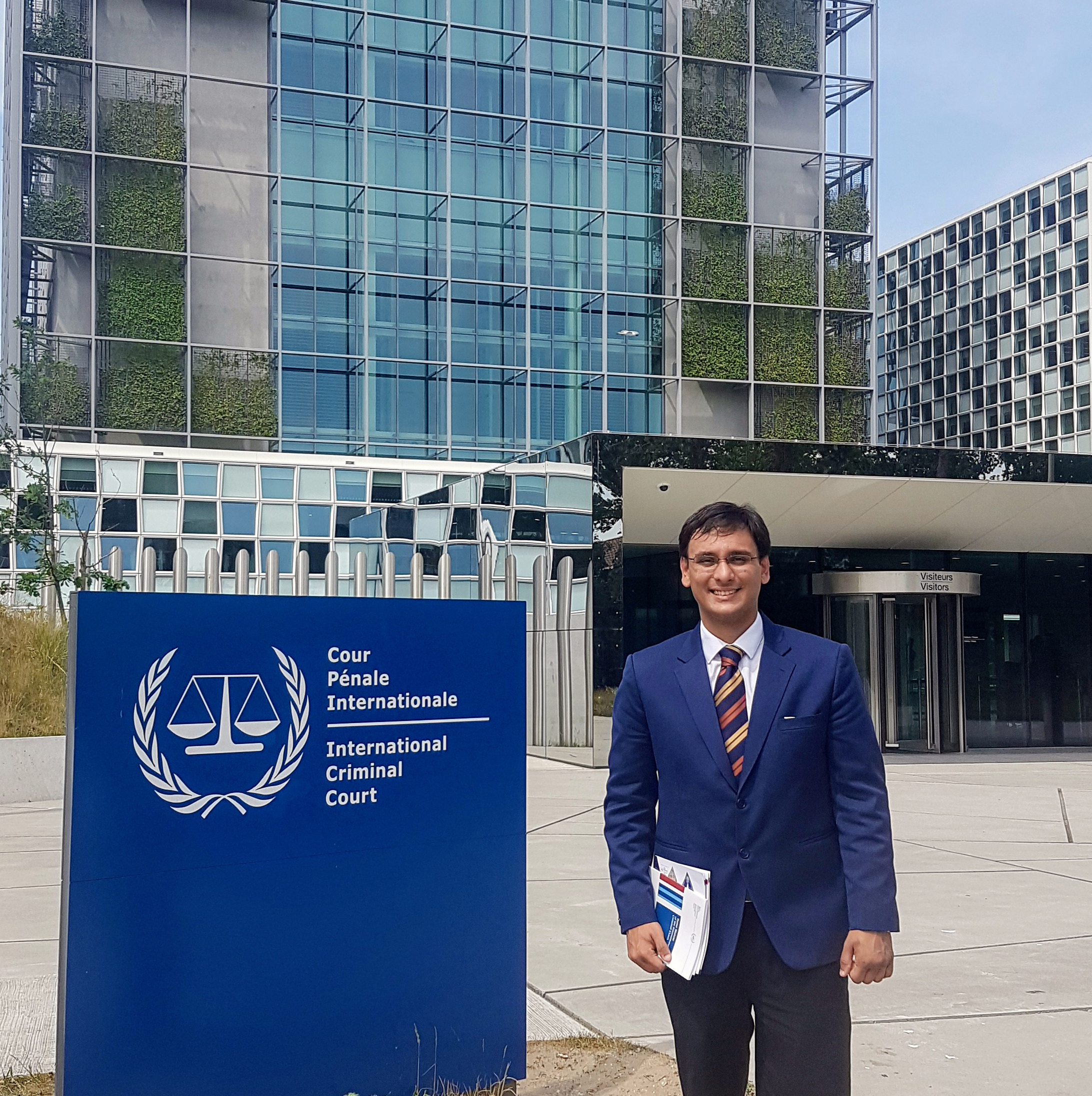
Although not part of the LL.M., I had the privilege to be selected as one of the youngest Judge’s at the International Criminal Court (ICC) Moot Competition 2018, at The Hague, Netherlands. Prima facie, the core difference between the University of Hamburg and Sarsuna Law College, Kolkata (affiliated to Vidyasagar University) was that the former University would consistently enforce the Socratic method of learning/teaching. This pushes students out of their comfort zone to develop argumentative debates, based on asking and answering questions to stimulate critical thinking.
“This pushes students out of their comfort zone to develop argumentative debates, based on asking and answering questions to stimulate critical thinking.”
What is your reading of the German market when it comes to recruiting international students?
Germany, having the largest economy in Europe, has a large pool of International Applicants/Lawyers looking to gain further exposure, especially post-studies. In my reading, two factors are significant: one should at the least have a basic understanding of the German language and two, one could apply at law firms having their Country’s ‘Legal Desk’ or which deals with International Legal fields (such as Arbitration, Competition, Trade – among others).
As for myself, I have secured a job-contract with a Law Firm (GERMELA Wülfing LLP) in Hamburg.
Lastly, any advice for Indian law graduates who are looking to do an LL.M. outside the country?
To you all I would humbly say, keep your grades in the above-average range and get “your feet wet” by practicing/working on various case-work (even pro bono cases) for at least a year, as it is of paramount importance to know what kind of LL.M./Legal Specialization you would like to embark on.
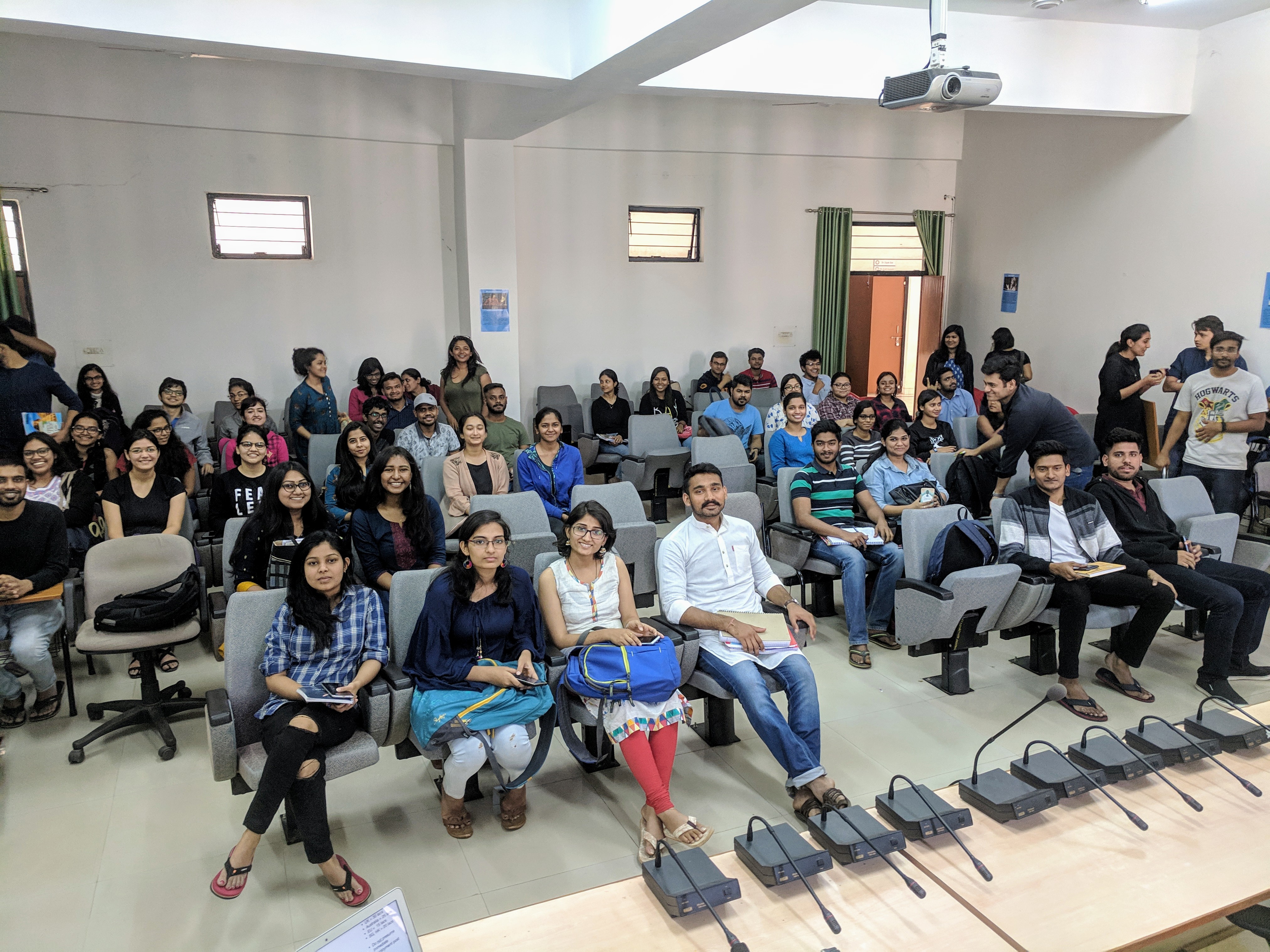
In the first week of February this year, I had the chance to give a talk on LLM applications at the Hidayatullah National Law University in Raipur. It was a short visit, lasting just about a day, but there were some memories made. These are the ones I am choosing to share.
One.
The silence is surprising. Very surprising. For the last twenty-odd minutes the students have been asking some damn good questions, ones that have some thought and research behind them. The questions were asked with confidence, and a curiosity that, I think, was genuine. But then came the silence, that eerie silence that just does not belong in a classroom, that silence of the pin drop kind.
And all I did was ask how many of them are applying for the Rhodes scholarship this year.
Do they really think they won’t make the cut? Or is that what “everyone” has told them?
The patient listeners. (Amicus Partners)
Two.
I am being treated to some great hospitality, and the kids are bright, and ambitious and talking about PPO’s and planning Day Zero’s for the fourth-year batch. This practice, of allowing recruitments to take place a full year before graduation, has been followed by the “best” law schools for some time now. With little, if any, discussion on just what this practice says about that final year of education, or about the dangers of herd mentality., or about the relationship between “national” law schools, and one of their biggest benefactors, the Indian Corporate Bar.
Three.
There is some sort of performance event taking place near the main building, and the “woo hoos” are puncturing the air. There is that vaguely familiar scent of hope, of optimism, of a cynicism that is not genuine. I am walking around the campus, and the university’s physical infrastructure is plenty impressive, quite at odds with the student uprising that recently led to their VC’s resignation. I suppose building a law school, developing a campus, building hostels and stadiums and tennis courts are one thing. Running a law school, however, is another.
Four.
To reach the HNLU campus from Raipur aiport, one rushes through Naya Raipur, a massive chunk of land that will be “developed” in the years to come. The roads are massive, straight, the buildings are new and shiny, and you can see a waiting and watching Capitalism at every crossing.
It is also incredibly desolate, and I do wonder what the HNLU students do to pass their time. And how the campus experience plays into their legal education, and their own, individual ambitions and hopes.
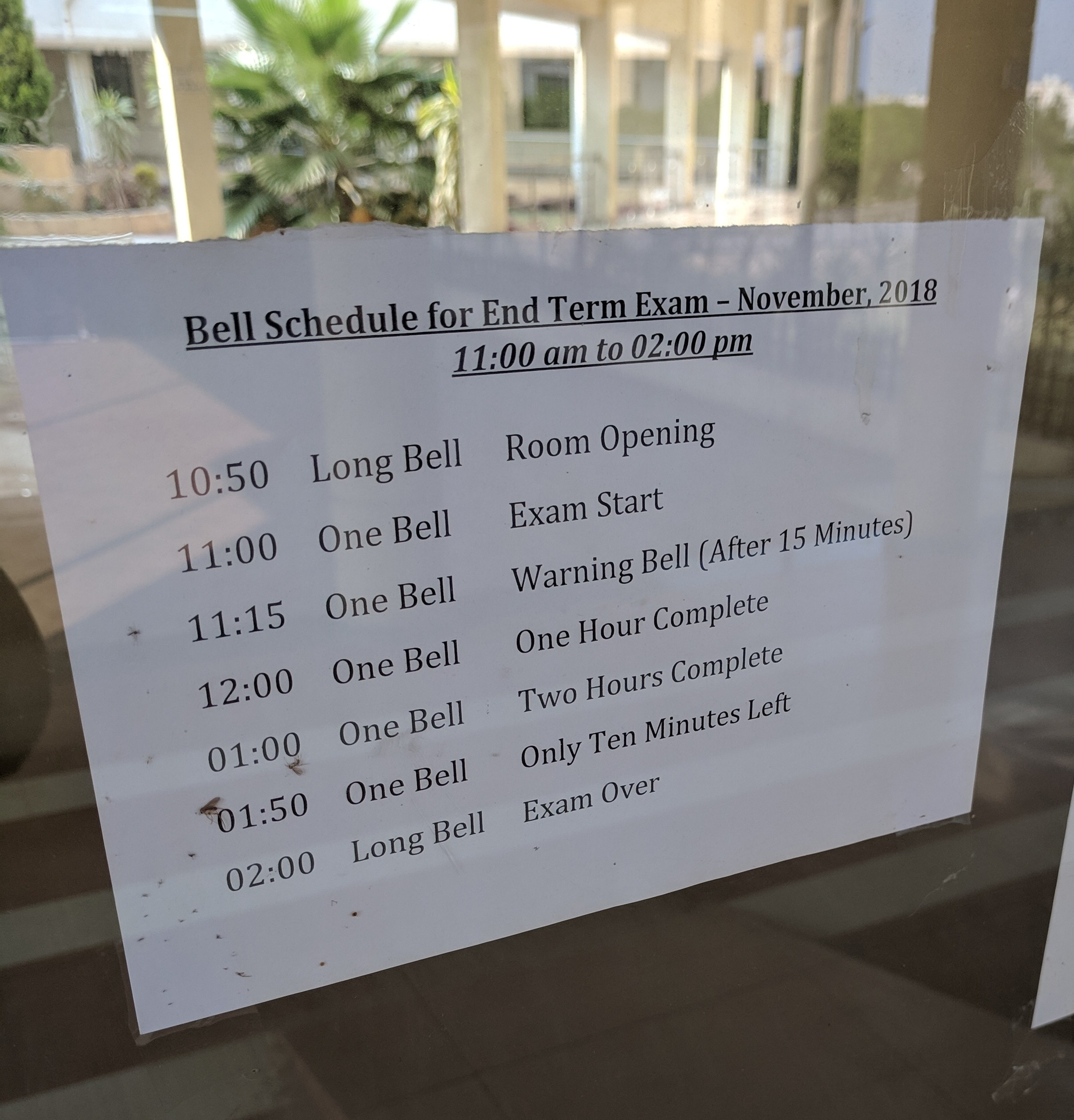
That penultimate bell is the worst (Amicus Partners)
Five.
I am sitting inside Raipur’s airport, looking back on the day, and hoping to make another visit soon. Given how efficiently this talk was arranged, that is a distinct possibility. I am also realizing that, more and more, today’s law graduate has global ambitions. Whether this is in terms of education, employment or, and this is quite likely, both.
These are some exciting times ahead for us at Amicus Partners. Most exciting.
(Much gratitude to the RCC at HNLU for arranging the talk)
(If you would like Amicus Partners to hold a session at your law school, reach out to us at contact@amicuspartners.co.in)




 Amicus Partners