• The Amicus Interviews are meant for broader discussions on legal education, and the legal profession at the global level. Along with the legal research and law schools, these interviews are meant to bring across a slightly “macro” perspective on things.

    Over the last two decades, Professor Stephen Horowitz has, in no particular order, created a comic strip on bankruptcy lawyers, taught English to high school students in Japan, worked as as a lawyer specialising in bankruptcy laws, and built the Legal English program at St John’s School of Law.

    Currently at Georgetown Law as a Professor of Legal English, Prof. Horowitz shares his journey as a student, lawyer, and teacher, and what it takes to teach and learn Legal English. 

    Professor Stephen Horowitz has created a comic strip on bankruptcy lawyers, taught English to high school students in Japan, worked as as a lawyer specialising in bankruptcy laws, and built the Legal English program at St John's School of Law.
    Prof. Stephen B. Horowtiz

    I have to start with “Bankruptcy Bill” – how did this idea come about? How did you team up with Gideon? Any particular highlight that you wish to share when it comes to setting up and publishing this comic strip? Lastly, any chance of a revival?

    Gideon Kendall was (and is) one of my closest friends. We’ve played ultimate frisbee together since 1999. And he’s a professional illustrator and cartoonist. I was working at the time with a company that worked on an aspect of corporate bankruptcies. And our business came by referrals from bankruptcy lawyers representing debtors. I was asked to take on a business development role, which was way outside my comfort zone. And I was looking for a way to give myself something to talk about with people and help our company stand out.

    I realized I was always good at creating content and also noticing and capturing cultures. Especially niche or esoteric cultures. So, I decided it would be fun to try and capture the culture of bankruptcy. Initially the intended audience was the big law firm bankruptcy world. But we started developing a following among the consumer bankruptcy lawyer community, and that’s when we started leaning into the BAPCPA Man character and the Mortgantua character.

    I had so much fun doing the Bankruptcy Bill cartoon and collaborating with Gideon. Other than my children, I think it might be my favorite thing that I’ve ever created! I later found out that some judges and bankruptcy law professors, among others, were big fans. I never really figured out a good way to turn it into consistent income, though. And Gideon at a certain point got too busy with his own fantastic work. And I haven’t worked in bankruptcy law in a while now.

    But if there were sufficient incentive, I would love to be able to pick it up and build on what we started. One project I never got to, for example, was to create a children’s book with the ABC’s of bankruptcy. Though these days a legal English course on bankruptcy would be a more likely candidate.

    How did your interest in language play out as a law student? Had you already begun contemplating a career where the language and the law intersected?

    I started law school at Duke after spending two years living in Japan working as an Assistant Language Teacher on the Japan Exchange Teaching (JET) Program. My initial thought was that I would somehow combine law with my Japanese language and cultural knowledge. And I very much gravitated to the international LLM students as I was craving the kind of cross-cultural interactions and friendships I had experienced in Japan.

    However, after interviewing with some law firms in which I talked frequently about my Japan interest, one interviewer was kind enough to explain that by that time, the Japanese economy had cooled down and any Japan-related experience was a nice-to-have but shouldn’t be my focus if I wanted to get hired.

    As a result, I began downplaying my experience in Japan and really moved away from that as part of my identity. And that was unfortunate because that  was my interest and identity and something I excelled at. Yet I spent the next 10 years suppressing it.

    How did you end up with both a Juris Doctorate (JD) and a Masters in TESOL?

    I worked in law-related jobs for about ten years, but knew I wanted to do something different but wasn’t clear what. I had started freelancing on the side, writing blog posts for lawyers among other things. And I decided to organize a JET Alumni Career Panel on freelancing. I had a few writers and translators/interpreters on the panel, and also a friend who was teaching ESL on a freelance basis at a private language school in Manhattan.

    As I was moderating the panel and listening to my ESL teacher friend talk, it hit me that that’s what I really wanted to be doing.

    I decided I needed to go back to ESL teaching, regardless of whatever it paid, because if I did something I truly enjoyed, I would be much more successful and effective. And I had confidence that if I were feeling good about my work, I would be able to create my own opportunities.

    That led me to first pursue a CELTA Certificate in Teaching English to Speakers of Other Languages (offered by Cambridge University.) And then I decided it would make sense to pursue a Masters in TESOL because that would qualify me for better paying jobs in university ESL programs.

    In the case of both, the CELTA and the MA TESOL, I initially decided to do them because I thought it was a ticket I needed to punch to access the opportunities I wanted. But to my surprise, they both taught me about teaching and linguistics in ways that opened my mind and completely changed my life and my understanding of teaching and language.

    As I finished up my MA TESOL in NYC, I began calling around to New York-area law schools to see if there might be any needs for someone with my skill set. And when I called St. John’s Law School, it turned out at that moment they needed someone exactly like me to teach in and eventually to run their legal English program for international LLM students. And my instinct about myself proved on target: I thrived when doing something I genuinely enjoyed, and I was constantly innovating and figuring out ways to create and improve the teaching of legal English.

    As I connected over time with others in the legal English field, I realized that this field defied easy categorization and that, like me, no one had it all figured out and everyone was experimenting and innovating, which makes it a wonderful community to be a part of.

    And it was the process of connecting and communicating and exploring that led to being offered an opportunity to become part of the Legal English faculty at Georgetown Law, which was an honor as I knew it was the first US law school to establish a legal English program and I had always viewed it as the leader in the field.

    Moving to the present,  what would you say have been some of the most challenging aspects of designing legal English courses? Moreover, any challenges that are particularly relevant to online teaching?

    I think the biggest challenge is how to “Hide the ESL,” as one of my mentors, Craig Hoffman, likes to say. My approach to legal English has always been to teach law and legal skills, but in a way that makes it accessible for students and actually helps them improve their language ability. That is, it’s not just teaching law in English in a simpler way. And it’s not just using law-related topics and vocabulary to teach language.

    It’s teaching them legal research and writing, or tort law or contract law or criminal procedure law and using actual cases and related legal texts as opposed to constructed legal English texts. And then teaching students to notice language in the texts that they need to build context so they can increase their comprehension.

    In other words, giving them strategies for turning complex texts into comprehensible input. This process involves teaching them the discourse patterns of what they’re reading and then helping them notice the writing moves used in the discourse patterns, and then the language and grammar associated with those writing moves.

    For example, one of the challenges of reading legal texts in a second language is that it can be harder to get context for what you’re reading. Our brains are subconsciously always making predictions as we read and then trying to confirm or deny those predictions. And that’s actually a major component of comprehension. When you read in a less familiar language, though, your brain often lacks all of the associated context information which in turn inhibits comprehension.

    So, I focus a lot on strategies for building context when reading a legal text. And I connect those strategies to language.

    By way of example, I teach students to “ruin the ending” when reading a court opinion. It’s not a mystery novel, I tell them. Don’t read it start-to-finish. Instead, look for the issue (i.e.,the question), the holding (i.e., the conclusion), and the rule of the case first so you know what the case is about. Then go back and read the facts.

    And then I show them language clues for quickly finding these parts of the case. Some are vocabulary based, e.g., the issue almost always uses the word “whether” in it. Or the holding frequently uses first person plural (i.e, “we”). This kind of knowledge helps to narrow down the sentences with the most important information. And if you know the main question and the answer to that question, then you’ve built context for reading the rest of the case.

    Additionally, awareness of verb tense can be valuable context. For example, rules always have a present tense main verb because they describe something that is always or generally true. And facts are described using past tense verbs because they’re things that already happened. In other words, if you can identify the tense of a main verb in a sentence, you can figure out what part of the case you might be looking at.

    And that’s a valuable form of context.

    As a result, preparing a legal English curriculum is an involved process of reviewing texts and identifying these kinds of discourse and language patterns relevant to comprehension. Because once I can provide the language knowledge to students and give them ways to practice using it, then the students have concrete, objective information they can use to build context and deeper comprehension of legal texts.

    For online teaching I’d say the biggest challenge is engagement. Especially with regard to modules that require self-study, since a lot of online legal English curriculum involves contexts where there’s not a grade or other motivational consequence hanging over the students’ heads. Students are taking the course to prepare for an LLM or other program, to prepare for a bar exam, or as an elective (often non-credit.)

    So, students have to understand what they’re getting and why they should spend time on a particular task. And the task needs to be compelling and provide a sense of immediate return on investment to keep the student motivated and sufficiently engaged to continue of their own volition. Especially when a smartphone with a world full of stimulating social media is  beckoning only a few inches away from their hand. And this is where having a student-centered teaching mentality can make such a big difference and impact on the students’ learning.

    The other big challenge for online curriculum is user design and interface. Every detail needs to feel intuitive. You have to constantly ask yourself, “What are ways that someone could misunderstand this?” The wording of every instruction needs to be as clear and direct as possible, and any potential ambiguities scrubbed away.

    As a prospective student, what can one expect from a course that you teach?

    If you’re a student in my class, you will be engaged in active learning. I don’t view myself as a pitcher full of knowledge pouring it into the empty vessels of my students’ heads. I view myself as a facilitator of learning, adding in my own knowledge while also drawing out the knowledge and accumulated experience of students in the learning process.

    I also view my class as a “community of learners.” People learn much better when they feel connected with the others in their learning group and understand how they can help each other learn from each other.

    So, I make sure my students get to know each other from day one, and students are frequently engaged in in-class learning activities with other students in the class. In particular, I give students a lot of tasks that involve active noticing of language and discourse in the legal texts.

    Students can also expect that their voices will be heard and respected in class. They will be challenged by me and they will also be expected to challenge me, as that is all part of the language of the law. 

    And the last thing I’ll mention is that I always tell my students that when they’ve been a student with me once, then they’re my student for life. That is, they can always stay in touch and ask for help and advice with their learning, with their careers, and with life.

    What exciting legal English projects have you been working on?

    Over the past two years I’ve gotten heavily involved on a pro bono basis in providing legal English support for Afghan judges who have had to flee their country. And also for Ukrainian law schools and their students and faculty.

    For Afghan judges, I’ve collaborated with Prof. Daniel Edelson of Seton Hall Law School, and the founder of USLawEssentials, and Prof. Lindsey Kurtz of Penn State Law School, to provide legal English assessments as well as online legal English course modules for those preparing to start an LLM program at a US law school. The three of us had already been developing a legal English assessment service for law schools and LLM students. And then an ABA member involved in a pilot program contacted me and mentioned needing assessment help, so we offered to help out. And that’s been a really terrific experience.

    For Ukrainian law schools, Prof. Edelson and I had already developed online legal English course modules. And when we learned of the need for legal English at Ukrainian law schools, we taught semester-long courses for two different universities. Subsequently, I got more deeply involved when we learned that Ukrainian law faculty were interested in legal English training since they will need to teach their law courses in English in the next couple years.

    So, I recruited others in the legal English community and, in collaboration with Artem Shaipov of the USAID Justice For All project, we’ve been doing a series of legal English training sessions for a cohort of about forty Ukrainian law professors from various universities.

    I’ve also ended up being the point person at Georgetown Law for recruiting JD students to be matched with Ukrainian law students at Kyiv-Mohyla Academy for a unique peer-to-peer legal writing project, where the Ukrainian students are tasked with writing a US-style legal memo, and the US law students serve as tutors and mentors. 

    All of this work with Ukraine has kept me motivated to learn Ukrainian on Duolingo, where my streak is now over 450 days.

    This is a bit of a silly question but what role does language play in the professional functioning of a lawyer? How can she make the best use of language?

    In law more than any other field, words have power. So control over language is crucial. The better you understand a language, and the more you understand about language in general, the better control you have of that language.

    Lastly, any advice for foreign trained lawyers to overcome difficulties in learning legal English?

    First, you need to make mistakes to learn a language. Shifting to that mindset will make your language learning process more productive.

    Second, if you’re trying to improve your speaking or writing, look for examples of the kind of language you want to be able to produce and then listen to, read, analyze, copy, and practice that language. For example, you don’t necessarily need to be able to speak like a TV news announcer or a lawyer making high-level arguments to the Supreme Court. But you might want to sound like a law-school educated person having a natural conversation about legal topics. That’s the main reason that Prof. Edelson and I created the USLawEssentials Law & Language podcast.

    We pick a sophisticated legal topic and then have a conversation about it in a way that makes it accessible and easy to follow. Listening to something like that is a great way to develop an ear and a voice that will enable you to produce similar language in talking about legal topics.

    Third, engage in extensive reading and listening. And that means find things to read or listen to that (1) you enjoy, and (2) are easy to comprehend (i.e., you know at least 90% of the vocabulary without using a dictionary.) This is how you build fluency and reading speed. It’s also the best way to build vocabulary. And equally important, it’s the best way to build background knowledge which is so crucial to comprehension in general. This is especially so in US legal culture, where court opinions are really stories, and they can be on any topic that you might encounter in life and in society.

    As a lawyer in the US, you need to be familiar with science and literature and hospitals and accounting and sports and pop culture. Everything you know is helpful. So the more you read and listen, the more you know, the better a lawyer (or law student) you will be.


    We need your help in keeping this blog alive. If you feel that the content on this blog has helped you, please consider making a donation here

  • First Person Accounts (FPA’s) are meant to provide a first-hand account of law graduates who have pursued, or are pursuing, a post-graduate course (an LLM or otherwise) from different universities across the world.

    Apoorva Gokare is an Indian law graduate who recently completed the 2-year Juris Doctor course offered by Iowa University.
    Apoorva Gokare

    Apoorva Gokare is an Indian law graduate who recently completed the 2-year Juris Doctor course offered by Iowa University. Like other accelerated JD’s, the Advanced Standing Program at Iowa College of Law allows foreign trained lawyers to complete the US JD in two years as compared to the three years that the traditional JD takes. 

    In this FPA, she discusses her reasons for opting for an accelerated JD, the US law school experience, finding employment in the US, and much more. 

    Before getting to the JD itself, I am curious to know what prompted the move to the US? And once you had decided to move, how did you go about selecting which 2-year JD to apply for?

    First, I decided to move to the US because my parents had already moved there while I was doing law school in India. My brother and his wife were also in the US at the time. I wanted to stay close to family and was a great opportunity to expand my horizons to practice law.

    After I decided to move, I knew I would live in the US long-term (mostly all my life, if everything worked well), so I weighed my options between an LLM and a JD.

    My uncle, a lawyer in the US, recommended the 2-year JD program. I spoke to some folks who had done an LLM and some who had done/ were doing a JD to get their perspective on employment opportunities and expenditure between the two.

    After that, I was convinced that a JD would give me a better thrust in launching my career in the US.

    The other factor that influenced me to go for a JD program was that an LLM would restrict my bar eligibility to only a few States, whereas a JD would allow me some flexibility. Not just the bar eligibility but also my chances of passing the bar – an LLM is technically a 9-month course on a specified area of law, but the bar exam has fundamental subjects like – property, criminal law, constitutional law, torts, etc., which I would not be taking as an LLM student.

    Another year, though a more expensive than LLM, felt more advantageous concerning all that I mentioned above. Rather than seeing it as an extra year, I saw it as a year less than traditional JD students for whom it is 3 years after a 4-year undergrad. Technically, it would be the same for me – 5 years of law school in India and 2 years here.

    Could you tell me a bit about the application process for the Advanced Standing Program at Iowa Law – what were some of the more challenging aspects of the application? What was the interview process like?

    Once I started looking for 2-year JD programs, I understood from my homework that it wasn’t a popular program and not many universities offered it.

    I shortlisted six colleges.

    The application process was through the Law School Admission Council (LSAC). Some universities required an LSAT score; some did not. All universities require TOEFL/IELTS for English proficiency. Other aspects of the application were – Statement of Purpose (SOP), Recommendation Letters, Transcripts, and a Degree Certificate for the Indian law degree.

    The most challenging part of the application was the SOP. It takes a lot of time and a lot of drafts to feel contended about what you submit. I thank my family for multiple reviews and for helping me refine it. Other than that, it just takes a lot of time to gather all the application materials, send hardcopies to the US, follow up on recommendation letters, etc.

    After submitting all the materials, LSAC came up with a report and sent it to every college I applied to. The report usually consists of undergrad grades converted to suit the American grading system, verifying LSAT and TOEFL scores, compiling the recommendation letters, SOP, employment history and background information, etc.

    Next, I got an interview request from Iowa. It was the COVID year, so the interview was remote. I met with the Director of Admissions, and we spoke for about 45 minutes. I did not have much experience with formal interviews, and it was one of my firsts.

    I thought it was a smooth conversation – she asked me about why Iowa, my prior internship experiences, extracurriculars, leadership roles, etc. Also, I asked her a few questions at the end to get a gauge of how Iowa would be a fit for me.

    Again, with the benefit of hindsight, what were the most difficult bits about the US law school experience – anything you wish you had known before you enrolled for the course? And how different was the course as compared to the Indian law degree?

    My US law school experience was quite different from India’s. The first-year courses felt familiar [because India and the US both follow the common law system as we were British colonies] but I never felt I knew more than my classmates. The class environment was very intimidating during my first semester.

    I dreaded the “cold calls.”

    I was scared to voice my opinions/answer questions in class. Also, I had to read before every single class to prepare for the class. It would take me at least 4-5 hours of reading for a 1 ¼ hour class. If you didn’t read, you wouldn’t be able to follow the discussion in the classroom. I would have about 2-3 classes a day, and the rest of the day, a lot of my time went into reading, briefing cases, prepping for cold calls, and outlining.

    The challenge for me was time management and discipline. Eventually, I got a hang of what worked best for me and did pretty decent in school. 😊 I had spoken to some alumni before starting law school and had an idea of these things, but I didn’t realize the intensity until I was in it.

    This is how I would summarize my experience – In India, they teach you “what the law is” but in the US, they teach you “how to think like a lawyer.”

    Given your experience, how do you think foreign trained lawyers can boost their chances of finding employment in the US? Any soft skills that you found really worked for you?

    According to me, networking is very important in landing a job in the US. Students should not hesitate to reach out to people, ask for informational interviews, attend conferences, and connect with people who are similarly situated or have similar interests. Also, having an outgoing personality, the urge to learn, being flexible, and getting out of your comfort zone is important too.

    Getting employed in the legal field in the US is tricky as it is influenced by external factors like visa sponsorship. I would say that’s one of the main hurdles. As it is a non-STEM degree, you would only have a one year OPT (Optional Practical Training) status upon graduation to find employment that would sponsor your work visa, and if you do, then get picked up in the H1B lottery.

    Because of the uncertainty with the whole visa process, I believe that employers (small-medium size law firms and other organizations) are hesitant to take a chance to hire a foreign-trained lawyer (cost v. benefit analysis, right!).

    This is where I feel pursuing a JD would give an advantage over LLM. My observation has been that a JD would stand a higher chance in the employment race than a person who has studied the law of the land for just 9 months!

    I say that because a fair number of foreign-trained law students in the 2-year JD program already had an LLM degree and decided to pursue JD after that for better employment opportunities. Subsequently, I know most of the students in the 2-year program at Iowa went into Big Law – so it’s definitely possible!

    Having said the above, I don’t want to discourage anyone from coming to the US to pursue their legal career, but I want them to have a clear picture. I am not demotivating anyone from pursuing an LLM, but they should be aware of their long-term goals and what aligns best with that!

    How has the Delaware Bar prep been? How much time do you think one should devote to this process?

    The Delaware bar prep was very stressful, to be honest! Not just for Delaware, bar prep is generally very stressful. I had not taken a lot of bar classes outside of my first-year mandatory curriculum, so my anxiety was at a higher level. I felt I had to put in more time than others.

    Also, not going to lie, my memory is not that great, so I felt as though I was learning concepts for the first time. Generally, most people who are taking the bar right after graduation will just do bar prep for the 10-12 weeks leading up to the bar, which is what I did too.

    Thankfully, I did not have to work during that time and did not have many family responsibilities either. My bar prep course – BARBRI – had a schedule that I could curate to my own needs. According to that, I had to study at least 5-6 hours a day (including most weekends) to finish the course. I felt like I had to put in more hours (about 7-8 hours) because I had to rewatch some parts of certain lectures if I had not taken those courses in law school.

    The key is to stick to the schedule and keep going.

    I did not have to worry about what subjects to study and when because the bar prep would schedule it for me – give tests in the concepts I was weak at, suggest more reading, balance out the subjects, change between different aspects of the exam – MCQs and essays, etc.

    Not just watching and reading the lectures but also practice, practice, practicing the questions – especially in a time setting – is very important!

    And, of course, I cannot emphasize enough that RESTING is crucial too!! Towards the end, I felt burnt out and was convinced I would fail (everyone goes through that phase), but it will all work out in the end, if you put in the time and effort!

    Lastly, any advice for other Indian law grads who are interested in pursuing a master’s or the JD course in the US?

     I have covered most of them briefly in my responses above. Before beginning to think about pursuing a legal education in the US, take time to think about long-term goals, research the areas of law that you are interested in, connect with people who are in those areas, and don’t hesitate to call/email them to ask a few questions about their journey!

    Talking to people who have gone through the whole process will bring some perspective and help decide what course suits you the best.

    If someone has specific questions or want me to elaborate on certain things, they can always connect with me on LinkedIn.

    We need your help in keeping this blog alive. If you feel that the content on this blog has helped you, please consider making a donation here

  • First Person Accounts (FPA’s) are meant to provide a first-hand account of law graduates who have pursued, or are pursuing, a post-graduate course (an LLM or otherwise) from different universities across the world.

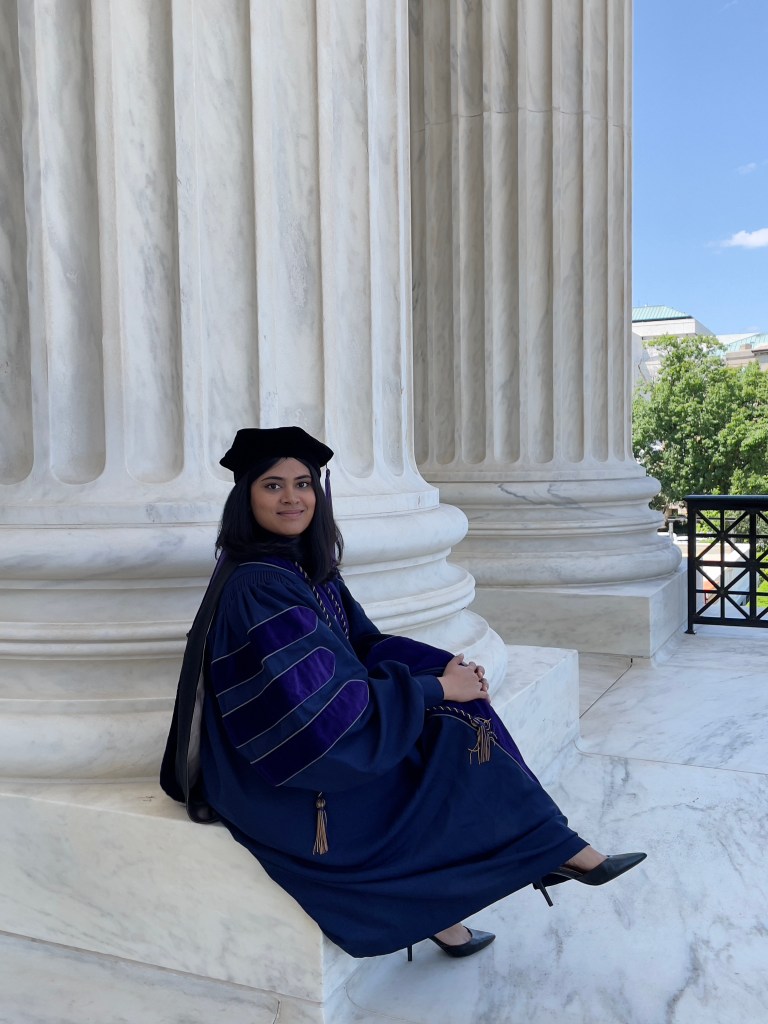
    This year Simhanjana G Sumathi graduated with an LLM in National Security Laws and a Certificate in International Human Rights Law from Georgetown University Law Centre. In this FPA, she shares her reasons for choosing such a specialised LLM, her internship experiences as a law student at the Dr. Ambedkar Law University School Of Excellence In Law, the GULC experience itself, and a whole lot more
    Simhanjana Gopikrishan Sumathi

    This year Simhanjana G Sumathi graduated with an LLM in National Security Laws and a Certificate in International Human Rights Law from Georgetown University Law Centre. In this FPA, she shares her reasons for choosing such a specialised LLM, her internship experiences as a law student at the Dr. Ambedkar Law University School Of Excellence In Law, the GULC experience itself, and a whole lot more. 

    Perhaps not quite connected to the LLM but two of your work experiences are particularly interesting – one was an internship with the then LG of Puducherry, Dr. Kiran Bedi and a judicial clerkship in the High Court of Madras. Looking back, what were some of the more memorable learnings from these two experiences? 

    My experiences, particularly the internship with the then LG of Puducherry, Dr. Kiran Bedi, and a judicial clerkship in the High Court of Madras, have left a lasting impact on my understanding of the legal profession, offering me a well-rounded perspective that I find immensely valuable as a young professional with a keen interest in public law, criminal justice, and human rights.

    During my internship with Dr. Kiran Bedi, I was exposed to the stark realities of access to justice, legal aid, and prison reforms. Beyond the academic knowledge gained, this experience shook my conscience and ignited a deep sense of sympathy. Witnessing the challenges faced by marginalized individuals seeking justice left a profound mark on me. It was a humbling experience that reminded me of the importance of understanding the ground-level issues within our legal system.

    In contrast, my judicial clerkship in the High Court of Madras provided a different dimension to my legal education. It taught me the importance of making impartial and informed decisions based on the rule of law. The role required me to approach cases with neutrality and rationality, ensuring that justice was delivered consistently. This experience allowed me to transition from a place of sympathy to one of empathy, which I believe is crucial for maintaining a balanced and just legal system.

    Unfortunately, due to confidentiality and privilege, I cannot provide specific instances from these experiences, but collectively, they have enriched my understanding of the legal field and have shaped me into a professional who is not only knowledgeable but also compassionate and committed to upholding the principles of justice.

    Just to set the context – when did you start considering an LLM abroad? What were some of the expectations you had from the course, and what were the factors you used to narrow down on just where to apply?

    Though I did not initially plan for an LL.M. abroad while pursuing my first degree in law in India, the idea certainly did cross my mind several times. My legal internships, interactions with college peers, and senior members of the Bar, though focused on litigation, fuelled my desire for an LLM after enrolling at the Bar and practicing law. Undergraduate and graduate legal education in India is often textbook-centric, with limited exposure to real-world interactions with professionals and policymakers. I aspired for a course that went beyond textbooks, offered a broad and research-oriented approach, and provided guidance from professors who were both academics and practitioners. I chose Georgetown University Law Center (GULC) over two other T-14 admissions primarily because it met these criteria. Additionally, GULC’s location in Washington, D.C., a hub for national and international policymaking, offered ample opportunities for academic interactions with policymakers.

    What would you say was the most time-consuming aspect of the entire LLM application process? Where do you think applicants should try and spend as much time as possible?

    The most time-consuming aspect of the application process, without a doubt, is the Statement of Intent and/or the application essay. These components demand a significant amount of time as they require deep self-reflection, especially for foreign-trained lawyers. Given the substantial financial investment and the time commitment required for this endeavour, applicants must thoroughly assess their motivation.

    Additionally, in my own experience, being used to the Indian style of judicial and legal writing which is more elaborate and expressive, first, I grappled with understanding the American expectations of writing style, which in contrast is more concise and direct.

    Second, was to understand their expectations of how applicants assess themselves. Given the differences in academic and work cultures, especially in the Indian context, it’s essential not to underestimate the value of your co-curricular performance, extracurricular interests, and work experience. Every relevant experience and achievement should be considered – no achievement or experience is too small. Though, applicants should be able to justify such experience and achievements in the context of their chosen program and future career goals.

    Lastly, in my personal opinion, there’s no need to tailor your curricular, co-curricular, and work experiences specifically for an LLM abroad. What truly matters is that you can convincingly demonstrate your consistent and passionate pursuit of academic and career objectives. I myself did not have a long term plan to apply for an LL.M. abroad, but my curricular performance was greatly supported by my co-curricular and work experiences.

    Now that you have had the chance to complete the LLM at GULC, do you think your expectations were met? Any pleasant (or other) surprises along the way?

    Thanks to the honest feedback from my mentors and friends with an LL.M. experience abroad – I went in with an open mind. This mindset allowed me to absorb more from the year than if I had specific expectations.

    During my time at GULC, I had the privilege of learning from exceptional faculty members, including Professors David Koplow and Laura Donohue in courses like National Security and Foreign Intelligence Law who are not only experts in their respective fields, but in their tutelage and guidance. While initially quite terrifying, the faculty and learning atmosphere at GULC helped bolster my confidence, and thereafter it was smooth sailing for me. 

    Too many pleasant surprises and memories lasting a lifetime made, actually! While I initially anticipated a more business-like atmosphere where individuals focused solely on their work and schedules, I was totally swept off my feet by the strong sense of community I found at Georgetown Law. I discovered a family away from home, consisting of incredibly talented and remarkable people. Each person I met was a successful leader in their respective fields and a wonderful individual. In addition, interacting and exchanging experiences and perspectives with accomplished women in the field of National Security was absolutely inspiring.

    The sense of unity extended beyond the faculty and students to the staff at the Law Center and the Gerwirz  Student Center (the on-campus housing); We were all one big happy family! A dream, I will never wake up from!

    Sticking with GULC, the National Security Laws specialisation is an interesting one – what got you to choose this one in particular?

    I did encounter a lot of scepticism regarding my choice of specializing in National Security Laws, with questions about its relevance and career prospects in the Indian context. However, I remained steadfast in my decision because I firmly believe that National Security Laws are of paramount importance, particularly in light of India’s increasing significance in the global arena and its role as an emerging international leader, amid the evolving geopolitical and economic landscape.

    My keen interest in monitoring India’s position in the ever-changing geopolitical landscape, especially its self-sufficiency in defence in relation to its neighbouring States had made me acutely aware of the pivotal role that India’s national security policies play in shaping its future.

    Since a young age, I’ve held a profound interest in matters related to peace, security, and defence. As a student, I co-founded an organization called the S Foundation, dedicated to raising awareness among civilians about the role and contribution of India’s defence forces in fostering peace and security in the nation. I also volunteer with Colours of Glory, an organisation founded and run by veterans of the Indian Armed Forces to spread awareness about the military history and heritage of India, and therefore regularly interact with veterans, and defence and security professionals. I even made a sincere effort to join the Judge Advocate General’s (JAG) branch. In fact, I consider this choice to be almost inevitable for me.

    As an LLM candidate, how did you find your work experience helping you in the classroom? Not to put you in a spot, but would you recommend gaining some work experience before applying for an LLM?

    Unlike the (my) law school experience in India, the American law school experience expects you to form and express your opinion and views based on research and extensive reading. I’d say this is where my work experience, particularly as a law clerk writing opinion and research briefs, and my experience writing op-eds and research papers specifically helped me.

    However, I wouldn’t categorically state that gaining work experience is a prerequisite for pursuing an LL.M. I had the chance to learn alongside and from some very erudite and competent friends who came in for their LL.M. right after graduating with their first degree in law. They were able to contribute and compete effectively alongside individuals with over a decade of professional experience. Therefore, it ultimately centres on your confidence, expertise in your field, and your willingness to embrace new learning experiences. 

    Specifically for foreign-trained lawyers, I would strongly recommend approaching the LL.M. program with an open mind and balance of perspective. For instance, I encountered instances where there was a lack of accurate understanding of political and developmental aspects of my home country, ranging from outdated misconceptions to potential bias rooted in Western media perspectives. I also encountered new perceptions and region-specific public laws. Having an open mind is essential, as unlearning preconceived notions allows you to allocate more intellectual space to acquire new viewpoints and perspectives. Moreover, it allows you to engage in  informed and rational debate and discussion, which can help break down stereotyped biases and misconceptions.

    What is your reading of the work opportunities that are available to foreign trained lawyers in the US? Is there anything in particular that you recommend all foreign LLM graduates ought to do?

    It’s better not to have absolute or overly rigid expectations regarding work opportunities in the U.S. as they can vary based on the courses selected and personal circumstances. In my case, as a foreign trained lawyer specializing in National Security, my opportunities were primarily limited to research positions. I would suggest structuring courses which do not restrict employment on the basis of citizenship. However, course selection is a personal choice, and you should customize it to suit your career goals and interests.

    Lastly, any advice for the Indian law graduate who is considering a master’s abroad? 

    For Indian law graduates contemplating a master’s program abroad, I’d offer the following perspective: An overseas master’s is a valuable means to an end. It’s neither an end in itself, nor a checkbox on your list of accomplishments. If one can afford to pursue education abroad, a master’s program overseas can indeed open doors to a whole new realm of legal knowledge and professional practice. It offers both professional and personal advantages. I would advise potential applicants to critically evaluate it as a strategic step toward achieving their academic, career and personal goals.

    We need your help in keeping this blog alive. If you feel that the content on this blog has helped you, please consider making a donation here

  • As most readers know by now, First Person Accounts (FPA’s) are meant to provide a first-hand account of Indian law graduates who have pursued, or are currently pursuing, a post-graduate course (be it an LLM or otherwise) from different schools across the world.

    The FPA (International) is meant to broaden this scope somewhat, getting non-Indian law graduates to discuss their LLM experiences in different law schools across the world. 

    First Person Accounts (International): Sindi Basha, LLM at Boston University School of Law
    Sindi Basha

    Earlier this year, Sindi Basha graduated with an LLM in American Law from Boston University, her second law master’s after an LLM from the University of Tirana in Albania. In this FPA, Sindi shares her reasons for choosing Boston University, the LLM experience itself, and a whole lot more. 

    The LLM at Boston University is your second master’s. What prompted you to pursue a graduate degree once again? And why choose to study at BU?

    I studied Law in Albania and my first Master’s Degree was in Criminal Law. Four years ago, I moved to the U.S. and I realized that I could not practice despite my background. Law is unique for each country and even more so, when it belongs to different systems. Albania is a civil law country, therefore I needed to familiarize myself with how common law works and pursue my license within this system.

    I applied at three top law universities in Boston and was accepted and offered scholarships from all of them. The choice was a difficult one to make, but Boston University offered me the most efficient route to what I was looking for. A one-year program to specialize in American Law, which provided me the opportunity to choose from countless interesting classes in accordance to my goals.

    Furthermore, BU is known for its networking events as well. And there’s nothing more essential than being able to connect with professionals that can share their experiences with you and provide a deeper insight on the real-life U.S. work environment.

    Before the LLM, you were working in the field of immigration law – was this a topic that you were particularly interested in? And did this work play a role in your decision to pursue an LLM?

    Immigration was a field I found myself in, once I came to the U.S. The first job I landed was as an Administrative Assistant in a reputable law firm and the sector I worked at, dealt with immigration matters, especially business immigration.

    It felt great helping other people overcome the same hurdles I once did and make sure their process was as smooth as it could be. It didn’t take long before I found myself wanting to learn more and more and within a year I was promoted to a Paralegal position and was now working directly on the cases. The route I took helped me understand all the steps of the process, including legal and administrative.

    I realized that I enjoyed this field and would like to return again, this time in the capacity of an attorney. That led to my decision to pursue an LL.M. and sit for the bar exam.

    Looking back, how was the LLM experience at BU? What would you say was the most challenging aspect of the LLM experience? 

    I can definitely say this experience was the highlight of the years I have been to the U.S. I was introduced to an entirely new system of studying and school environment. I met people from all over the world and was exposed to amazing cultures from all around. Boston University provided many opportunities for us to connect and forge deep bonds with one another.

    I can certainly say, I have made friends for life and stepped out of my comfort zone continuously.

    That said, it is surely challenging to get out of your safe space. As an introvert, I found it particularly difficult to engage in discussions during class. It was due to our great professors that even the most reserved students were able to feel at ease and comfortable enough to share their opinions and concerns.

    Furthermore, as foreign students, we were in a constant state of mental exercise. Everything is being translated and processed, as we go but the faculty was more than understanding of this particular challenge and accommodated accordingly.

    It seemed scary at times but I reminded myself of all the times I had been in similar arduous situations and succeeded nonetheless. The LLM is no different and with the right mindset, one can truly gain so much.

    How would you compare the LLM at BU with your Master’s experience at the University of Tirana in Albania? What were some of the differences between the two?

    In Albania, every year’s schedule is predetermined; we only had one elective per semester. For each subject, there are lectures and seminars. During lectures, we would simply listen to the professor explain the material and ask occasional questions. The seminars on the other hand were the ones we got to have a discussion.

    At BU, we could build our own schedule based on our interests and goals. Our advisers helped us at every step of the way, until they made sure we were satisfied with our end result. Classes were either lectures, where the material would be discussed or seminars, which consisted more in assignments and projects.

    I loved the fact that all materials ought to be read before class, so that during the discussion, we were getting to the essence of each case and further solidifying our knowledge on the topic. Seminars were also a very new and interesting experience, because we had the opportunity to learn how to compile actual documents, negotiate and litigate which are real life skills, necessary to our profession.

    As a foreign trained lawyer in the US, what is your reading of the employment opportunities available in the US? Any advice on how one can improve their chances of finding employment in the US?

    Although I am still pursuing my license and not actively applying for a job, I believe I can share some useful tips from the time I was searching for a job.

    I have come to realize that landing your first job in the U.S. may be the most difficult task, one has to do as a foreign trainer lawyer. Although understandable, since our experience is inherently different from the U.S. trained lawyers, it can be highly demotivating during the process.

    When I first came to the U.S. I applied to more than 300 job positions from multiple employers; most of whom never responded. It seems to be a common practice; most likely due to the high amount of applications a work place receives. It is of no use to be discouraged. I would suggest attending networking events, be it from the school or the Bar Association. 

    Moreover, I also recommend volunteering. There are plenty of options, especially in the immigration field, that one can apply and contribute to. This will not only help foreign trained lawyers to familiarize themselves with the work but it is also another chance to meet people from the field they are interested in, which may, in turn, lead to unexpected opportunities.

    Lastly, any advice for the foreign trained lawyer who is considering an LLM in the US? 

    Certainly! Pursuing an LLM is an enriching experience, regardless of whether one intends to pursue a career in the U.S. or return to their country with a valuable addition to their resume. I would strongly suggest anyone considering it, to evaluate their goals and define exactly what they intend to get out of the program.

    That is the only way one can make the most out of it.

    Firstly, as far as the scholar year is concerned, consistency and outlining will be your best friends! Outlining was a fairly new concept for many of us, but it is definitely the one that helps students best to structure everything they have studied and be able to see the bigger picture. The workload is great and it is easy to get lost in the details.

    As my Torts professor would often tell us “Don’t lose sight of the forest, for the trees”.

    Secondly, despite all the efforts one may put into studying, nothing can make up for the lack of networking. Use this time to connect with people in your school and beyond. BU provides great network opportunities throughout the year. There’s a number of events every day and along with the workload, it may feel a bit overwhelming at times.

    I encourage every new student to start early on, and simplify things by aiming to participate in at least one informative seminar and one social event per week. Try to connect with people you see you can resonate with and establish strong relationships.

    Last but not least, do not forget to have fun! This will definitely be one of the most remarkable experiences you have encountered and looking back, I wish for everyone to feel fulfilled with their journey and have made the most out of it

    We need your help in keeping this blog alive. If you feel that the content on this blog has helped you, please consider making a donation here

  • First Person Accounts (FPA’s) are meant to provide a first-hand account of law graduates who have pursued, or are pursuing, a post-graduate course (an LLM or otherwise) from different universities across the world.

    Sandra Mathew opted for a J.D. at the USC Gould School of Law, a course she opted for after working for a years as a corporate lawyer in India. In this FPA, she shares the reasons behind opting for the JD as opposed to the more popular LL.M., the J.D. experience itself, and what it takes to find employment in the US as a foreign trained lawyer.

    Alright, let’s get the most obvious question out of the way – why a J.D. as opposed to the more popular LL.M? Were you deterred by the fact that the J.D. would require substantially more investment in terms of time and finances?

    I had initially decided to do an LL.M., but when I started talking to people about job prospects, specifically in the U.S., the responses were not encouraging. For personal reasons, I had to stay in the U.S., and popular post-LL.M. job destinations like the U.K. and Singapore were not viable.

    By researching, I realized that only a handful of U.S. firms hire L.L.Ms, and even then, the choice of practice areas offered was extremely limited. Job prospects with a traditional J.D. track are excellent because, like the day zero’s placements in India, most schools will help you with recruitment through On-Campus Interviews (OCI).

    LL.M.s are not usually given an option to participate in OCIs. So, for an LL.M. student, the job hunt is their responsibility, with minimal support from the school.

    Also, since 3L J.D. recruiting is extremely rare unless you are interested in public defense or some public interest organizations, most J.D.’s will have two years to figure out a full-time position compared to a nine-month LL.M.

    I also understand that lateraling with an LL.M. is much more difficult than when you have a J.D. So, the repercussions of limiting yourself to an LL.M. will follow you through your career.

    Time and money were huge considerations in deciding between the J.D. and the LL.M. However, scholarships are available for a J.D. if you have a good LSAT score. With my merit scholarship from USC, my J.D. for three years is only marginally more expensive than an LL.M.

    Of course, the loss of three years and earning potential during that time was a harder sell. I had to think hard about whether I was ready to sacrifice two extra years for the certainty of a job and a solid career in my practice of choice versus whether I should graduate early, but possibly with the uncertainty and potential issues throughout my career.

    The choice was clear for me; I was ready to invest two extra years of my life for the next thirty years of my career.

    And once you had decided that it was going to be the JD, how did you go about shortlisting schools? What were some of the important factors for you in the shortlisting process?

    For me, the most crucial factor was the availability of scholarships. I mostly shortlisted schools where my LSAT score was above the 75th percentile to have the best chance at good scholarships. The other considerations were location, past employment rates in Big Law, and law school ranking.

    How did you balance the law school admission process along with work? How early did the preparation begin, and what would you say is a good amount of time to prep for the LSAT?

    LSAT is a very learnable test. But it requires quite a bit of studying and testing. I took the LSAT 3 times, out of which I had the same score twice! It was imperative for me to get an excellent score to maximize my chances for scholarships. You can do all the basic studying in about two months, but practice is critical.

    So, even if you know the base material, you need to practice to keep on increasing your score constantly. J.D. applications also place a lot of value on your personal statements and diversity statements. Schools are looking for holistic candidates who would succeed in their educational environment. All in all, studying, testing, and the application process took about six months.

    How has the JD experience been thus far? If you could compare this to your undergraduate law degree, what would some of the differences in the learning experience be?

    My JD experience has been gratifying, but it has been more rigorous than my LL.B experience. The difference would be that you are expected to be prepared for all the classes because cold calling is rampant, and class participation is usually a sizeable component of the grades.

    Coursework is also heavier because it is usually thirty to seventy pages of readings for each class, and this adds up to a lot. Indian international students will have an advantage in pursuing the JD because the curriculum is rooted in the same case law method we are familiar with.

    What have been some of the most challenging aspects of the JD experience?

    One of the marked challenges was that a lot more importance is placed on first-year law school grades if you are a Big Law aspirant. So, before you are acclimatized to the system, there is constant pressure to be competitive and do well.

    Recruitment for Big Law internships happens during the summer after your first year and is focused on first-year grades. You need to try your absolute best in your first year.  However, since you will have your internship that will convert to a job offer right after your first year, the other years become quite manageable.

    This is unlike in India, where you had to consistently perform at least till the fourth year to get a job during Day Zero.

    Given your position, what is your reading of the employment opportunities available to foreign-trained lawyers in the US? Do you think that it is getting more difficult (or easier) to break into the US legal market?

    I don’t have enough experience to answer this question because, as a JD student, my target market was equivalent to domestic students. However, U.S. employers loved that I had transactional law experience in India. I could network meaningfully, relying on my work experience in India. I didn’t even have to participate in OCI because networking and good grades helped me get a Big Law internship before my first year was over.

    In my experience, there are always plenty of options for a J.D. candidate. It is extremely competitive, but you can always make it. 

    Lastly, any advice for the Indian law graduate who is considering pursuing higher education abroad?

    Knowing why you want to study abroad and choosing a course according to your goal is important. If you want to work in the U.S., a J.D. is a much better option than an LL.M. However, if you are amenable to working in other countries, an LL.M. may be a better fit. I also want to stress the importance of researching your options and networking once you have started your course here.

    We need your help in keeping this blog alive. If you feel that the content on this blog has helped you, please consider making a donation here