• First Person Accounts: Rubanya Nanda on the LL.M. in Investment Treaty Arbitration at Uppsala University

    First Person Accounts (FPA’s) are meant to provide a first-hand account of Indian law graduates who have pursued, or are currently pursuing, a post-graduate course (be it an LLM or otherwise) from different schools across the world.

    In this edition, I speak with Rubanya Nanda, who is currently enrolled in the Master’s Programme in Investment Treaty Arbitration at Uppsala University in Sweden. Rubanya, who graduated from Damodaram Sanjivayya National Law University (Class of ’18), shares the reasons for opting for an LL.M. right after her undergrad, how she narrowed down on Uppsala, and her experiences during the course thus far.

    (Edited excerpts)

    At what point during your undergraduate days did you decide to pursue a master’s degree?

    I always had an interest to pursue higher studies. But, I was not sure of which subject to specialize in. I chose arbitration for my master’s as the prospect of out-of-court dispute settlement fascinated me. It has a prominent inter-disciplinary aspect which widens its scope.

    Furthermore, it deals with facets of international law as well. I used to enjoy working on propositions related to arbitration during my internships. I was sure of pursuing a master’s in the field of arbitration by the end of my fourth year.

    Did you consider working for a few years before embarking on a master’s?

    I decided to pursue my LLM in 2018 as I was skeptical that I might not have the patience to go back to academics if I take a break from studies. But, I would put emphasis on the fact that one should always strive according to one’s individual preferences.

    Work experience does add certain weight to your scholarship applications. It is an added advantage but not a compulsion. Everything works out if you are sure about the subject you want to specialize in.

    “Work experience does add certain weight to your scholarship applications. It is an added advantage but not a compulsion. Everything works out if you are sure about the subject you want to specialize in.”

    How did you go about selecting which law school to apply to? And how did you narrow down on Uppsala University?

    I had applied only to two Universities for my LLM. One was the ICAL programme of Stockholm University and the other was Investment Treaty Arbitration (ITA) programme of Uppsala University. Both of them are in Sweden.

    I had decided to do my masters in Sweden even before shortlisting the Universities.

    This was  essentially due to the fact that the quality of education in Scandinavia is very high. In addition to that, both Universities have good reputations. I got admitted into both courses. Ultimately, I chose the ITA programme at Uppsala University as the programme is very specific, it is interdisciplinary in nature and gives ample scope to explore. It is intrinsically linked with Public International Law.

    “Ultimately, I chose the ITA programme at Uppsala University as the programme is very specific, it is interdisciplinary in nature and gives ample scope to explore.”

    Also, my decision to pursue this programme strengthened because Prof. (Dr.) Kaj Hobér is the programme director. He is a prominent arbitrator specializing in investment disputes and it is a privilege to study under his aegis.

    Any advice on how to go about the application process? More specifically, on the writing requirements as well as getting letters of recommendation?

    I would advise to keep a track of the application deadlines in advance. In case of any doubts, do not hesitate to contact the respective Universities. The Universities have a very efficient support system and they are often reliable. They will guide you with respect to clarifications on eligibility criteria.

    The first step is to shortlist the University of your choice. Secondly, it is pertinent to keep in mind that statement of purpose (SOP) is something which is very individualized. You need to tell and rely on your own story. It is completely your discretion. Thus, be honest and genuine in writing your SoP.

    You need not boast excessively about your achievements (your CV is enough proof of that) but focus on what motivates you to pursue a master’s in that subject. Try to be precise about your law school journey and mention your aims in your SOP.

    “Focus on what motivates you to pursue a master’s in that subject. Try to be precise about your law school journey and mention your aims in your SoP.”

    It is wise to start collecting the LoRs way before the application deadline to avoid any last minute hassle. Do have a look at website of the University to have an idea of its requirements. There is no specific format for the LoR but do inform your professors, mentors about your areas of interest. Avoid any kind of gross errors in your documents.

    Did you apply for financial aid of any kind? 

    My parents have been kind enough to fund my studies. The Swedish Institute (SI) provides a generous scholarship to students who want to pursue their master’s in Sweden. It wants specific hours of work experience and looks into other subjective factors. I missed the deadline of the SI scholarship application. Thus, I would strongly advise to keep a track of the scholarship applications as well.

    How has the LLM experience been thus far? What are the biggest differences you have noticed between your time at DSNLU and your time at Uppsala?

    My LLM experience has been really enriching. This journey in Uppsala has been both about learning and unlearning.  Throughout the master’s, I have been subjected to numerous mock arbitrations and seminars. There were specific seminars on dispute resolution clause drafting in treaties. These seminars made me aware of my inhibitions and helped me grow academically.

    I have also been exposed to numerous study visits which included law firms as well as Stockholm Chamber of Commerce. The programme includes guest seminars by professionals working in the field of dispute resolution at international law firms. There are networking events in Stockholm which is in proximity to Uppsala.

    The classes in DSNLU were held in the form of lectures. It helped in creating a theoretical base for subjects such as arbitration and public international law. There were a number of lectures in a week during my bachelor’s. Apart from arbitration, it is important to have knowledge of the concepts of public international law (PIL) to study investment disputes settlement. I studied PIL during my third year at DSNLU.

    The classes are held in the form of seminars in my LLM programme. We are divided into smaller study groups and the strength of the class is 25. This exclusive class consists of students from 16 jurisdictions.  You are expected to discuss the questions with your study group before the seminar.

    This master’s demands a high level of independent thinking, planning and active participation. Prof. (Dr.) Hobér always encourages us to voice our opinions. The programme also offers adequate amount of flexibility and independence to explore subjects such as investment law, international arbitration and public international law. It is divided into four modules in which exams are held at the end of three modules. The last module is the thesis drafting period.

    Uppsala as a place is very vibrant and student friendly. It offers an ample opportunity for students to develop varied interests. Being a University founded in 1477, it has a rich legacy. You can develop yourself academically as well as individually.

    It helped me widen my perspectives, being aware of certain nuances and grow as a person. If you love academic research, brainstorming sessions and want a memorable student experience, Uppsala University is the place to be!

    “[The LL.M.] helped me widen my perspectives, being aware of certain nuances and grow as a person. If you love academic research, brainstorming sessions and want a memorable student experience, Uppsala University is the place to be!”

    What is your reading of the recruitment prospects of international LLM graduates, particularly in the field of arbitration?

    A master’s in Arbitration opens up many avenues when you are looking for employment. Since, international arbitration is something which is not limited to a specific jurisdiction, there are a number of institutions, and there are ample amount of opportunities.

    It is an evolving area which entails exposure both in practice and academia. Investment Treaty Arbitration is a very niche area which needs more experts. You can work in a law firm along with keeping option of further academic research in it. It again depends upon your personal preferences.

    Lastly, any advice for Indian law graduates who are planning a master’s abroad?

    Apart from the aforementioned checklists, I would advise you to be aware of your interest(s). That is a starting point. If you are not sure, then it is okay to take your time in exploring it by yourself. Look for subjects that inspire you the most. It is good to talk to the programme director, the coordinator of the specific master’s programme in advance.

    “If you are not sure, then it is okay to take your time in exploring it by yourself. Look for subjects that inspire you the most.”

    Try making contacts with the alumni of the same programme as it widens your network. Just be prepared to give in your best of efforts during your stay abroad. An LL.M, abroad demands substantial amount of resources and time, thus make a calculated decision. Try making fruitful connections by exposing yourself to moots, international seminars and interacting with your faculty.

    But, do enjoy your time when you are there. It is the experience of a lifetime!

  • First Person Accounts (FPA’s) are meant to provide a first-hand account of Indian law graduates who have pursued, or are currently pursuing, a post-graduate course (be it an LLM or otherwise) from different schools across the world.

    Krusha Bhatt
    Krusha Bhatt

    In this edition, I get to speak with Krusha Bhatt who is currently enrolled for the LL.M. course at the University of East Anglia.

    A graduate of the Auro University (Class of ’18), Krusha shares her reasons for choosing UEA, the LL.M. experience thus far, and her advice for Indian law graduates who are considering a foreign LL.M.

    At what point during your undergraduate days did you start thinking about a master’s? Did you ever consider working for a few years before enrolling for a postgraduate course?

    The first thought of doing a master’s degree clicked my mind during my third year when I was figuring out best suitable  career after graduation for myself, I decided to be an academician.

    I started looking at Indian universities at first. With a perennial love for Constitutional Law, my initial thoughts were doing a Comparative Constitutional Law master’s but then there were only 2-3 National Law Universities which offered this course and one of them was GNLU which is situated in my home town.

    So, everything was pretty smooth until I was introduced to International Law in my fourth year. One of my professors motivated me to look for foreign universities as well and this is how I enlarged my sight and decided for UK specific countries because Indian law is almost in parallel with UK law.

    However, I wasn’t ready to invest in a foreign degree, and that is why my idea was to work for a few years, and study further on my own. But I cannot thank my mom enough for always motivating and pushing me towards achieving the best. She convinced me to select the University I deem best for me and continue with my master’s.

    How did you go about selecting universities, and where all did you apply to?

    Selection of universities wasn’t really a challenging task for me because I had referred the Guardian and Times Higher ranking 2018, and selected the top 5 Universities in the UK. I had applied to University of Leeds, University of Sheffield, University of East Anglia, Queen Mary University. I had received offer letters from each of them, however I discarded QMUL because it is situated in Central London and was costing me almost ten more lakhs than the others.

    One of the major reasons was also to not have distractions; living in small cities leave you with more time so that you can invest it in academics. I made a comparative analysis of the pros and cons of studying in QMUL and UEA, and the reason I picked UEA is answered in the next question.

    What got you interested in this particular LLM at the University of East Anglia?

    When I started reading more about the course structure and learning environment, the UEA fascinated me because they have a limited number of seats for each specialisation and offer a group coaching kind of arrangement to enhance class participation and interaction with the module leader, which I couldn’t find in any of the other Universities.

    Also, I was very much interested in Competition Law since my under-graduate days, and UEA is very popular for this particular area. They also have wide variety of optional modules to pick from. So, with the combination of International Business Laws and Competition Law I was looking forward to study at the UEA.

    “Also, I was very much interested in Competition Law since my under-graduate days, and UEA is very popular for this particular area. They also have wide variety of optional modules to pick from.”

    Did you apply for financial aid of any kind?

    As soon as I received offer letters, my first decision was to apply for the available scholarships but the University of East Anglia offered me ‘International Excellence” scholarship worth 5,000 GBP along with the offer letter itself.

    So without thinking twice I selected the offer.

    How has the LL.M. experience been thus far? What are some of the bigger differences, if any, between the learning experience at East Anglia and Auro University?

    The experience so far is very different and challenging than Auro because when you go out of your country especially leaving your home town, things change completely. From living amongst 200+ nationalities, cooking food, buying groceries and doing everything on my own, living a totally independent life, moreover competing with students having accustomed to English being their first language is not easy coming.

    “The experience so far is very different and challenging than Auro because when you go out of your country especially leaving your home town, things change completely.”

    When you go to a foreign university it is not just the learning or teaching pedagogy that counts but all these factors which I mentioned above helps you grow and makes a substantial part of your degree. In my batch majority of the students are aged between 30-40, having work experience in the relevant fields so the practical knowledge they possess can never be matched without working in the field. This is my major drawback so far.

    Any advice for how to go about writing the Statement of Purpose? And also choosing referees for Letters of Recommendation?

    Your SoP should be crystal clear mentioning about who you are, where you come from, what have you done so far, what you intend to do in future, and most importantly why this particular university. Universities are interested in knowing you and your goals – this is the basis on which offer admissions.

    “Your SoP should be crystal clear mentioning about who you are, where you come from, what have you done so far, what you intend to do in future, and most importantly why this particular university. “

    The referees to your LOR should be your recent professors with whom you have worked closely or they know you as student since a very long time because writing just good things doesn’t interest as much as writing on real stories which reflect your potentialities and calibre.

    Lastly, what is your reading of recruitments in the UK legal market, especially for international LLMs?

    For an international student, the UK legal market is not easy to enter unless one is ready to take further steps like writing QLTS (Qualified Lawyer Transfer Scheme) which means if you are a qualified lawyer from a common law jurisdiction, you can convert your eligibility to practice in UK by writing an exam.

    Or if one is ready to further take up LPC (Legal Practice Course) that is a one year course after having finished your LL.M in order to appear for 2-stage exam to become a solicitor in England and Wales, this course can lead you to 2 years of training contract with law firms followed by recruitment in most cases if passed successfully.

    Apart from these two choices you have to work day and night in making your applications for  vacation schemes, winter or summer internships, work placement. So if you are considering UK for your LL.M, you be mentally prepared about these hurdles.

  • First Person Accounts: Chithra P. George on the NUS-MIDS double degree, LLM applications & more

    First Person Accounts (FPA’s) are meant to provide a first-hand account of Indian law graduates who have pursued, or are currently pursuing, a post-graduate course (be it an LLM or otherwise) from different schools across the world.

    In this edition, I speak with Chithra Powathikunnil George who is currently enrolled for the NUS-MIDS double degree. In this interview, the ILS graduate (Class of 2015) shares advice on how to go about applying to both, NUS and the MIDS course, the differences between the two institutions, and what Indian law graduates should keep in mind while looking at an LL.M. abroad.

    (Edited excerpts)

    What prompted you to take up the LLM? Did you consider enrolling for an LLM right after your time at ILS Pune?

    I hail from a family of academicians. Having grown up in an academic oriented background, I have always been inspired to enjoy the process of studying and to never give up on it. Therefore, pursuing Masters was a long cherished dream, particularly on account of encouragement by my father Dr.K M George who himself retired as a Professor from Govt. Law College, Kerala.

    Regarding enrolling for LL.M., I did not want to do it immediately after my graduation from ILS, Pune. A master’s is a specialised programme for which I believe it is better to gain some practical experience before joining the course. That will enable a person to interlink practice and theory and make the best use of the master’s programme. Hence, before joining for Masters, I worked for two years.

    ” A master’s is a specialised programme for which I believe it is better to gain some practical experience before joining the course. That will enable a person to interlink practice and theory and make the best use of the master’s programme.”

    How did you go about selecting universities to apply to? And why narrow down on NUS?

    The first stage when a person decides to pursue Masters is to decide the branch of law that one intends to specialise in. Accordingly, the choice of Universities has to be made. For example, if one intends to specialise in Constitutional law, then one could opt for Yale or Harvard. In case of Intellectual Property Law, then Max Planck, Germany is a good choice.

    As I intended to pursue LL.M. in International Arbitration, MIDS, Geneva (Masters in International Dispute Settlement jointly conducted by Graduate Institute of International and Development Studies and University of Geneva) is the best in the world.

    Also, National University of Singapore (NUS) is the best in Asia for LL.M. in International Arbitration, especially as Singapore is Asia’s arbitration hub. So, as I wanted to pursue LL.M. in International Arbitration, I narrowed down on my choice of NUS and MIDS. So, in the first instance, I applied to NUS for LL.M. in International Arbitration and fortunately I received admission with full scholarship and stipend.

    Any advice on approaching the applications at NUS? How should one write a personal statement, who should one seek Letters of Recommendation from? Also, any advice on scholarship applications?

    The first step in approaching application to any University is to study in depth what the University offers and whether what it offers matches one’s expectations. The personal statement is extremely crucial in the application process and it is expected to be a true reflection of the candidate’s personality. Ideally, it should contain what motivated the individual to choose a particular specialisation, why the candidate has narrowed down on that particular University and suitability of one’s candidature. Brevity, simplicity and clarity of thoughts and expressions are qualities of an exceptional Personal Statement. Also, it is always better to get it vetted. In my case, I vetted my brother Mathews P.George’s (Graduate Scholar in LL.M. at Max Planck, Germany) Statement and he vetted mine.

    “Ideally, it should contain what motivated the individual to choose a particular specialisation, why the candidate has narrowed down on that particular University and suitability of one’s candidature. Brevity, simplicity and clarity of thoughts and expressions are qualities of an exceptional Personal Statement. “

    Regarding the Letter of Recommendation, it is advisable to obtain the same from Professors with great academic standing or Partner or other Senior Professional under whom the person has worked.

    The primary aim is that the person who endorses for a particular candidate, should have had the opportunity to constantly monitor or supervise the candidate and is in a position to vouch for the candidate.

    Personally, in my case, I had Letters from Prof.Vaijayanti Joshi, Principal of ILS; Prof. Sathya Narayan, Director, Institute of Advanced Legal Studies; Dr.Nitish Nawsagaray, Professor and Editorial Committee Faculty Head (I was a member of the Editorial Committee); and Prof. Sonali Jadhav who taught me arbitration.

    For my admission to MIDS, I was recommended by Dr.Michael Hwang, Chartered Arbitrator and Former Chief Justice of Dubai International Financial Centre Courts; Prof.Lucy Reed, Professor and Director of National University of Singapore – Centre for International Law; and Dr.Vincent Joel Proulx, Professor at National University of Singapore.

    In terms of scholarship application, there is no clear cut formula. However, giving scholarship is a financial burden on the University and therefore, it is an extremely competitive process. Generally, it is very rare and difficult to secure full scholarship and stipend for LL.M. and I personally think that it is awarded to a candidate with a holistic personality. This means, it is generally awarded to someone with an outstanding academic record, very good track record of extra-curricular activities, pertinent work experience, excellent letters of recommendation, impeccable personality reflected through the personal statement, active participation in social service activities etc.

    “In terms of scholarship application, there is no clear cut formula. However, giving scholarship is a financial burden on the University and therefore, it is an extremely competitive process. “

    Was one of the reasons behind enrolling at NUS, the chance to study the MIDS course? Or was this something you decided to do only after starting your semester at NUS? Could you talk me through the process of applying for MIDS while at NUS?

    The double degree programme is structured in such a way that a person gets double LL.M. each from NUS and MIDS over a span of three semesters instead of four semesters (Usually, LL.M. at NUS/ MIDS is two semesters each). So, under this double degree programme, candidate pursues LL.M. for two semesters at either of the Universities, i.e. NUS/ MIDS, and the remaining one semester in the other University.

    I had aimed at doing LL.M. in international arbitration at NUS and MIDS to study the discipline from Asian and European perspectives. So, I was eyeing on the double degree programme.

    However, enrolling at NUS does not de facto guarantee admission at MIDS. The selection for the double degree programme is a two tier process. Firstly, one has to be nominated by NUS based on academic performance at NUS and secondly, out of the nominated candidates, MIDS decides on whom to admit.

    “However, enrolling at NUS does not de facto guarantee admission at MIDS. The selection for the double degree programme is a two tier process. Firstly, one has to be nominated by NUS based on academic performance at NUS and secondly, out of the nominated candidates, MIDS decides on whom to admit.”

    Personally speaking, I had an added obligation of performing well at academics on account of my being a Scholar (scholarship contractual obligation). So, in a way, being a Scholar facilitated me to perform well at academics and thereby easily clear the first step of nomination process. The second step is completely in the hands of MIDS and I was fortunate to get admitted. In my batch, four students were nominated by NUS and out of the four nominated candidates, two of us were admitted by MIDS – myself and Mr.Yao Ruochen from China.

    Again, any advice on how to go about applying for the MIDS course?

    MIDS gets the largest number of applicants from India. So, in order to maintain diversity, applications from Indian applicants are strictly scrutinised. As said before, if you have a holistic personality, then chances of getting admission are higher.

    Along with the mandatory documents that one has to submit, most of the Universities offer an option for submitting English Language Waiver Request letter. Both NUS and MIDS offer the same and therefore, it is not mandatory to give TOEFL/ IELTS test if one has ample evidence to prove proficiency in English.

    Comparing your time at NUS and the Graduate Institute, what were some of the differences in the learning experience?

    The LL.M. at NUS and at the Graduate Institute are indeed rich experiences. Both the institutions are located in arbitration hubs of the world and have well designed curriculum, stellar faculty, Socratic method of teaching and a cohort of passionate arbitration enthusiasts. Also, both of them are located in clean and safe cities in the world with high standard of living. A few differences are:

    • In NUS, one gets the option to learn modules from different branches of law along with one’s area of specialisation. Of course, majority of the credits should be from one’s area of specialisation. Therefore, at NUS, a student who has arbitration major could do modules on other areas like Behavioural Economics, Criminal Practice, Freedom of Speech, etc. This is generally not the case in MIDS. All the modules are either purely focused on arbitration or have some nexus with arbitration.
    • Both NUS and MIDS offer general modules on international arbitration and specialised modules on arbitration from Asian and European perspectives. However, in NUS, there are more specialised arbitration modules from Asian perspective and in MIDS, there are more specialised modules from European perspective.
    • MIDS has number of training workshops, field trips within and outside Switzerland etc. that help you to widen your practical exposure in arbitration. Also, it strengthens your bond with your classmates. Further, gatherings of students and Professors organised by MIDS are quite frequent. On the contrary, field trips at NUS, especially outside Singapore, are not common. However, NUS also has trips within Singapore and I made my best friends during the city tour that happened at the beginning of our course.
    • MIDS has mandatory thesis submission as part of the curriculum. This gives you the opportunity to sharpen your analytical skills under the supervision of a faculty member. On the contrary, NUS evaluation does not have mandatory thesis submission and there remains an option to carry out research under the supervision of a Professor.
    • MIDS has exams all throughout the semester as exams take place immediately after a course finishes, whereas NUS has exams towards the end of each semester. I personally prefer the NUS system as it gives more breathing space during the semester.

    Lastly, any advice for Indian law graduates who are planning to move jurisdictions? Do you think an LLM acts like a good stepping stone for the same? 

    Of course! There is no doubt regarding that. Pursuing an LL.M. abroad reforms and refines your personality in multiple ways. It gives you access to the international landscape, facilitates in building contacts, widens your exposure, gives you the opportunity to engage in discussions with world-renowned personalities, sharpens your analytical thinking and above all makes you a global citizen.

    “It gives you access to the international landscape, facilitates in building contacts, widens your exposure, gives you the opportunity to engage in discussions with world-renowned personalities, sharpens your analytical thinking and above all makes you a global citizen.”

    However, one should tread on this path only for the right reasons because otherwise you may end up regretting of having taken that decision.

    I have seen some of my classmates dropping midway, finding it hard to cope with the pressure of the Masters Programme and facing difficulties in confining themselves to a hectic schedule with very little breathing space. But if a candidate has made an informed decision, then the sky is the limit!

    On a personal note, I’m humbled to have received this coveted opportunity of doing the NUS-MIDS Double Degree Programme and will certainly cherish it all throughout my life. I hope this  turns out to be a helpful guidance to all the aspirants, and my best wishes to them!

  • The Amicus Interviews: Cristóbal Alvear, IE Law School

    The Amicus Interviews are meant for broader discussions on legal education, and the legal profession. And one of the viewpoints that I find particularly interesting relates to how legal education professionals view the Indian law graduate.

    In this edition, I speak with Cristóbal Alvear who is part of the faculty at IE Law School. Cristobal has spent several years in India, working on a comparative study of the legal systems of India and Spain. I got to speak with him while he was on a quick trip to India, and managed to get his views on the similarities (and differences) between India and Spain, the future of Indian law graduates who choose to study in Spain, and a lot more.

    You have had quite an interesting career – you studied law, worked as legal counsel, and then opted for a master’s international relations.  

    After studying in Paris and working in Bordeaux, I decided to go international. But first I wanted to pursue a master’s in international relations and diplomacy at the Diplomatic School of Spain. After that, I moved to New Delhi and joined the Spanish Embassy there.

    I joined the political department at first but later I started providing legal advisory services, comparing the family law systems of both countries, and the interaction between them. I began studying laws related to marriages, adoption, surrogacy etc.

    What were some of the highlights along the way?

    After leaving the Spanish Embassy I started working with the Spain-India Council, which is a very interesting organization because it is established by the government but the funding also comes from private actors.

    So, I started working with them organizing bilateral interactions. We created together Spain-India forums and dialogues between governments, think-tanks and civil society. Spain is a very complex country, but India is (laughs) a whole subcontinent. So, we tried to create common programs between both countries fostering a better understanding of each other.

    How did you land up at IE Law School?

    IE offered me the opportunity to teach about South Asia, and I created a course on an Introduction to South Asia not only for the Law school but also for the business programs.

    I started teaching about South Asia from a cultural and a legal perspective as well as discussing the business environment in the region. The program worked very well; I think we were the first to do this in Spain.

    When it comes to legal systems, the two countries are quite different. Where does one even begin with a comparative study?

    It is challenging, it is an onerous task at times. We have to invest a lot of time, but it makes sense because we are going international, we are part of a globalized world. Individuals, companies and governments meet internationally across a significant number of fields where different legal frameworks are involved. Consequently, we are forced to compare them.

    For example, we are now talking a lot about global compliance for international companies. We know that for doing global compliance you really need to have a very good knowledge about what is happening in different legal systems, those which have nothing in common with your own legal system.

    Any advice you would have for Indian students looking to do a masters, not just in IE, but in Spain?

    I would really recommend them to take advantage of the opportunity. Go into the streets, meet people, and really be a part of the society and culture. Get an idea of how the country and the society work. Have a very good look at what is happening in the country.

    The second piece of advice would be to try and learn the local language. Learning Spanish opens up the Spanish-speaking Latin American market, which is not only huge but a quite interesting one.

    And the third piece of advice is – it is only nine months, but it is almost a lifetime in terms of all the knowledge that you can learn.

    You have been teaching for a while. Would you say that IE is different from other law schools?

    Although I do comparative law, I don’t want to compare schools. (laughs). What I love about IE is that it is centrally located in Madrid. It is a law school really connected to the profession.

    Our professors are all legal professionals. Some have their own law firms, some are advocates before the court, some do international legal transactions. So, they have this amazing professional experience. They are not talking about what they have learnt in theory, but what they have learnt through experience.

    Placements – that is always the big question. What is your reading of employment LLM students?

    I will say that whoever works hard will get whatever she or he wants in the legal profession; good professionals will always do well. And there are many opportunities here because the legal profession is one that is really changing a lot.

    We used to think about the legal profession as this “innovation resistant” industry. But now, we can see digitalization, LPO, AI – all this is changing the industry. So, there is a great opportunity for entrepreneurship in the legal industry.

    But as you said, even studying in IE, you don’t have hundred per cent guarantee of getting a job. However, I do feel that things are changing in the legal profession, and there is space for new people trained in excellent institutions such as IE.

    What do you think is a good legal education?

    For me, it is one that focuses on legal concepts and institutions from a practical point of view. There must be a practical approach.

    We should be talking about what is happening in the legal world, what is happening in the business environment, what is happening in the government – we should be really connected to the legal trends that are around us. And we should create debates around these trends. We must help our students to build an opinion about them.

    That is a good legal education because we train professionals to play a key role in a better society.

  • First Person Accounts (FPA’s) are meant to provide a first-hand account of Indian law graduates who have pursued, or are currently pursuing, a post-graduate course (be it an LLM or otherwise) from different schools across the world.

    In this edition, I speak with Akber Ahmed who completed an LL.M. from Cambridge University (Class of ’18). Akber graduated with an Indian law degree from Amity Law School (Class of ’14) and worked as a junior counsel immediately thereafter. In 2016, he became a legal consultant to the Central Information Commission before finally deciding to embark for a postgraduate degree.

    (Edited excerpts)

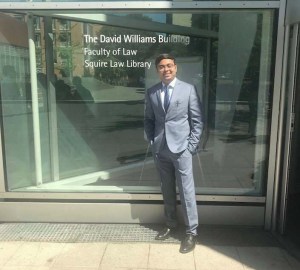
    Akber Ahmad
    Akber Ahmad

    Were you planning on an LLM while you were studying law as an undergraduate? Or was this decision made only after you joined the legal profession?

    While reading for Bachelors of law, I had no plans of pursuing an LL.M. However, it was only after entering the profession that I realized of how specialized law practice is these days and the cut throat competition in this profession.

    In order to stand out in the crowd, one has to have that extra edge and exposure that can supplement hard-work, so I decided on pursuing an LL.M degree which would not only give me specialized knowledge in my chosen area of law practice but would also somewhere give me the exposure I was looking for.

    “An LL.M degree would not only give me specialized knowledge in my chosen area of law practice but would also give me the exposure I was looking for.”

    You made an interesting switch from junior counsel to working with a CIC Commissioner – what prompted the move? And did you use this experience while preparing your personal statement/applications?

    I was always very inquisitive about the reason of people preferring Government jobs over private sector and because these days there are so many opportunities to work for the Government even as a lawyer so I decided to give it a shot and experience the workings of a Government department.

    I came across the Central Information Commission’s (CIC) notification inviting applications for legal consultants. For me it was a good opportunity because of the increasing role of the RTI Act in bringing transparency and accountability in governance and at the same time one would experience the working of a Government department.

    Honestly, the initial plan was to gain some experience for six months or so but the work turned out to be interesting. I was involved in drafting of some landmark decisions of the Commission.  Therefore, my plan of leaving early was put on hold and it turned out that I ended up working for almost 20 months before leaving for the UK.

    I did use my CIC experience in writing my SoP relating it to the UK’s Information Regime because the UK also has a strong Freedom of Information Act, 2000.

    Apart from Cambridge, did you consider any other schools? What made you narrow down on the Cambridge LLM? 

    When I decided to pursue LL.M, I was very clear that I have to only concentrate on the UK, firstly because India and UK have a similar common law background and secondly, a self-funded Master program from US would turn out to be more expensive than UK.

    “I was very clear that I have to only concentrate on the UK, firstly because India and UK have a similar common law background and secondly, a self-funded Master program from US would turn out to be more expensive than UK.”

    I only wanted to apply to the top three UK schools i.e. Oxford, Cambridge, and LSE. Oxbridge was obvious because of the reputation and LSE because it has some very interesting course combinations. Fortunately (or unfortunately) I didn’t get through Oxford but I got through Cambridge.

    I think the main reason to choose Cambridge and not LSE was the years of reputation attached with the name and particularly an interesting module on International Commercial Litigation that was taught by Professor Richard Fentiman who is considered to be an authority on commercial litigation.

    How much time did you devote to the application process?

    The application process takes a toll on you so the sooner it starts the better it is because it requires a lot of research to come up with a good SoP. So I had made sure that SoP and Letter of recommendations (LoRs) are ready before the applications are even open in the month of September/October. Since I was working and completing the application process simultaneously so I couldn’t have waited for the applications to open and then start the preparation of SoP and LoRs.

    Did you apply for any sort of financial aid?

    I did apply for a few scholarships like Commonwealth and Inlaks. Cambridge Trust also grants some scholarships for which prospective students are considered automatically on the basis of the same application form.

    However, for the scholarships granted by the Gates Foundation, a separate process is followed.

    How would you describe the Cambridge LLM, in terms of academic rigour and demands? Any advice for those considering this very course?

    The Cambridge LL.M is rigorous and demanding for two reasons: one, because Cambridge would make sure that students when they graduate they live up to the name of the University and two, it becomes rigorous because it’s a ten months course so there is a lot to do in very less time.

    As a Cambridge LL.M student, in roughly eight months (that excludes one month of winter vacations, one month of preparatory leave after Lent Term and almost three weeks for exams), one has to attend regular classes, then small group teachings for every module which are like tutorials. Also, write regular formative essays, work the practice questions for small group teachings and then finally appear for the examination.

    “In roughly eight months one has to attend regular classes, then small group teachings for every module which are like tutorials. Also, write regular formative essays, work the practice questions for small group teachings and then finally appear for the examination.”

    My advice to those considering to pursue Cambridge LL.M would be to enjoy the Cambridge experience. It is not just the course but the entire journey which would be important in redefining in who you are and so one should make the most out of this one year.

    In an LL.M class, one would meet students from varied global jurisdictions and it can serve as a great platform to make friends and contacts, learn about different legal systems, engage in discussions on legal issues etc.

    Looking back, what do you think are the tangible benefits of the LLM? And to whom would you recommend an LLM to?

    It is beneficial in terms of broadening your horizon because you share a classroom with the brightest legal minds all over the globe. It makes you understand the various global issues pertaining to the subjects you have chosen.

    The LL.M journey like mentioned above would add to your personality. It is recommended for everyone who aspires to delve into legal issues and are inquisitive to learn and look into the details of a specialized area of law and at the same time want to get a global exposure.

    Lastly, any advice for those considering an LLM but are unsure if it is worth the time and money?

    I have faced this dilemma myself even after holding an offer letter from Cambridge. I would say taking a call whether to go for an LL.M entirely depends on an individual’s priorities.

    For me, the Cambridge LL.M was definitely worth the time and money because it changes you for the better. It is just 10 months and so not very crucial on the time front. As far as money is concerned, I am sure as a lawyer one would make much more later in professional life but this opportunity is not going to present itself every time. So it is definitely worth experiencing.

    Having said that, I would like to add that potential LL.M. applicants should evaluate various factors including their financial conditions, the job market, family responsibilities and most importantly what are they aiming for and expecting out from an LL.M.

    An LL.M would definitely add to your CV but I am not too sure if it would also add to one’s employability.