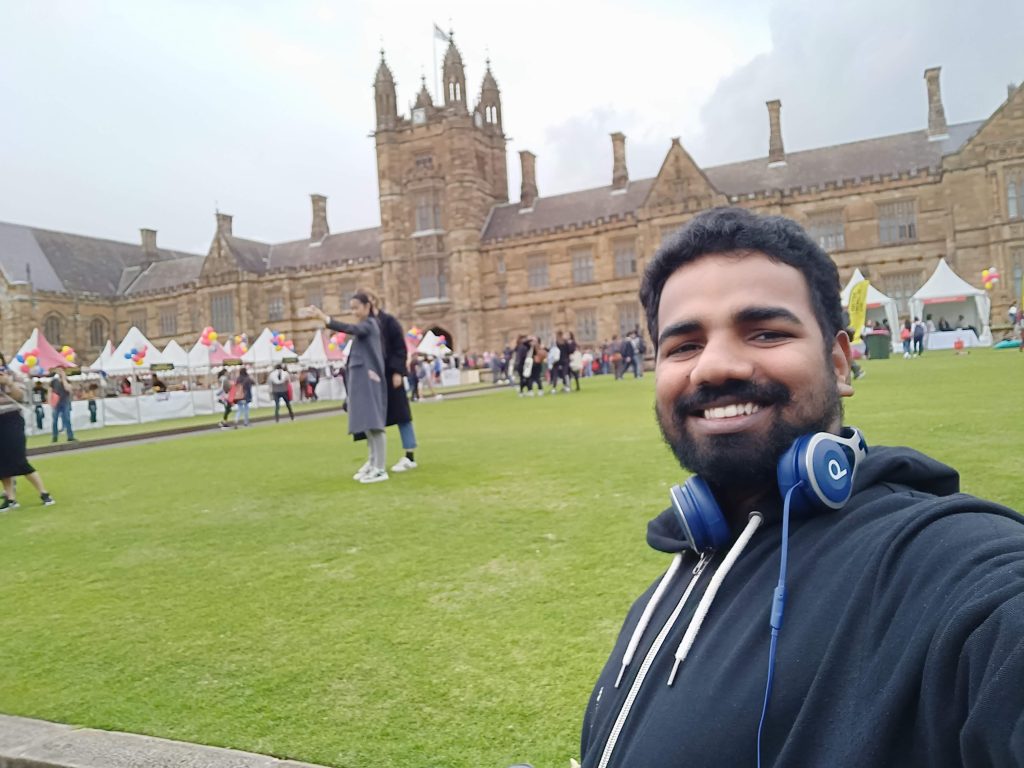
• First Person Accounts: Ranesh Anand on the LL.M. at the University of Sydney

    First Person Accounts (FPA’s) are meant to provide a first-hand account of law graduates who have pursued, or are pursuing, a post-graduate course (LL.M. or otherwise) from different universities across the world.

    In this edition, we speak with Ranesh Anand, a graduate of the National University of  Study and Research in Law (Class of ’16). Ranesh has recently completed an LL.M. from the University of Sydney, and in this FPA, he shares his experiences as an LLM candidate from India, studying constitutional law and legal philosophy, and a whole lot more.

    (Edited excerpts)

    Did you plan on doing an LLM right after your graduation? What made you wait a year before enrolling?

    For the LLM, I had already planned it while I was in my under-graduation; more specifically I started planning and researching in my 8th semester and I had applied in October 2015 for the July session at University of Sydney. At that time I was in my 9th semester. Just to clarify University of Sydney takes admissions twice a year, first one is March session and second is the July session.

    I had applied for the July session as I was supposed to complete my under graduation in June 2016. But the publication of final results, which the University of Sydney asked for, took some time. Fortunately I did get through the admission process and if I recall correctly, it was in September 2016 that I was given an Unconditional offer for the admission for the March 2017 session.

    But I deferred my admission for a year because of the financial constraints and by the time I was offered admission all the scholarships were filled up; so I thought taking chance of applying for scholarships in a year.

    How did you go about selecting where to apply, and what made you narrow down on the University of Sydney?

    I had Constitutional Law (Hons.) in my under-graduation, so it was very much clear in my mind that if I am going pursue higher studies, I will take subjects in which I could study the Philosophy and has to be related to the Constitutional Law. Hence, when I was researching for the Universities, I went through their courses and if I liked the courses of if I found them to be of my aptitude then only I short-listed that University.

    “Hence, when I was researching for the Universities, I went through their courses and if I liked the courses of if I found them to be of my aptitude then only I short-listed that University.”

    Secondly, because of my financial constraints I had to leave the US [law schools] aside because they are costly.  Other places where I applied were in the UK and Netherlands (Leiden University) because of their unique course in Cyber Law. Now the choice for Sydney was because of the course they offered. I applied for Masters in Administrative Law and Public Policy.

    If Constitutional Law is a tree then Administrative Law is its most fruit-laden branch. I am also very much interested in Politics and Politics Studies, so when I found a course which has integrated Public Policy and Administrative Law, I had to apply.

    Any advice on how to go about the application process – time management, written requirements etc?

    I sincerely believe I do not know what advice I can give to others. But I will tell you my story, if someone finds any relevance they can use it as advice.

    When I started my research, I found that two things are of the utmost importance. The Statement of Purpose and Recommendations. Another important factor is your resume but you cannot do too much with this. For e.g. I was good in theatre and had been awarded at school level and appreciated even in the college. When it came to put this detail in my resume, I just wrote it under the heading of hobbies that I like theatre and nothing much because university is looking for academic achievements and not specifically extra-curricular achievement; although I must remind that they have importance in the sense that the university looks into the personality of the student also.

    Therefore, do mention such things but don’t give emphasis. Next important thing is your Statement of Purpose. I would only say that try to be as honest as you can be; do not exaggerate, do not try to paint  yourself  in something which you are not. Just the truth because they are experts and they know when you are faking. So I can tell that if somebody reads my SOP, They will get the complete picture of what and who I am as a person, and as a student. That was my funda which worked in two from where I did get the offer and not in another from where I could not succeed. Also I tried my best to answer the question as to why I should be selected for the course I am applying.  Lastly, about the recommendations try to make good relations with your professors while you are doing your under-graduation and the people you intern under.

    Most universities take admission on first come basis so be prepared with everything in advance.

    Did you apply for/receive financial aid of any kind?

    I applied to almost 2-3 scholarships and I got aid from an education Trust in India itself and I took 35% as education Loan from the Bank in India. I would add that it is not necessary that you will get scholarship just because you have been offered admission.

    How was the LLM experience? What were some of the highlights along the way?

    I would say this LLM has broadened my thinking base and opened new avenues to look into any issue very differently. In all my subjects I had to write essays as the final exam and when you have to write an essay of a standard of post-graduate scholarship you need to study in depth. That’s the first major experience.

    I can say that not only this has helped me in learning but also changed me as a person. The motto of University of Sydney is “Let’s Unlearn”. So the courses were designed in ways where you evolve as a person.

    “The motto of University of Sydney is “Let’s Unlearn”. So the courses were designed in ways where you evolve as a person”

    Secondly the benefit of group discussion with multi-cultural students has its own impact on your life. Lastly in terms of education I was fortunate to be taught by a Barrister, A policy expert who worked in the Obama Administration, a policy advisor to the then PM Tony Blair, and an EX-MP of Australia. These gave me the opportunity to learn from the real life experiences.

    Apart from that I had the opportunity to work with Australia for UNHCR, which made me meet and interact local people, so it was nice experience. If you get the chance work part-time because that to helps you in growing as a person.

    I did feel lonely sometimes because when it’s not your home it is not always easy to adjust. There were times when I just wanted to book flight back home and there were times when I never wanted to return.

    “I did feel lonely sometimes because when it’s not your home it is not always easy to adjust. There were times when I just wanted to book flight back home and there were times when I never wanted to return.”

    What is your reading of the Australian legal market when it comes to recruiting international LLM students?

    Before I answer this, I think it is necessary to tell you that I never went to Australia with a mind-set that I have to get a job there. Therefore, I never looked very seriously for the corporate jobs. But , I did my research and met lawyers, and I learnt that Indians have to study few under-graduate subjects to be eligible to get a job in New South Wales.

    These courses can be done in the university or through other different sources;  Legal Profession Board of NSW conducts such courses. I learnt that even the solicitors join law firms which conduct cases unlike our country where you directly join the court under a lawyer and begin your practice.

    Lastly, any advice for the Indian law graduate who is looking to pursue a master’s course abroad?

    Look for the courses because at PG level it’s not the university in whole but the course which you are looking for which matters. Next, try to mix with as many as people you can because once you are out of your comfortable zone it is to learn new things which you cannot do by sitting at home.


  • First Person Accounts: Ishan Arora on the Paralegal Diploma at Fleming College, Canada

    First Person Accounts (FPA’s) are meant to provide a first-hand account of law graduates who have pursued, or are pursuing, a post-graduate course (LL.M. or otherwise) from different universities across the world.

    In this edition, Ishan Arora talks about his experience with  Fleming College’s Paralegal program. A law graduate of Sardar Patel University (Class of ’17), Ishan worked for roughly one year before taking up the paralegal course. In this interview, he talks about the benefits of the course, working as a paralegal in Canada, and his plans for the future.

    The paralegal course is an interesting choice to make – did you consider an LLM as well? 

    Yes, I did consider L.L.M., but due to time constraints in the application process, the paralegal program was the most worthwhile option. The unanticipated advantages of the program are too numerous to mention. For an instance, I was able to understand the client perspective from the entry level of Canadian Justice system.

    As a consequence of the Community College delivery model, I was immediately integrated with my fellow students in group-work that requires one to establish and maintain relationships across cultural boundaries. To be an international thinker, you have to present an international perspective. The Ontario college curriculum design is focused on producing graduates with immediately transferrable skills. Practical application is as important to successful completion as a good theoretical foundation is.

    “The Ontario college curriculum design is focused on producing graduates with immediately transferrable skills. Practical application is as important to successful completion as a good theoretical foundation is.”

    The duty of the litigator (be they paralegal or a lawyer), to act as the interface between the civil service and the client, is of primary importance. More than half of cases fall under the scope of paralegal practice, such as quasi-criminal, tribunals, and small claims courts that help an individual to get more opportunity.

    How did you go about selecting where to apply, and what got you to narrow down on the Paralegal course at Fleming?

    My priority was to take admission in Ontario, because The Law Society of Ontario is the only body that regulates lawyers and paralegal across Ontario. Fleming is one of a number of colleges which offer the same type of program across Ontario. However, Fleming offers an accelerated diploma program with a January intake, which helped me to finish my academic course of study in 16 months.

    The program also has mandatory requirement of 160 hours of field placement, which is very beneficial to gain more practical experience. It also opens the choice of dual diploma; if the student wants to also enrol in the Law Clerk program, they have to attend the college for only one more semester to earn an extra diploma.

    “The program also has mandatory requirement of 160 hours of field placement, which is very beneficial to gain more practical experience. It also opens the choice of dual diploma; if the student wants to also enrol in the Law Clerk program, they have to attend the college for only one more semester to earn an extra diploma.”

    My consideration was more toward cultural acclimatisation and gaining the experience of diverse culture, so Fleming was the best option for me.

    Any advice on how to go about the application process?

    Application process is not very complex as compare to the university program. These types of skill development programs are covered under the Student Partnership program popularly known as SPP. I applied for January intake in August and received my college offer letter in September.

    Application fees vary by college, but there were no application fees for Fleming, when I applied. I would also recommend making a very strong SoP which does not only indicate about your skills but also how you correlate with your program. Both Canada and India are common law countries, so you have to justify how this program is going to be beneficial for you.

    Did you apply for/receive financial aid of any kind?

    There is no option to apply for Financial aid when you apply for the admission. However, once you are enrolled in college, you may be eligible for bursaries, awards and/or scholarships, based on academic or other considerations.

    How has the course been thus far? What aspects have you particularly enjoyed?

    As I was enrolled in January intake, I successfully completed my studies. But I would say, I was not only academically oriented, but also open to establishing social ties. Cultural confidence is directly correlated with professional effectiveness. I did my internship at Peterborough Community legal centre, funded by Legal Aid Ontario which helped me to gain more pragmatic experience.

    I was able to understand how to conduct client intake interviews, ethical obligations in the legal field, and experience in tribunals.

    When I was in law college, I had participated in presenting research papers and moot court competition which helped me to gain confidence and enhance my interpersonal skills. I was able to apply the foundational skills developed in law college and so legal research and advocacy were easily adopted to Canadian setting.

    Early days, but have you thought about how you will be using this course to find further employment?

    I would say, I had the leverage of a law degree which makes me a different and strong candidate compared to having only the diploma in paralegal. Also interacting with a broad range of community helps for maximising networking with people both potential colleagues and clients.

    “I had the leverage of a law degree which makes me a different and strong candidate compared to having only the diploma in paralegal. Also interacting with a broad range of community helps for maximising networking with people both potential colleagues and clients.”

    Canada has very flexible immigration policies and there are lot of international students coming from across the world, and the majority are from South Asia. So, regarding that, knowledge of multiple languages enhances my opportunities. Further, I am planning to write my licensing exam for Paralegal (P1 license) which will help me to litigate in court and tribunals as per my scope of practice.

    Lastly, any advice for the Indian law graduate who may be considering higher studies outside the country?

    Never stop believing in yourself. If you are really planning to study abroad then start preparing yourself. Start working under the lawyer, even if it is volunteering work, because you would be able to know that basic things you learned can make the difference.

    You should be prepared of being independent because you have to balance your quotidian part of life while working part time. Start approaching people; I was fortunate enough to make friends from other justice programs in Fleming like Custom Border Services, Police Foundation and Community and Justice Services and keep updated about their programs.

    This field is more about networking and research oriented, so would only suggest never stop researching and keep yourself up to date.

  • First Person Accounts: Rachaita Saha on the LL.M. at Florida State University

    First Person Accounts (FPA’s) are meant to provide a first-hand account of Indian law graduates who have pursued, or are pursuing, a post-graduate course (LL.M. or otherwise) from different universities across the world.

    In this edition, Rachaita Saha shares her thoughts on an LL.M. at the College of Law in Florida State University. An alumni of the KIIT School of Law (Class of ’18), Rachaita discusses ways to shortlist the ideal law school, what got her to FSU, and a lot more.

    (Edited excerpts)

    When did you start the application process for the master’s? Did you consider working for a few years before applying?

    I started my application around November 2017 for Fall 2018. But my research started at the end of my 4th year around the end of 2016. I wanted to complete my masters because of my interest to get into academics eventually. Another reason for me was I had the intention of completing my education at a stretch.

    However, there is some impetus for working before LLM, but for me I wanted to finish my education before starting to work.

    How did you go about selecting universities? And what got you to narrow down on Florida State?

    For me choosing colleges was a lot of research. I first was stuck in the dichotomy between reputation of the college or the preference of the subject I wanted a masters in. So I listed down some schools in London and the US like FSU, Berkeley, Boston School of Law, NYU.

    My shortlisting of schools was mostly on the subjects and reading reviews, watching YouTube videos of students who took a masters there. I got through some of the good schools but for me scholarship was a big thing. I got scholarship at Berkeley, Boston and FSU but fortunately FSU was offering a scholarship of almost 80% .

    Moreover all the faculties of business law were Harvard and Yale graduates which motivated me to accept my offer at FSU.

    Any advice on the application process, more specifically the personals statement and letters of recommendation?

    It is very important to write a good statement. I had good help from my faculties, they helped me structure it in a way that portrays all the accolades in law school while also sounding humble at the same time. It is the statement that attracts the admission committee. So make sure it highlights every nice thing you have achieved in law school no matter how minuscule that might sound.

    “It is the statement that attracts the admission committee. So make sure it highlights every nice thing you have achieved in law school no matter how minuscule that might sound.”

    With regard to the recommendations, it is better to get it from professors or dignitaries who know you more than a year. For professors, it is good if they have taught you more than one course.

    One of the main goals one should focus at is also their grade and co-curricular in law school. This strengthens one’s statement and is valued very high by the admission committee for scholarship.

    Grades are very underrated in law school, and should never be taken casually by students

    How has the LLM experience been thus far? If you could compare your undergraduate and post-graduate learnings, what have been some of the bigger differences between the two?

    My LLM experience has been great! American law schools teach you how to think like a lawyer, not just the legal semantics of an issue but also discuss why parties acted the way they did. I majored in business law and in my classes we talked about various economic concepts behind certain decisions.

    The prime difference is we had to be prepared for the class beforehand. Moreover, the exams are open book. It was quite overwhelming for me at the beginning , but it focused more on understanding the concepts than  just memorizing the statutes.

    Lastly, any advice for the Indian law graduate who may be considering an LLM abroad?

    I would advice all the students who want to have a LLM abroad , to focus on  first what is the course he/she wants their masters in. After that is done, consider the applications like a job – research the schools, their faculty, read reviews etc. I would also urge to reach out to Indians or alumni who had LLM from the schools one is targeting.

    The masters program would be really tedious but if one is ready to take in the grind, he/she will have a benefit a great deal out of it in his/her career.

  • First Person Accounts: Balaji H. Iyer on the IDR LL.M. at Humboldt University of Berlin

    First Person Accounts (FPA’s) are meant to provide a first-hand account of law graduates who have pursued, or are pursuing, a post-graduate course (LL.M. or otherwise) from different universities across the world.

    In this edition, National Law University Delhi graduate (Class of ’15) Balaji Harish Iyer shares his thoughts on the International Dispute Resolution LL.M. at the Humboldt University of Berlin. Currently an advocate in the Chambers of George A Rebello, Balaji worked for a few years in Mumbai before embarking on the LL.M. which he then completed in the year 2018.

    Was quite interested in your decision to join the boutique firm of George A Rebello – what got you interested in dispute resolution as a law student? And what got you to this firm? 

    I guess I have to answer this backwards, starting with what got me into The Chambers of George A Rebello (“GAR”). I was a part of the Recruitment Coordination Committee of National Law University, Delhi (“NLUD”) and the committee had informed us of an internship opportunity at GAR. I applied, got the internship and attended. The rest, as they say, is history; Ashwin Shanker, one of the chamber partners, tasked me with some research work for a particular case, and it took me a week to go through the entire bundle to understand the dispute.

    Then came the research, which involved my finding an obscure and forgotten indemnity clause in the concerned contract, and researching on indemnity contracts. Ashwin was impressed with my research, and ability to think out of the box and asked me to intern again; I ended up interning four times at GAR. I liked the office, the colleagues, the camaraderie and the environment; it was opposite to the experience that I had had at some other law firms. When I spoke to Ashwin after my third internship, and told him I was interested in working with him after graduation, he was more than happy to have me.

    Like all national law schools, NLUD too had a compulsory clinic course on Alternate Dispute Resolution. For the uninitiated me, it was fascinating to conceive that there was something other than regular litigation (an impression left by Bollywood and John Grisham). During my first internship at GAR, I had the opportunity of attending one or two arbitrations, and that only heightened my curiosity. During the final two years of law school, I took as many seminar courses on ADR as possible. All this got me interested in dispute resolution as a law student, and I was always of a mind to study more about this.

    “During the final two years of law school, I took as many seminar courses on ADR as possible. All this got me interested in dispute resolution as a law student, and I was always of a mind to study more about this.”

    When did you decide to embark for a master’s? Was the plan to always work for a few years and then go, or was this decision based on your professional experiences? 

    Yes, the plan was always to work for a couple of years and then embark for a Master’s. Dispute Resolution was my law school romance. I would read as much as possible about Indian Dispute Resolution, but the literature was quite narrow. Justice Bachawat’s commentaries can only enlighten you so much.

    I wanted to read and study Dispute Resolution from a global perspective, so I knew that that was the subject that I wanted to specialise in. The problem was that my finances were limited. I wanted to self-fund my higher studies, so the plan to work for a couple of years was made.

    How did you go about selecting where to study, and how did you go about narrowing down on HU Berlin?

    I researched about various specialised, dispute resolution Master’s programs. There were a lot of factors that were accounted for: tuition fees, accommodation expenses, courses offered within the program, admission criteria, study hours, faculty, guest lecturers, amenities, living standards in the concerned country, etc.

    The course offered by HU hit all the check-marks, but what it really came down to was the money involved. Education in Germany is cheap (and free, in many cases). Since I was planning on self-funding, money was a genuine constraint. I had saved enough over two years of working to cover the tuition fees of Humboldt University, and with some help from my parents, was able to take care of the living expenses.

    “The course offered by HU hit all the check-marks, but what it really came down to was the money involved. Education in Germany is cheap (and free, in many cases). Since I was planning on self-funding, money was a genuine constraint.”

    Did you apply for financial aid of any kind?

    I did apply for the need-cum-merit based financial aid offered by the International Dispute Resolution program.

    Any advice on how to go about the application process?

    Bring the best of yourself. Everybody who gets in to the program is academically great, but you need to be able to bring that “oomph” factor to get the admission. It’s not all about great grades in your under graduate program. That’s important, but that’s not the be-all-end-all.

    What you can contribute to the program socially and culturally, your experience (or inexperience), your thirst for learning – these “grade un-related” factors are also determinative of your application and admission.

    When you’re writing your statement of purpose (or as this particular program calls it, the letter of motivation), see what you can bring to the table, that others may not have; see how you can contribute and give back to the program; tell them how you’re going to use the education to boost yourself, and tell them how you can boost them.

    “When you’re writing your statement of purpose (or as this particular program calls it, the letter of motivation), see what you can bring to the table, that others may not have; see how you can contribute and give back to the program.”

    The HU Berlin interview was taken a while back; looking back now, what were some of the highlights of the program, and how has it shaped you as a legal professional?

    In terms of highlights, there were two: first, was the exposure to the international faculty and the quality of education in general; second, was my class – the “LLM-Fam” as we called ourselves.

    The regular courses were taught by some of the best European minds, and gave me a lot of perspective. The class structure in general involved studying at home, and preparing for the next class; we were not “lectured”. Instead there were discussions based on the recommended readings. There was an openness in the faculty, and they were learning from our different perspectives and experiences as much as we were (from theirs).

    International Commercial Arbitration was taught by four different professors, with different cultural and work backgrounds. Interacting with Professor Gerhard Wagner (my thesis supervisor) was in itself an experience. Although I had studied international investment arbitration in a seminar course in NLUD, re-learning it as part of the program rekindled my interest in the subject. For me personally, there was a lot of un-learning and re-learning: un-learn whatever NLUD had taught me, and what I had experienced as part of my career over two years, and re-learn everything from a broader, global perspective.

    “For me personally, there was a lot of un-learning and re-learning: un-learn whatever NLUD had taught me, and what I had experienced as part of my career over two years, and re-learn everything from a broader, global perspective.”

    The LLM-Fam was a great source of learning too. My class was a melting pot of cultures. I remember a “potluck” night that we organised, for instance, with everyone bringing food and drink from their own home countries. From Panamanian banana fritters to Australian fairy bread, there was a spectrum of sweet and savoury food: we learned and appreciated each other’s cultures and that brought us closer together.

    Professionally, I was lucky enough to work in a “proper” law firm that was engaged by a South Asian state in a couple of investor-state arbitrations. That was a practical application of something that I had studied theoretically during the LLM. During the course of these arbitrations, cultural differences among members of the team had to be appreciated, and my exposure to the various cultures of my LLM-Fam helped in that too.

    Lastly, any advice for Indian law graduates who are considering a master’s abroad, particularly in the field of IDR?

    Yes. Research. Know what you want to study and then research about it. It’s okay to not have an Ivy League or Oxbridge tag, if you get what you want out of your program. But you will only know what a program offers and what you can take away from it if you spend time researching. Great law schools don’t necessarily make great programs; great students make great programs.

    “Great law schools don’t necessarily make great programs; great students make great programs.”

    Secondly, don’t go abroad with the expectation of securing a job wherever you go. Learn from schools abroad and come back and contribute to your own country. Make this place better than what it is right now – educate our people and tell them about the best practices that you’ve seen abroad. That’s your job.

  • First Person Accounts: Pavithra Jaidev on the LL.M. at the University of New South Wales (UNSW)

    First Person Accounts (FPA’s) are meant to provide a first-hand account of law graduates who have pursued, or are pursuing, a post-graduate course (LL.M. or otherwise) from different universities across the world.

    In this edition, Pavithra Jaidev talks about her LL.M. experience at the University of New South Wales (UNSW) which she will complete next year. A graduate of Jindal Global Law School (Class of ’18), Pavithra shares her reasons for opting to study in Australia, joining the Australian legal profession, and a whole lot more.

    (Edited excerpts)

    At what stage of your undergraduate course did you consider an LLM? And were you ever planning to work for a few years before the LLM?

    During my 4th year of study I decided to pursue an LLM abroad and no, I never really thought of working before pursuing an LLM, this was because during my 4th year of study I realised that i was really passionate about the area of dispute resolution, and therefore wanted to specialise and build my career in the same.

    Also, I did not want to work immediately after my undergraduate studies because one, I wanted to first finish with my studies before I dived into full time work and two, I wanted to practice abroad.

    How did you go about selecting law schools? And why narrow down on UNSW?

    I enjoy the art of researching, and I personally believe that am a very organised person, and so, I combined these two interests of mine and started exploring my options. I was always very passionate about the area of Dispute Resolution and so, for me an LLM with a specialisation in the area of Dispute Resolution from a really good university was my top most priority.

    Like any law school student, I aspired to study at one of best law schools in the world, and so drew up a list of the top 20 law schools in the world. I came up with this list making use of online sources like QS Masters in Law ranking, Times Higher Education Ranking for Masters in Law and read up various blog posts on the LLM guide. This list contained application deadlines, scholarship deadlines, application requirements, English requirements, annual fees, facilities etc.

    However, while making this list I was very particular about the fact that I didn’t want to apply to any of the American universities, because without a scholarship, studying in America would have turned out to be a very expensive affair immediately after graduating from Jindal. Having taken off America from my list, i was left with universities in the United Kingdom, Europe, Canada, Hong Kong, Singapore and Australia.

    “I was very particular about the fact that I didn’t want to apply to any of the American universities, because without a scholarship, studying in America would have turned out to be a very expensive affair “

    Amongst these places, I applied to 6 universities in total, got selected into 4, of which UNSW offered me two scholarships. Also I already had an internship with a premier law firm in Sydney called Mitry Lawyers arranged via Jindal.

    Everything seemed to be working out towards Sydney and so I decided UNSW it is. Also, UNSW is one among the top few universities which has a full 5 star QS rating, is ranked one among the top 15 law schools in the world for Masters in Law, is ranked the second best law school in Australia after University of Melbourne, and is located in a booming city.

    So for me, UNSW was the choice.

    Australian law schools usually have a very compact writing requirement for LLM admissions – was this the case with UNSW? And any advice for prospective applicants on how to go about the application process?

    That stands true for most of the Australian law schools but not for UNSW. This is because they give more weightage to the grades that you have achieved during your undergrad degree and your resume which more or less must enlist a diverse range of activities such as your work experience, publications, scholarships, competitions and any other skill sets that you possess.  Also each of these achievements must be properly documented, because at some point in time during the application process, they will ask you to provide the same, so there is literally no scope for faffing.

    I believe, they rely on grades and resumes primarily because UNSW is a very competitive law school and you come to this realisation immediately after you start interacting with your peers and seniors.

    These interactions make you understand that UNSW’s PG program is composed of both working professionals and highly competitive students. Students who know that their performance is being pitted against these working professionals who have already achieved certain amount of experience in their area of practice and are now pursuing this course either because they are taking a sabbatical or are planning to expand their areas of expertise.

    UNSW wants to gain a holistic overview of the person they are admitting into their program, they want to see what kind of diverse skill sets does the applicant possess and what kind of contribution can he/she make towards their program.

    “UNSW wants to gain a holistic overview of the person they are admitting into their program, they want to see what kind of diverse skill sets does the applicant possess and what kind of contribution can he/she make towards their program.”

    I divided my SOP into three prime parts, the first part basically explained my motivation for pursuing a career in the area of dispute resolution. The second part described the kind of work i had undertaken previously, which in turn motivated me to pursue a career in this area of law and the course itself and the last part spoke about what kind of contribution I planned on making in the society by making use of the education and knowledge that I received at UNSW.

    You were awarded the Future of Change scholarship – any advice on the scholarship application? How did you go about preparing the video testimonial?

    I was basically awarded two scholarships, one was the Future of Change (FOC) scholarship like you rightly pointed out and the other one was The Faculty of Law Postgraduate Coursework Academic Excellence (FLPCAE) Scholarship and both of these scholarships have helped me out immensely.

    For the FOC, I had to prepare a video testimonial which spoke about how I could bring about a change in the society using my career, and  how the scholarship would assist me in reaching that platform which i would use in future to bring about the required change. I looked up a few videos online, but couldn’t really find anything in relation to my field, and so i just listened to my heart, put out my story along with some creativity and hoped for the best (I still have it on my YouTube channel, people are free to view it, if it helps).

    Secondly, for both the scholarships, I had to answer a lot of questions, interview style, ranging from questions which were about my academic credentials, to my work experience history, to my aspirations, learnings, ambitions and a lot more. Therefore, though some of the questions posed were very interesting, it was a long drawn process.

    At UNSW, you changed courses midway – what was the thought process behind this?

    So, initially I enrolled into the ‘Masters in Dispute Resolution’ (which i believe after 2018, is no longer offered at UNSW Law) a Master’s Program which was specifically curated for the area of Dispute Resolution.

    However, the subjects lined up in this program were very specific and they gave me access only to a limited number of subjects, whereas on the other hand, my friends who were pursuing ‘Masters in Law’, specialising in fields such as criminal laws, business laws, or IP had more subjects to choose from, few subjects that were even outside of their specialisation.

    These were subjects that I wanted to take up, and so I decided to move from a very specific course to a course which offered a wide range of subjects to choose from, the only criteria being that in order to graduate you have to complete 48 credits (8 subjects, each subject is worth 6 credits) and in order to gain a specialisation as a part of your Masters of Law degree, you have to complete 24 credits (6 credits per subject, you choose any 4 subjects relating to one particular area of specialisation that you are interested in), the remaining 24 credits can belong to any of the subjects offered.

    You even have the option of writing an independent research paper under the guidance of an authorised supervisor or do an internship both domestically and internationally (for which there are a number of scholarships available).

    So in short, I chose the Masters of Law program because of the flexibility that it offered.

    Also, the transition process was very smooth, the credits that I had earned from my initial program, got easily transferred in to the new program, because I met all the requirements for a successful transfer such as – meeting the required WAM criteria (CGPA equivalent in Australia) and academic standing etc. Hence, because of the same reason my course also got extended by 6 months, therefore instead of graduating in September 2019 with a Masters in Dispute Resolution, I’ll be now graduating in March 2020 with a Masters in Law (specialising in Dispute Resolution).

    How has the LLM experience been thus far? What are some of the bigger differences between your LLM and your undergraduate days?

    The LLM experience so far has been really great, I have not only had the opportunity of studying under some really good academicians and practitioners such as Profs. Rosemary Howell, Alan Limbury, Natalie Klein, and Jonathon Rea, but also had the opportunity of building some meaningful lifelong connections.

    I have also had the opportunity of participating in a number of events hosted by UNSW, such as the annual educative on-campus event ‘Private Law Careers Fair’ in which all the world renowned law firms such as Allens Linklaters, Minter Ellison, Baker McKenzie, Clayton Utz, White & Case LLP and many others participate, host different kinds of workshops for students who are interested in their clerkships and graduate programs.

    UNSW also hosts tours for international students in and around Sydney and often organises cocktail evenings for PG/JD students interaction which in turn provides the students with ample opportunity to build their networks and make connections.

    As far as the bigger differences between my LLM and my undergraduate days are concerned, my class is now composed of both working professionals and competitive students; the level of preparation and competition is definitely higher.

    On the other hand it has also brought this sense in me that it’s not really about the marks anymore but also about understanding the subject material thoroughly. Therefore, Aamir Khan’s line in 3 Idiots stands true – ‘Don’t run behind success, run behind excellence and knowledge, which in turn will make you successful in life.’

    “On the other hand it has also brought this sense in me that it’s not really about the marks anymore but also about understanding the subject material thoroughly. “

    Furthermore, UNSW also offers certain courses which are called intensives, which usually run for 4 days, from 9 am to 5 pm and which mandate a 100% attendance. By the end of the 4th day, these courses turn out to be really hectic because there is so much going on study wise, assessment wise, interaction wise, that there is a lot to absorb and it’s better not to lose focus, and this was something that I wasn’t exposed to in Jindal Global Law School (JGLS).

    Apart from these two differences, I don’t really think there was much of a change because, JGLS is a global university, and it does train its students in keeping with a global university’s standards, be it in regards to research, competitions, building networks, JGLS has trained me really well in all of these aspects so I was good to go.

    What is your reading of the Australian recruitment market when it comes to international LLMs?

    To be honest it’s not very open to foreign students who are pursuing LLM’s here, particularly because in order to practice in any of the states in Australia, one needs to be first enrolled as a solicitor in that particular state.

    Unlike America and the UK where students have to give the bar exams to qualify for the same, Australia follows a very different system, domestic students such as those pursuing a JD or an LLB don’t really need to qualify a bar exam in order to practice as a solicitor here, instead they need to complete their undergraduate studies, finish their practical legal training, popularly known as the ‘PLT’ and then get enrolled with Supreme Court in the state in which they wish to practice.

    As far as international graduates are concerned, they can qualify as a solicitor in either of these two ways:

    • You can get your degree assessed by the State Legal Board, post which they might ask you to undertake further studies which can range from 2 – 13 subjects, after which you would qualify to undertake the PLT and eventually qualify as a solicitor. Now, for those students who have been asked by the board to take up more than 3 subjects it’s a very bad situation because they don’t have enough visa time to complete those subjects and based on this ground there will be no extension of their visa either; or
    • If you have already qualified as a solicitor in your home jurisdiction, either of these three situations may arise – they assess your qualification and ask you to take up further studies and then qualify for your PLT, or if they are satisfied with your credentials they might just ask you do the entire PLT, or they might ask you to take up just a few subjects in relation to your PLT.

    In any case, I would suggest its best if international students apply for graduate lawyer positions or associate positions with international law firms, if they wish to practice here.

    Thankfully, as far as my situation is concerned, Jindal’s degree is the only Indian degree which is recognised by the legal profession board here in Sydney. As a result of which if students of Jindal score an A- or 65 in all their subjects, they would be asked to only take up 3 subjects post which they would qualify for a PLT and then eventually qualify for becoming a solicitor. This is my chosen path, so yes I am hoping for the best.

    Lastly, any advice for Indian law grads who are considering a master’s abroad?

    First decide what exactly you would like to do with your degree, chalk out what you expect out of it, put all your ideas in place and then calmly make the ultimate choice. Don’t be in a rush to submit the applications, think it through.

    Also, if you plan to practice overseas, always remember this Latin phrase which is also my go to phrase ‘Labor Omnia Vincit’ which means ‘Work conquers all’. Be ready to work really hard, you will be facing some tough competition.

    Do your research thoroughly, read the market carefully, see what kind of scholarships and opportunities you can avail, talk to people, network, collect information and plan ahead. You don’t want to get stuck once you land there and end up going back empty handed, because that would be just very disappointing.

    “Do your research thoroughly, read the market carefully, see what kind of scholarships and opportunities you can avail, talk to people, network, collect information and plan ahead. You don’t want to get stuck once you land there and end up going back empty handed, because that would be just very disappointing.”

    For those who just want to pursue an LLM at UNSW Sydney I would say it’s definitely worth the shot. It’s a great place to be at, with great minds at work, and a lot to study and explore.