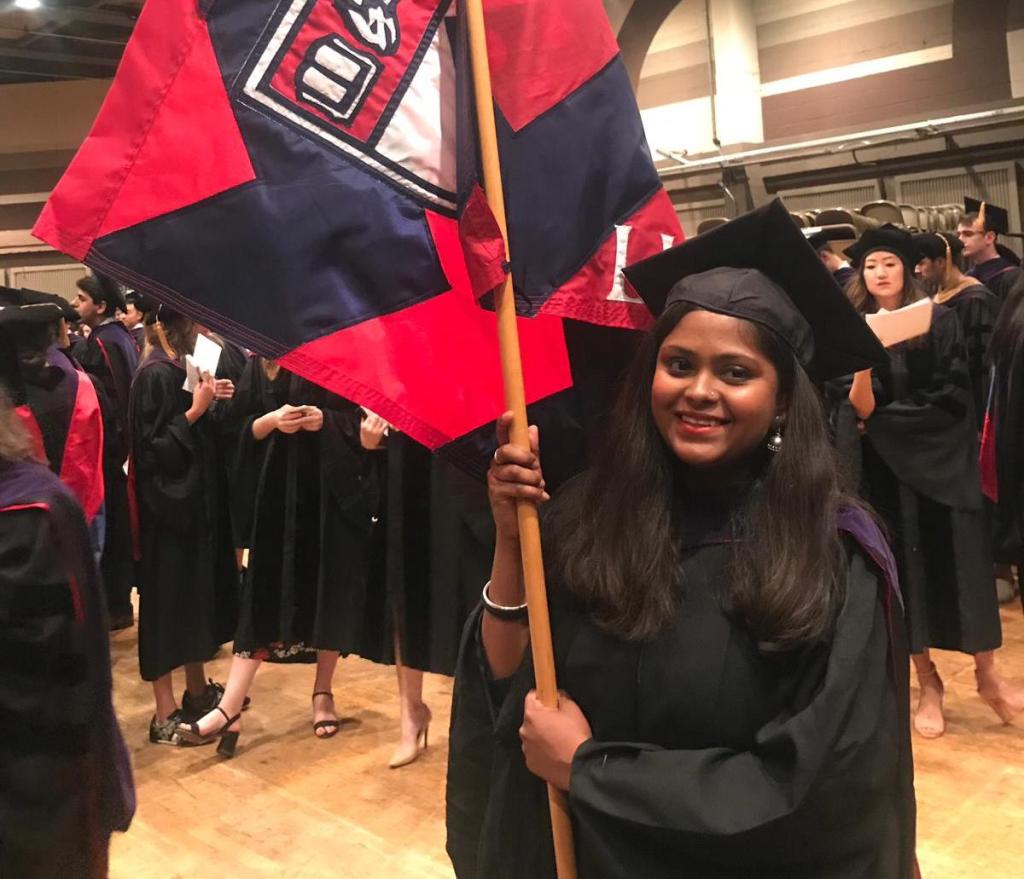
• First Person Accounts: Shilpa Singh on being a DAAD scholar for the LLM, University of Hamburg

    First Person Accounts (FPA’s) are meant to provide a first-hand account of Indian graduates who have pursued, or are pursuing, a post-graduate course (LL.M. or otherwise) from different universities across the world.

    Shilpa Singh enrolled for an LL.M. at the University of Hamburg, where she was the DAAD Scholar for 2017-18. A graduate of Gandhinagar National Law University (’17), Shilpa studied EU law and international law, as well as Commercial and Competition Law during her time at Hamburg.

    At what point of time as an undergraduate student did you start planning a master’s? And did you ever consider working for a few years before applying?

    I decided to pursue a Master’s in my 3rd year of 5 year studies, but just was not sure whether I wanted to do a specialized course or a general LLM, like the one offered at Cambridge. It took almost one and half years for me to figure out my likeness in a particular field of law and pursue my career in.

    It was the time when I took an internship under a Competition Team of a renowned firm at New Delhi that helped me to forge my decision to do my LLM in Competition law.

    There I was also fortunate to meet someone who was awarded with DAAD scholarship. I was completely blown away by meeting him and other members of the team, who I found to be my source of inspiration for pursuing competition law.

    The course offered by DAAD is very demanding and it covers different areas of law which can be a problem to some students. That is why a lot of people do not end up applying in this course, whereas the intake is only 20.

    “The course offered by DAAD is very demanding and it covers different areas of law which can be a problem to some students. That is why a lot of people do not end up applying in this course, whereas the intake is only 20.”

    I took the course right after my undergraduate and undertook internships in competition, corporate, arbitration and litigation lawyers that helped me to bring clarity in practical application of law. So I never felt the lack of experience when I compared myself to other students with experience or European classmates of mine. Nor did it affect my academic performance, as I was among the top performers and my LLM thesis was published as a Study Module.

    But professional experience is one of the criteria to assess candidate for DAAD scholarship and other scholarships and it definitely adds on as a person’s strength. I think more than this, the panel took an impression of me and passion for law because I was awarded a funding which is different from the one that is usually awarded by DAAD.

    My focus was on King’s LLM and DAAD’s Master of European Law. The course offered at DAAD as found by me was holistic giving me better opportunities to connect with lawyers and Professors, learning German, internship opportunities, course in EU law which is not like any national law or international law.

    Any advice on how to go about the DAAD scholarship application? 

    The application is demanding and it is advised to prepare beforehand. More than this, one needs to make mental preparation because the interview is the deal breaker here. Whatever one chooses to write in the application, it is advisable to honestly depict the kind of person one is and her aspirations.

    “Whatever one chooses to write in the application, it is advisable to honestly depict the kind of person one is and her aspirations.”

    Personal statements are very important as it reflects the person and one must give in few words about their present and future plans. Also, mention about how this scholarship can help one to achieve their goals. Having publications is good way to reflect your interest in law.

    Looking back, what were some of the best learnings of the LLM course? 

    The modules in Microeconomics and Macroeconomics in Semester 1 and Economics in Competition law in Semester 2 were my favourite. My favourite faculty among all is the one who taught us Economics in Semester 1.

    As a student of science, I had never studied Economics and these modules helped me to hone my analytical skills needed for a competition or trade lawyer.

    And lastly, what advice would you have for the Indian law graduate who is considering an LLM abroad? 

    Before applying for any course, I would recommend that students must ask themselves that why they want to do this course and in case of being offered with something else, would they give up on this? My point is that students must be clear with what they want to do and which course they want to pursue. This can be done by reading about course outline and asking former students of that course.

    “I would recommend that students must ask themselves that why they want to do this course and in case of being offered with something else, would they give up on this? My point is that students must be clear with what they want to do and which course they want to pursue. “

    There can be situations where students may not get the course they want to pursue due to certain circumstances or missing deadlines. Here, I would suggest them to wait for a year or two and reapply for the desired course rather than looking for an optimal amount of experience in CV.

    However, my application did not face any disadvantage due to lack of experience and in my opinion it is wrong to take experience as the sole criteria for measuring someone’s capabilities.

  • First Person Accounts: Vanya Rakesh on the LLM in Law & Digital Technologies, Leiden University

    First Person Accounts (FPA’s) are meant to provide a first-hand account of Indian graduates who have pursued, or are pursuing, a post-graduate course (LL.M. or otherwise) from different universities across the world.

    Vanya Rakesh is currently enrolled in the LL.M. in Law & Digital Technologies at Leiden University. A graduate of the Institute of Law, Nirma University (’15), Vanya worked at the Centre for Internet and Society, and then Infosys before enrolling for the LL.M. course from which she will graduate in 2020.

    Were you ever considering a master’s right after graduation? Or was the plan to always work for a bit before applying? 

    I always intended to work and acquire some field experience before applying for a Master’s specialization. Though I was very sure about pursuing masters at some point in time, undertaking 12 legal internships with varied legal experts, law firms, and organizations during the course of 5-years made me realize the importance of having work experience before embarking on LL.M.

    How did you go about selecting just where to apply? What were the schools you shortlisted, and what eventually got you to narrow down on Leiden? 

    Right after graduation I ventured into the field of technology law professionally. That opened a lot of avenues for me, and became a starting point as a selection criterion to look for a suitable course as well as university offering a specialization in this field. Since the field is comparatively still in its nascent stage, it was challenging to be able to find and further shortlist reputed universities offering an exclusive course covering the intersection between technology and law.

    Though a couple of top-ranked U.S. Universities offered the specialisation, the exorbitant tuition fees made me decide to look for options in different geographies. Interestingly, a handful of European universities offer a technology law specialisation and does not mix it with courses on Intellectual Property law, like many universities across the world. This made me apply to 5 Universities across Europe, namely- Edinburgh, Tilburg, VU Amsterdam and Oslo, besides Leiden University.

    “Interestingly, a handful of European universities offer a technology law specialisation and does not mix it with courses on Intellectual Property law, like many universities across the world.”

    I was extremely lucky to have received offers from all 5 Universities (with full tuition fee waiver from 3 of them).

    However, after spending substantive amount of time before deciding and narrowing down on one University, I narrowed decide to go ahead with Leiden due to several reasons:

    • The comprehensive curriculum it offered was exactly what I was looking for.
    • Leiden Law school is ranked amongst top 30 law schools in the world. The global ranking for that matter could not be overlooked.
    • Netherlands as a country offers an amazing quality of life, so moving continents for studying had to be decided on that factor.

    Any advice on how to go about the application process itself? As well as the LexS scholarship? 

    It is important to keep a tab on the dates concerning the application window. Leiden University accepts applications on a rolling/FCFS basis. Hence, it is advisable to apply as soon as the application window opens sometime in October. This will help you decide (based on the response from the University-affirmative or negative) your next step.

    In order to be able to send in your application as soon as the window opens, have a plan in place-starting from which course/specialization you intend to opt for, whether the university requires a IELTS/TOEFL score, working on the SOPs on the basis of requirements called out by the University for your program of interest, working on getting the right Letter of Recommendations (if required). It is vital to remember that your SOP can take months together before taking a final shape, where you may to rework on a single draft numerous time, to the point of exhaustion.

    “It is vital to remember that your SOP can take months together before taking a final shape, where you may to rework on a single draft numerous time, to the point of exhaustion.”

    So, the earlier you begin the process of shortlisting a university, the better. Also, make sure to abide by the specific requirements mentioned by the University regarding what they are looking for in a prospective student. This will help you draft your SOP and articulate your motivation to apply in a clear manner.

    Similarly, keep a tab of the LExS scholarship deadline and work on the application accordingly. Stick to the word limit and write your motivation letter based on the selection criterion mentioned by the University (and not rely on any sample letters available online). It is important to remember that you do not repeat the content that you have stated in your Motivation letter, and you keep the letter original and concise.

    What are your expectations from the LL.M. course? 

    I am looking forward to explore the multi-faceted curriculum that the Advanced LL.M. program in Law and Digital Technologies at Leiden University has to offer. I am hopeful about developing a strong base in the field and learning immensely.

    It will be great to pursue a course like this in Europe, which has sort of become the heartland for this field when it comes to driving legislations and policy initiatives in technology law matters.

    Also, it will be an extremely fulfilling experience to interact with a class encompassing students from across the world, ranging from all possible continents. Drawing from the experience of the professors as well as the students will be highly rewarding.

    “Also, it will be an extremely fulfilling experience to interact with a class encompassing students from across the world, ranging from all possible continents. Drawing from the experience of the professors as well as the students will be highly rewarding.”

    Early days I know, but how has the LL.M. experience been thus far? What are some aspects that have surprised you about the course on the whole? 

    Yes, as rightly pointed by you, though it is early to comment on the LL.M. experience, however, the approach is worth mentioning. The curriculum encompasses class-room discussions and group activities, following a fun-while-learning approach.

    Also, since the course is advanced in its nature, one is expected to read a lot for every lecture. However, you are also given ample time to study or work on your self. In addition to this, the professors are extremely friendly and approachable.

    Lastly, any advice for the Indian law graduate who is considering a master’s abroad? 

    Two things which in my opinion matter a lot for every student who intends to pursue LL.M. abroad are: firstly, though not a necessity, but gaining some work experience before taking a plunge will help you to be sure about your plans and the direction in which you want your career to proceed. Practical insights gained at work contributes immensely towards your profile.

    Secondly, spend some quality time to research the course you wish to pursue and the university(s) you intend to apply to. Keep a tab of deadlines for sending in applications (including for scholarships) and start very early. This will give you enough time to work step-by-step on every requirement.

    Applying early saves you time for everything that will follow- visa process, scholarship decision, arranging for accommodation, etc.

  • First Person Accounts: Radhika Saxena on the LL.M. at the University of Pennsylvania

    First Person Accounts (FPA’s) are meant to provide a first-hand account of Indian graduates who have pursued, or are pursuing, a post-graduate course (LL.M. or otherwise) from different universities across the world.

    Radhika Saxena graduated from Delhi University’s Campus Law Centre in 2015, and worked in the chambers of senior counsel, Indira Jaising, before enrolling for the LLM at the University of Pennsylvania (’19).

    Not quite connected with the LL.M. but given your interest in law while in school, what made you opt for an undergraduate in English literature? And how did you find yourself using this degree while studying law at Delhi University?

    While in school, I had no real interest or exposure to law as a career. As a daughter of a doctor and an architect, I was expected to pursue engineering. When I graduated from school and took various entrance examinations for engineering colleges, I realized that the science life was not for me.

    I then focused my energy on the Bachelor of Arts programmes at Delhi University. I was interested in pursuing Mathematics, but I chose college over course and landed at Sri Venkastewara College having enrolled in the B.A. English (Hons.) programme.

    I am not kidding when I say that it changed my life!

    I had some amazing professors, who taught me a lot, not just in the classroom but outside it too. A subject I studied in my final year – Literary Theory – had the most impact on me. The subject focused on four thematic areas – Marxism, Feminism, Poststructuralism and Postcolonialism.

    As a result, I read the works of Derrida, Edward Said, Spivack, Althusser, Simone de Beauvoir, etc. which taught me a lot about life in general, but most importantly it trained me on forming opinions and to have a critical eye on everything around me and thus began a feminist uprising, which I hoped to carry forward, and finally decided to study law.

    “I read the works of Derrida, Edward Said, Spivack, Althusser, Simone de Beauvoir, etc. which taught me a lot about life in general, but most importantly it trained me on forming opinions and to have a critical eye on everything around me”

    While in law school, given my background in literature, I was able to appreciate law better and learned how to analyze it and be critical of it. It also made me choose the unpopular subjects such as Gender Justice, which eventually led me to a career in women’s rights.

    “While in law school, given my background in literature, I was able to appreciate law better and learned how to analyze it and be critical of it. It also made me choose the unpopular subjects such as Gender Justice, which eventually led me to a career in women’s rights.”

    Do you think the 3-year LLB holds an advantage over the 5-year integrated course? And if so, what would they be?

    I’m not sure if the 3-year LLB has any advantages over the 5-year integrated course. But having pursued a separate undergraduate degree, I think I had a lot of time to engage with a particular subject and could apply my learning there to my time at law school and beyond.

    For me personally, that was the biggest advantage.

    Being affiliated to Delhi University throughout also gave me access to a politically active campus and a chance to fully pursue extra curricular activities like music, which may have been tough to manage with a 5-year programme.

    “Being affiliated to Delhi University throughout also gave me access to a politically active campus and a chance to fully pursue extra curricular activities like music, which may have been tough to manage with a 5-year programme.”

    I also had the opportunity to meet different people, learn and grow with them throughout the six years that I was affiliated with Delhi University, which I may not have experienced at such a magnitude on a residential campus.

    Was the plan to always enrol for a master’s, or was this something you decided to do after working for a few years? 

    I was very candid about my future plans with Ms. Jaising, when I interviewed with her. She required a minimum 2-year commitment from me and inquired if I had plans to pursue higher education, which I did.

    I knew I enjoyed studying and wanted to pursue a master’s degree, not just for the learning but for growth in my career too. At the same time, I was aware that professional experience prior to that would add not only to my applications, but also to my individual growth as a women’s rights lawyer.

    With this in mind, I worked for three years before pursuing my LL.M. at the University of Pennsylvania. I had in fact decided to apply right after graduating from Campus Law Centre, but I abandoned the process so as to work.

    While I planned to work before applying, I did not decide how long I wanted to work for, which was something that I figured out once I started working.

    How did you go about selecting just where to apply, what were the schools that made the shortlist, and why narrow down on UPenn? 

    Since I wanted to continue working on women’s rights after my LL.M., I primarily focused on institutions with a strong academic focus on women’s rights and human rights.

    I applied to universities in the US and the UK. Columbia University, University of Pennsylvania, University of Michigan, Cornell University, Harvard University, University of California Berkeley, and University of California Los Angeles were my picks in the US and School of African and Oriental Studies in the UK.  The former all had professors or courses that I was interested in, while the latter provided me with the option to specialize in Gender and Sexuality.

    When I was applying, I was keener on studying in the US since you have the option to work for one year after the degree and I wanted some professional experience there, given that many of our laws on women’s rights are adapted from counterparts in the US.

    “I was keener on studying in the US since you have the option to work for one year after the degree and I wanted some professional experience there, given that many of our laws on women’s rights are adapted from counterparts in the US.”

    Moreover, I received a 65% tuition scholarship from UPenn, which helped me pick it over Columbia and Michigan. I had also spoken to many people about which college I should pick and the advice I received was to either study in New York or Washington D.C. and UPenn only being two hours away from New York City and four hours from Washington D.C., I decided that it would be a good fit for me.

    UPenn also has multiple cross-disciplinary courses and certificates of study and you are allowed to take one class outside the law school without any additional fee. It therefore offered me some flexibility in designing my schedule and helped me graduate with a certificate in Gender, Sexuality and Women’s Studies, which I was looking to do and something that neither of the other US universities except UCLA offered.

    “UPenn also has multiple cross-disciplinary courses and certificates of study and you are allowed to take one class outside the law school without any additional fee. It therefore offered me some flexibility in designing my schedule.”

    Did you apply/receive financial aid of any sort?

    I was awarded the Human Rights Scholarship at UPenn, which covered 65% of my tuition fee, which was a substantial expenditure.

    I also received funding from the Lady Meherbai D. Tata Education Trust, which helped defray some of my costs associated with living.

    Could you tell me a bit more about working at the Transnational Legal Clinic at UPenn? And how did this work tie up with your previous role as a litigation counsel?

    My experience with the Clinic at Penn Law was exceptional. I was looking for some exposure to international advocacy and that’s how I decided to apply for it. It was an extremely supportive environment and the weekly schedule was such that I learned both by doing and instruction. It also gave me the space to work on specific skills and/or issues that I felt were important. The clinic allowed me to represent clients in the immigration court under the supervision of my professors.

    Unlike the J.D. students, I had prior experience with litigation, so I wasn’t looking to work on my drafting or oratory skills. Nevertheless, I learned a lot in that department. The manner in which we approached a client’s case was very comprehensive and very different from what I was conditioned to in India. I learned a great deal about dealing with client trauma and managing it during interviews, counselling sessions, etc. I also had the opportunity to focus on my own experiences with vicarious trauma, which was lacking in my practice in India.

    “The manner in which we approached a client’s case was very comprehensive and very different from what I was conditioned to in India. I learned a great deal about dealing with client trauma and managing it during interviews, counselling sessions, etc.”

    The clinic organized a trip to a detention facility for immigrants, which was eye opening for me. It forced me to think about immigration in a human rights context, which did not occur to me/affect me so much before that. It made me very aware of my own position as an immigrant in the United States and provided me with added motivation to work for women’s rights in similar settings.

    Looking back, what do you think have been some of the most valuable components of the LL.M.?

    For me, the most valuable components have to be the relationships I built at the law school, both personal and professional. I will forever be grateful to my professors and friends for supporting me in everything that I did.

    Given that all of us were international students, we learned to support each other academically and otherwise, which was very refreshing compared to my previous experience at law school in India.

    What is your reading of the recruitment opportunities available to international LLM graduates in the US? 

    Opportunities for international students certainly exist, but you are constantly competing for them with a J.D., so your chances of securing employment are relatively low. Your specialization during the LL.M. also impacts the kind of opportunities open to you. I felt that not being in big cities and being an international student interested in human rights limited my opportunities.

    Nevertheless, I was able to secure a Fellowship with Women Enabled International where I’m engaged in international law advocacy at the intersection of women’s rights and disability rights. It’s hard securing a job, but not impossible. It requires a lot of work, knowing exactly what/where you want to be, and so, I would advise anyone looking for a job to start early.

    “It’s hard securing a job, but not impossible. It requires a lot of work, knowing exactly what/where you want to be, and so, I would advise anyone looking for a job to start early.”

    And lastly, what advice would you have for the Indian law graduate who may be considering a master’s abroad?

    I would advise anyone who’s interested in pursuing an LL.M. abroad to give it a go. Even the process of applying teaches you a lot about yourself and the world. It is expensive, but definitely worth it.

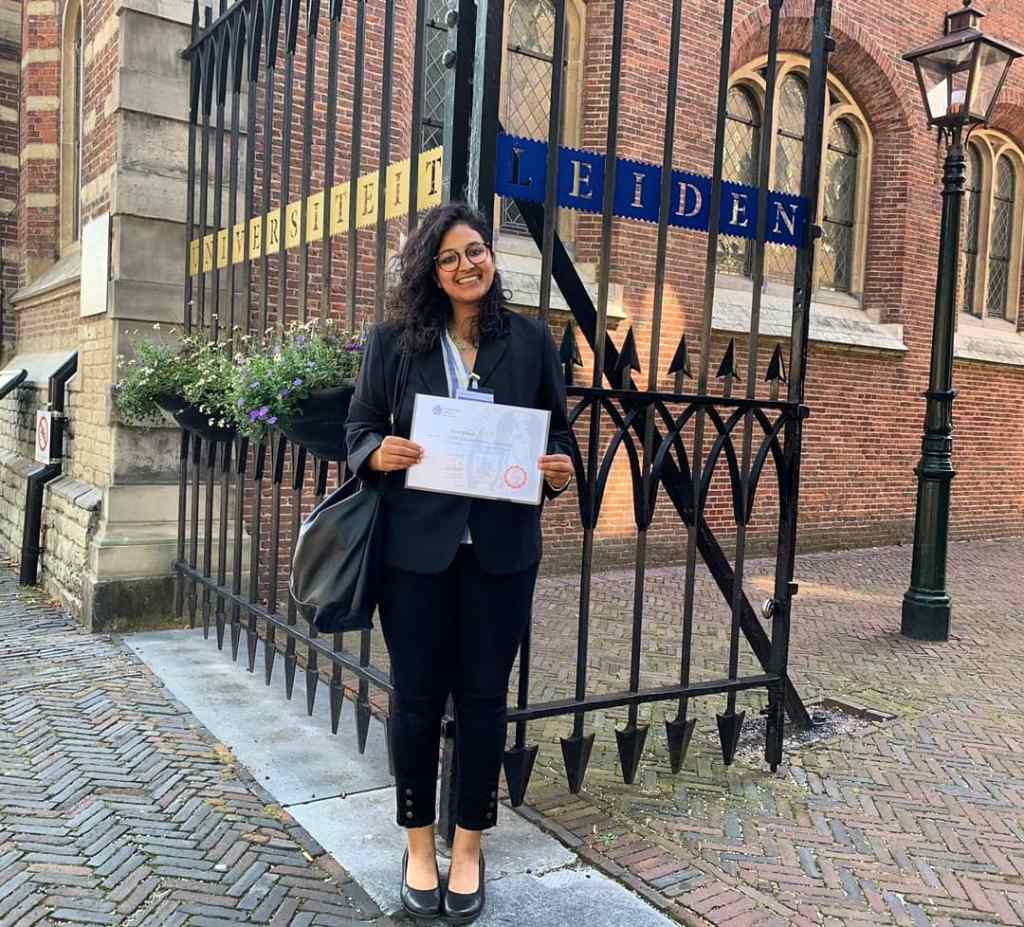
  • First Person Accounts: Umika Sharma on the PhD at National University of Singapore NUS (Part II)

    First Person Accounts (FPA’s) are meant to provide a first-hand account of law graduates who have pursued, or are pursuing, a post-graduate course (LL.M. or otherwise) from different universities across the world.

    In the second part of the interview (read Part I here), Umika Sharma shares her thoughts on the PhD application process at NUS, a day in the life of a PhD scholar, and some advice for the Indian law graduate who may be considering a postgraduate education outside the country.

    How did you go about selecting your thesis topic, and then, your thesis guide/supervisor? 

    The easier bit of the question first, about the supervisor. At NUS, the law faculty chooses your supervisor. Generally, a specialist suitable for your research. You do have the option of putting forward your preference at the time of the online application, but the final decision rests with the Faculty of Law, I believe.

    Unlike European universities, one doesn’t need to go through the whole process of choosing a supervisor and then convincing them to support your topic. If you are chosen as doctoral candidate, your supervisor is chosen for you. I feel, it really cuts down on a lot of effort while you’re trying to make a strong application and saved a lot of my time.

    ” If you are chosen as doctoral candidate at NUS, your supervisor is chosen for you. I feel, it really cuts down on a lot of effort while you’re trying to make a strong application and saved a lot of my time.”

    As for the topic, it was something that I got interested in early during my master’s at QMUL. During one of my lectures, an off-topic comment by one of my professors made me curious about diversity in international arbitration.

    As an Indian lawyer, I had already assumed that first, the presence of diverse arbitration practitioners (in terms of gender, race, age or nationality) would be good in London as the city itself was such a diverse place. Second, as international arbitration is ‘international’ there is bound to be better representation of lawyers from all parts of the world.

    A deep research on these questions demolished both these assumptions.

    Then I spent the next ten months or so speaking to professionals about this topic. I did some informal interviews, small scale empirical researches and finally narrowed down on my central thesis idea about the issue of diversity in international arbitration. As there was barely any concrete existing empirical research on this topic, all I could do was draw parallels with research in other areas of law and often from the field of business to try to understand how the lack of diversity has the potential to affect the arbitral process. Once I had defined the bounds of the diversity issue in international arbitration, I decided I wanted to delve deeper into the topic and fill the gap that currently exists in terms of empirical data. That’s how I came around to the idea of doing a Ph.D. on this topic.

    “Once I had defined the bounds of the diversity issue in international arbitration, I decided I wanted to delve deeper into the topic and fill the gap that currently exists in terms of empirical data. That’s how I came around to the idea of doing a Ph.D. on this topic.”

    Could you tell me a bit more about your PhD thesis? And any advice for law graduates who are interested in applying for a doctorate degree? 

    My PhD thesis is still a work in progress. I am trying to understand how a lack of diversity affects the business of international arbitration. It’s an inter-disciplinary topic and will draw research from many areas outside of law-like social sciences and business.

    Currently, I am also designing an empirical research model where the main aim is to collect diversity data in the international arbitration community based on gender, race/ethnicity/nationality and age. My research will also involve conducting a lot of interviews. Realistically, I will be spending a lot of time with spreadsheets and complicated data.

    Of course, having said all of this, a Ph.D. is always a work in progress and might end up on an absolutely different tangent to where it started from. Let’s see where mine will go.

    As far as giving any bits of advice are concerned, I will share one. Choose your topic wisely. You will live with it for years to come and will spend every waking moment, and sometimes even dream about it, either working on it or thinking about it. It better be a topic you enjoy and have a deep interest in.

    “Choose your topic wisely. You will live with it for years to come and will spend every waking moment, and sometimes even dream about it, either working on it or thinking about it. It better be a topic you enjoy and have a deep interest in.”

    Right now, I am extremely happy with my topic and the direction it’s going in. It helps in keeping me motivated and not feel any pressure. So, just make sure that your topic is of interest to you. Not something that’s popular or which others think should be researched on. It should be a reflection of your interests as it will become the centre of your universe for years to come.

    Early days yet, but what does a typical day look like?

    I received excellent advice from one of my professors here at NUS, that a Ph.D. should be treated as a full-time job. I took it to heart, and that’s how I look at it now. Though I am still trying to design and set my typical day, it usually begins early at around 7 am (I am most focused and productive in the first half of the day).

    “I received excellent advice from one of my professors here at NUS, that a Ph.D. should be treated as a full-time job. I took it to heart, and that’s how I look at it now. “

    I set a few big goals for the day and build my day around those goals. What I’ve realised is that as a Ph.D. scholar you will not have a set structure to your day like your LL.M., where you will need to attend classes, tutorials and cover a set number of readings. It’s very flexible, and your research will probably never end unless you don’t check yourself. Therefore, planning a schedule and being disciplined about it will be key.

    After all the planning, I block the first half of my day into big chunks (with a few short breaks) where I do my work before lunch. As I’ve just begun my degree, I foresee deep-diving into a lot of research and spending a few months only reading. Then I take a two-hour break to absorb all the material and grab lunch, roam around the campus or wrap up on any pending miscellaneous tasks like emails, calls and so on. I go back to my readings in the second half for a few more hours.

    Generally, I squeeze in a workout if my brain feels too saturated and then go back to reading for a few hours more before I call it a day. At NUS, all the first year Ph.Ds. have been allotted research spaces which is our own and one we often refer to as our “office” on the campus. It’s quite helpful to have these as then you can do uninterrupted work as per your convenience.

    “At NUS, all the first year Ph.Ds. have been allotted research spaces which is our own and one we often refer to as our “office” on the campus.”

    Then I head home and cook myself some food (one can never get over Indian food, no matter how many years you spend abroad), only to crash soon to begin an early day the next morning.

    These are not the days when I have classes or other research tasks to complete. Here at NUS, the research community is vibrant and very active and invites all the doctoral students to research workshops where doctoral candidates as well as faculty present their research and seek comments.

    Honestly, I find this exercise the best way to expand one’s mind to learn about research in other fields and share research ideas.

    Lastly, any advice for the Indian law graduate who may be considering studying outside the country? 

    I do not consider myself any authority to give any advice as my own journey has been a trial and error exercise. I will try to share my opinions based on my experiences (albeit, limited and individualistic experiences).

    Please do not look at a degree abroad as a magic portal to a job. That, in my opinion, is a flawed assumption and will only lead to disappointments. Also, undertaking an expensive degree (if one doesn’t obtain a scholarship) and spending so much time and energy should never be seen as a means to an end. The end being a short-term goal like a high paying job in a foreign country or even your own.

    Think long term.

    Think in terms of how studying in an international university will add to your skillset and make you a better lawyer. Think in terms of how interacting with people from all over the world will add to your personality, maybe make you a better communicator but most importantly, add a whole new dimension to your understanding of people and cultures.

    A degree abroad should not be seen as a fall-back option if you don’t find a job you like or want to continue being a student for some reason. Rather, look at it as a life-altering decision that has the potential to completely change who you are as a person and often, shake up your core belief systems.

    Look at a degree abroad as a long-term investment in yourself. It might or might have no short-term returns, but if you’re mindful of making the most out of your degree, it will most certainly yield a very high long-term return.

    “Look at a degree abroad as a long-term investment in yourself. It might or might have no short-term returns, but if you’re mindful of making the most out of your degree, it will most certainly yield a very high long-term return.”

    Finally, be mindful of the course and the university you choose. In India, we have been taught that brand names open up a lot of new possibilities, which is sometimes right. But be wary of this thinking while choosing your degree abroad. Go beyond the brand names.

    Make your choices based on- first, where your interests lie. Second, the quality of the courses and the professors in addition to the methodology of teaching. Some universities abroad are known for specific programs and might be better choices over other better “ranked” universities — lastly, the alumni network and reputation of the university. Often, I have made choices based not on the status of institutions or their brand value but their value addition to what I want to do. Not once have I regretted these choices.

    “Often, I have made choices based not on the status of institutions or their brand value but their value addition to what I want to do. Not once have I regretted these choices.”

  • The #LLM Admission Interviews: Prof. Douglas Brodie, Strathclyde University

    The Admission Interviews, are meant to provide insights into LLM admissions right from the law school itself. The primary idea behind this series is to provide that little bit of extra information that may not be available on the law school’s website.

    Professor Douglas Brodie is the Dean of Humanities and Social Sciences at the University of Strathclyde. In this interview, the labour law expert talks about the LLM admissions at Strathclyde, the benefits of an international LLM, how one can maximise the benefits of the course, and a lot more.

    As someone who has been teaching for quite a while now, what do you think are the benefits of a non-professional degree like an LLM from the point of view of the international student?

    LLM (Master of Laws) are internationally recognised qualifications. This allows graduates to experience studying in another country whilst gaining a qualification which will be recognised throughout the world. The life experience of studying in a different country can add more interest to someone’s CV as well as a qualification.

    “The life experience of studying in a different country can add more interest to someone’s CV as well as a qualification.”

    They also offer students to specialise in particular areas of law.  The pursuit of an LLM will help demonstrate expertise and in depth knowledge that perhaps an undergraduate qualification will not have covered.  It may also lead to a career in academia!

    What are your views on rankings such as THE and QS World Rankings? I suppose what I am asking is how do you think prospective applicants should go about choosing just where to apply?

    I think that rankings can give an indication but prospective applicants should take far more into account. I would advise people to get in touch with the institutions that offer the topics they are interested in. Find out more about the academics, current students, normal class sizes etc. You are committing a lot of time and money so it’s important to get the right fit for your area of interest and expectations of how you’ll be taught.

    For example, our Law School is not “ancient” nor would we want to be. We’ve been educating lawyers for 50 years and our teaching is informed by current research. We have innovative teaching methods and we are researching topical issues that resonate with today’s society.

    Our academics, graduates and current students regularly speak with applicants to tell them more about what it would be like to study here.

    “For example, our Law School is not “ancient” nor would we want to be. We’ve been educating lawyers for 50 years and our teaching is informed by current research.”

    One of the more questions we get at Amicus Partners is what happens after the LLM – what is your reading of the recruitment possibilities for the international LLM candidate who is looking to work in, for instance, Scotland?

    The UK Home Office has announced proposals to allow international students to stay in the UK for two years after graduation to find a job.  This is fantastic news as it will open up more opportunities for our international graduates what want to stay in the UK.  We offer a number of LLM specialisms so the possibilities will vary for each.

    Coming to Strathclyde, is there a particular profile of applicants that you are looking for? And as a law department, what are the characteristics/aspects that you look for in applicants?

    We generally look for applicant to have a 2:1 honours equivalent.  We attract a variety of students and it’s important to note that we do not necessarily need applicants to have studied Law at undergraduate level.  (Ideally, applicants will have studied a subject that would require essay based assessments.)

    We have a range of different types of students on our programmes, including professionals studying alongside work or taking time out, to people who have progressed directly from their undergraduate qualification. This provides an interesting mix of backgrounds and adds to discussion within our classes.

    Generally speaking, we want individuals who have a passion for their subject and a willingness to embrace different opinions and ideas.

    “Generally speaking, we want individuals who have a passion for their subject and a willingness to embrace different opinions and ideas.”

    Any advice on how the international LLM graduate make the most of the LLM experience?

    I would advise any student to immerse themselves in student life, attending the free seminars and getting involved in the societies through the Student Union.

    For Law in particular, we have an active Law Society and opportunities to get involved in work with our research centres.

    I know that you have been a consultant to the dispute resolution firm Simpson & Marwick – how has that experience been and how do you think Indian law firms could be encouraged to work more closely with Indian academia?

    I think it is hugely beneficial to law academics to have a connection with professional practice. One important benefit is that you gain a better awareness of the practical skills required by new practitioners.

    I would urge Indian academics to reach out to firms and explain their undoubted relevance.

    “I would urge Indian academics to reach out to firms and explain their undoubted relevance.”

    Lastly, I am quite curious to know what you think are the fallouts of Brexit (if it ever happens) in the context of international students? Do you think it will lead to an increase in students who choose to study in Scotland?

    Whatever the outcome of Brexit I think that the UK will still be a very popular destination for international students.

    Strathclyde is attracting record numbers of students and I think that will continue as long as we keep refreshing our portfolio of programmes.