First Person Accounts (FPA’s) are meant to provide a first-hand account of Indian graduates who have pursued, or are pursuing, a post-graduate course (LL.M. or otherwise) from different universities across the world.
Poornima Balasubramanian
Poornima Balasubramanian is working in London as a compliance consultant. A graduate of ILS, Pune (’15), Poornima worked in Bombay for three years before enrolling for a specialised LL.M. at the London School of Economics and Political Science. In this FPA, she talks about the motivations behind the LL.M., finding employment in the UK, and a whole lot more.
Let’s start with the question you must be getting asked a lot – how does an international LLM graduate find employment in the UK? What were the lessons learnt with your own post-LLM experience?
At the outset, I didn’t decide to pursue an LL.M with the sole purpose of ‘working abroad’. I ended up applying for a few positions during the year, one of which worked out for me. I guess it’s also about being in the right place at the right time!
But I must accept that having the relevant work experience in India definitely helped me tackle the questions in the technical interview.
With regard to lessons learnt on my post LLM experience, it’s probably too soon to tell. Maybe I’d have a better answer in a year or two. One thing I have to say, every extra minute of work beyond official hours is highly appreciated and never taken for granted – that’s a change!
Close to three years after your law degree, you opted for an LLM – what was the reasoning behind this move?
Academics was always important for me. I come from a family of doctors (medical and Ph. D’s) and have seen the impact that higher education can have in shaping an individual’s personality and mindset. So an LL.M was always in the pipeline. But I just wasn’t too sure of my specialisation.
By my fifth year at ILS, I was really eager to get make the switch from classrooms to courtrooms. I realised I couldn’t do another year of academics right after ILS so decided to put my LL.M plans on hold and take up the job offer from M/s Crawford Bayley & Co. (CB).
My three years at CB gave me an insight into the diverse aspects of the legal field, ranging from family law matters to capital market transactions. Once I knew of my interest (securities regulation), I decided to take the plunge and apply for an LL.M.
What were some of the expectations you had from the LLM experience?
I wanted my LLM experience to have some practical elements and not just be theoretical. Apart from being academically challenging, LSE also adds a practical aspect to its courses, for example, an M&A class doesn’t only involve postulatory reading but also a practical analysis of some recent deals and deciphering what worked or what went wrong / could have been avoided.
I was looking forward to interacting with lawyers from different backgrounds (particularly civil law jurisdictions), engaging in stimulating discussions and improving my prowess as a lawyer.
In hindsight, I can definitely say I got more than I expected from LSE, including a lovely bunch of friends from different parts of the world.
How did you go about narrowing down on just where to apply? And why finalise on LSE?
I had applied to a total of 5 schools including LSE – two in the UK and three in the US. I looked at a bunch of aspects, (i) the reputation of the law school, (ii) got some alumni insights, (iii) profile of the professors teaching the courses I was interested in and (iv) lastly and most importantly, financial aid opportunities at these schools.
Did you apply for/receive financial aid?
I did. I am a recipient of the LSE Marchant Foundation Scholarship for the year 2018 – 19 and the RD Sethna scholarship. I wanted to pursue the LL.M using my own personal funds without relying on my parents so I did my financial planning well in advance.
Also, since I was working while applying for my LL.M and financial aid, I had to be more organised about my applications. The best suggestion I got while applying was to create an excel sheet with deadlines, set reminders for myself and weekly goals to go about the entire process of applying.
What were some of the most surprising and challenging aspects of the LL.M? Anything that prospective applicants often overlook?
The Indian education system is very different from the UK. We aren’t used to / trained at writing legal essays, dissertations, papers, etc. and that was definitely a challenge one could face during the LL.M.
Personally, I found structuring a legal essay to fit the needs of LSE a bit challenging (It’s not just applying the IRAC rule!). So I spent a lot of time working on my writing skills by attending extra writing practice sessions at LSE.
My only suggestion for prospective applicants is to accept and recognise where you fall short and ask for help. Universities are well equipped to assist you in every way possible so don’t be shy to approach the staff for help.
“My only suggestion for prospective applicants is to accept and recognise where you fall short and ask for help.”
And, a slightly more general question, what advice would you have for the Indian law grad who is considering a master’s abroad, but not quite sure about the RoI aspect?
Make sure you know why you are doing an LL.M. It is an expensive course, often considered a luxury. If your only reason for pursuing a masters is to get a job abroad – it is unfortunately the wrong way to go about it. Do a masters if you believe it will truly add value to you. If along the way you do get a job abroad, give yourself a pat on the back and grab it! Just don’t make it the only sole objective of your LL.M.
“Do a masters if you believe it will truly add value to you. If along the way you do get a job abroad, give yourself a pat on the back and grab it!”
If you would like Amicus Partners to provide some personalised advice on your LLM applications, please fill in this form and we shall get back to you as soon as possible.
First Person Accounts (FPA’s) are meant to provide a first-hand account of Indian graduates who have pursued, or are pursuing, a post-graduate course (LL.M. or otherwise) from different universities across the world.
Pallavi Chandrasekhar
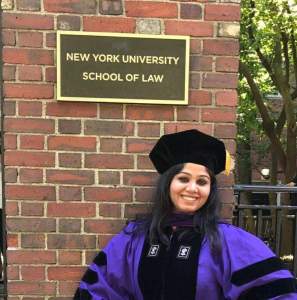
In 2017, Pallavi Chandrasekhargraduated with an LL.M. from the School of Law at New York University. A graduate of the Campus Law Centre, Delhi University, Pallavi worked for a year before embarking on the LL.M.
Not quite connected to the LLM, but what made you opt for a judicial clerkship right after your law degree? Looking back, what were some of the learnings you made during the clerkship?
My marks in law school were good, not excellent. So I needed something to boast my resume. Clerk ships are very prestigious in the US. So I clerked for a year before applying.
When it came to the LLM, when did you decide that you wanted to enrol for a master’s, and how did you go about selecting just where to apply?
I decided I wanted to study LLM abroad, when Mr. Ajay Sondhi, partner at Luthra & Luthra came to my college and told us it was worth to do an LLM abroad to make global connections.
I chose the top ten law schools in the world and applied.
Am sure you get asked this a fair bit, but do you have any advice on the application process? NYU has a pretty tight word limit for the personal statement – how did you tackle this?
I just trimmed the edges and edited my previous two page statement into one.
Did you apply for/receive financial aid?
I received scholarship at UCLA but chose to study at NYU.
How was the LLM experience itself? Looking back, what were the aspects of the LLM that have helped you in your professional growth?
Passing the bar exam helped me in my professional growth. Rest is yet to be demonstrated.
Lastly, any advice for the Indian law graduate who is considering a master’s abroad?
Do your homework well. It is not worth to study abroad if you are not studying in the top ten/twenty law schools, because brand value and quality matters in our profession.
With an estimated hundred thousand new law graduates every year, it is not surprising that international law schools are increasing their focus on India. After all here is a large pool of law graduates with global aspirations, aspirations that may be met with the varied programmes that foreign law schools have to be offer. Be it the more popular LL.M, or the Juris Doctor, or even executive programmes for mid-career lawyers – foreign law schools are offering it all, and more.
So why do Indian lawyers continue to form a not too significant proportion of postgraduate students in foreign countries? Well, the reasons for this are many, including the costs of legal education and the very utility of the degree (perceived or otherwise). But I also think that there is something to be said about simply building awareness, about making sure that the Indian law graduate knows about her various options.
It is not like foreign law schools are unaware of this. Although some may cringe to classify their efforts as “marketing”, to my mind, that is exactly what they have been doing. And this is not a bad thing.
It could, however, be more effective.
Let’s take the example of education “fairs” – representative(s) of foreign law schools get to interact with prospective applicants or parents or both. On paper, this sounds like a great idea, but I am not sure how effective this in the real world. I don’t think it is that easy to ensure the right kind of footfall at such fairs, especially for something as specialized as law.
Today’s generation expects, no demands, information be brought to them, and not the other way around. Add to this the over-supply of information online, and you can see the need for a more effective channel of communication. One way that this could be done is for representatives to actually visit Indian law schools, speak to the students, the faculty etc. Some schools are, in fact, making this effort. Of course, this needs to be done consistently, over a period of time, for the results to show up.
Another thing that foreign law schools are engaging in is online advertisements. In fact, this is something that Amicus Partners devotes a lot of time to. But again, I think the danger here is of believing that online banners are all that is required, that having a banner advertisement will immediately start getting you leads.
In an ideal world, at least for the media vendor, this would be the case. But it is not an ideal world, and online banner adverts certainly do not work that way.
At best, much like law fairs, one can view this as brand building exercise; a necessary investment for long-term rewards. In other words, I don’t think the challenge is to get people to view and click. Or, to reframe, the real challenge would be to get them to engage after they have clicked.
How can this be done?
Well, and this comes back to the initial point, I think the message, as well as the delivery of the message, has to be more personalized. Foreign law schools will not only have to demonstrate how their programmes are top-notch, but also how their programmes fit into the Indian law graduate’s plans.
Another avenue, one that some of the smarter foreign law schools are exploring, is to tie in directly with Indian law schools. This, in my opinion, holds a lot of promise. Not only does this grant direct access to a large pool of prospective applicants, but also allows both parties to test and explore the relationship. This is always (always!) a good thing.
So, will foreign law schools bite? I definitely think they will, if they have not already. All in all, these are some exciting times ahead!
First Person Accounts (FPA’s) are meant to provide a first-hand account of Indian graduates who have pursued, or are pursuing, a post-graduate course (LL.M. or otherwise) from different universities across the world.
Tinaz Kalyanvala
Tinaz Kalyanvala is currently pursuing the Comparative and International Dispute Resolution LL.M. at the Queen Mary University of London. A graduate of ILS, Pune (’17), Tinaz worked for close to two years before embarking on the LL.M.
In this FPA, she shares some advice for prospective applicants, discusses her reasons for wanting an LL.M., and a whole lot more.
At what point in time did you start planning for an LLM, and what were some of your expectations from the course?
An LLM, or just pursuing a masters was always a part of my education goals. But while in law school I had the privilege of interning at some of the best firms and working alongside some of the best lawyers in the country and not all of them necessarily had an LLM or an LLM from a foreign law school to be precise.
Moreover, pursing an LLM abroad is an expensive affair and hence post graduating I decided that it would probably be wise to put plans for an LLM on a hold and get some practical experience first. I always knew that I was disputes and particularly arbitration inclined. Through all my arbitration experiences a question that would often trouble me was why is it that Institutional Arbitration in my home jurisdiction is yet not that advanced despite certain other developing economies scoring so much better on this front.
I spent a lot of time reading about comparative dispute resolution and when I read about the program offered by QMUL in Comparative and International Dispute Resolution, I was instantly drawn towards pursuing the same. By this time, I had also worked for almost two years as a disputes lawyer in India.
As for my expectation from the course, to be brutally honest with you and I am sure as most other LLM applicants might concur, the entire application process when one thinks of pursuing a masters abroad is such a roller-coaster ride and especially when your managing the same alongside working as a professional that there really seems to be no time to think about what you expect exactly and before I even realised it I was on the flight to London. Thus, my expectations from the course was something I only exactly discovered upon commencing the program here.
Given the specialised nature of your LLM, what were some of the other schools that you applied to? How did you go about narrowing down on QMUL?
There are some great programs for arbitration in the US as well as Europe but as I was more inclined towards law schools in Europe, I applied for the MIDS program at Geneva, the IDR LLM offered by the Humboldt University of Berlin and the LLM program offered in Comparative and International Dispute Resolution by QMUL.
I was particularly keen on the MIDS program as well but as that did not work out, I was more than happy to accept the offer by QMUL. As for narrowing the scope, I would sincerely urge aspiring LLM candidates to reach out to the alumni of the Universities they are keen on. I personally reached out to past alumni of each of these law schools through LinkedIn and was glad to have sought valuable insights from most of them.
“I would sincerely urge aspiring LLM candidates to reach out to the alumni of the Universities they are keen on.”
Of course, one could always write to the administration office of the law school you are interested in directly but a student’s insight is always the best as there are a lot of factors other than the subject of the LLM in itself that go in to making the decision. For example, questions specific to certain faculty, or living arrangements or other support.
Another strong recommendation for all those keen on applying for an LLM would certainly be while choosing your University do not look at the overall ranking of the University but look at how well the University is ranked for the subject you are looking at specialising in.
Any advice on how to go about the application process itself?
START EARLY! I cannot emphasize enough on this. Every University has its own unique requirements for submissions and when multiple deadlines are tormenting you together, it is very easy to make a mistake.
Most Universities require transcripts, apply for these from your respective law schools early on to avoid unnecessary delay. Certain Universities require details of your passport certain ones your birth certificate, then there may be requirements for official translations of certain documents and of course there are your extra credentials like internship certificates, diplomas etc.
It sounds like obvious stuff but when you put together all these documents which feels like your entire life’s accomplishments in short you will realise that certain documents must be of a particular size and resolution and in a particular sequence and this too differs from University to University. So, make sure you start getting everything together early. Personally, I started organising my documents a good six months prior to the application dates but despite that, I felt like I could have done with a little extra time.
“I started organising my documents a good six months prior to the application dates but despite that, I felt like I could have done with a little extra time.”
The Statement of Purpose and Letters of Recommendation are the common element for all applications. For the Statement of Purpose I personally redrafted mine 16 times and was still not a 100 percent convinced about it so do not panic if you feel you are not sure about yours as it is very much a part of the process but, ensure that you write it yourself, that it truly reflects your personality and genuine reasons for interest in the subject and last but not the least definitely have your friends or colleagues review the same.
Letters of Recommendation are very influential in making your case and I would sincerely recommend that for all those who can manage a recommendation from someone with industry experience relevant to the subject of your LLM try and seek these it makes a world of a difference.
A quick disclaimer for all those thinking of making their applications through various educational consultancy organisations, representatives of these entities can only guide you with the procedural aspects of the application and not very many of them are necessarily in a position to recommend the best schools for your selected subject so that homework must necessarily be done by you.
Having said that I went through two organisations to assist me understand the documentation and it was extremely beneficial especially for the visa formalities which are utterly confusing otherwise, so I would recommend availing services of these organisations even if it is only for the visa stage.
“For all those thinking of making their applications through various educational consultancy organisations, representatives of these entities can only guide you with the procedural aspects of the application and not very many of them are necessarily in a position to recommend the best schools for your selected subject so that homework must necessarily be done by you.”
Did you apply for/receive financial aid?
Yes, I applied to various trusts/organisations in India and overseas and also for tuition waiver/scholarships to the Universities I applied to. To be precise I made 15 applications in total and if I may add the process was equally if not more challenging than the application process for the LLM itself.
To name a few of these were the JN Tata Endowment, the KC Mahindra Scholarship Funds, the RD Sethna Trust, the Lotus Trust etc. Many of these organisations I applied to offer gift scholarships and many of them offer scholarships in the form of an educational loan (some with interest and some interest free).
It is a cumbersome process with each organisation requiring a statement of purpose of its own, your educational certificates, letters of recommendations, proof of your personal or your parent’s financials etc.
Many of these organisations also require you to make submissions in person and also to go through interviews if you are shortlisted. The deadlines for these applications again vary from organisation to organisation and one should be watchful of these. In the end however, every cent counts as pursuing an LLM abroad is expensive right from the word go!
“In the end however, every cent counts as pursuing an LLM abroad is expensive right from the word go!”
I was personally fortunate to have received a combination of gift and loan scholarships that assisted me fund a major chunk of my tuition and living expenses.
How has the LLM experience been thus far? What have been some of the most rewarding elements of the course?
The faculty at QMUL for the disputes LLM is absolutely STELLAR and that has been the major takeaway for me. Also, being affiliated with School of International Arbitration and thus being part of an environment where constant efforts are made to continuously contribute to the world of International Arbitration has been very enriching.
Also, since I wanted a truly International exposure, I have been very lucky as in addition to the course being taught from an international comparative point of view our classes at any given point in time easily has students from a minimum of 10 jurisdictions if not more.
You can always read about the litigation or arbitration processes of a country other than your own but when you indulge in dialogue with colleagues from diverse cultures you also understand the culture, politics, policy and economic influences behind the differences that exist worldwide and our classroom discussions have enabled me to appreciate the nuances not just of International Arbitration but also Litigation.
“You can always read about the litigation or arbitration processes of a country other than your own but when you indulge in dialogue with colleagues from diverse cultures you also understand the culture, politics, policy and economic influences behind the differences that exist worldwide.”
I would also like to talk about my position at qLegal a legal clinic run by QMUL that provides pro bono advice to various tech start-ups and entrepreneurs. My training and role as a legal designer with qLegal has particularly exposed me to the role of Innovation and Design in the practise of the law, an avenue that I was aware of but not quite well equipped with.
“My training and role as a legal designer with qLegal has particularly exposed me to the role of Innovation and Design in the practise of the law, an avenue that I was aware of but not quite well equipped with.”
In the age of propositions for Artificial Intelligence playing a substantial role in the practise of the law it is alarming that innovation and the use of design techniques has not entirely found its place quite as yet and I have thus been very fortunate to have worked with some exciting people and on some interesting projects in this regard. I sincerely hope that more law schools in India in the future too will impart this training as part of their curriculum. It really is the need of the hour!
You asked me initially of what I expected from the course, to be honest I do not think even if I had given it some serious thought I would have possibly imagined benefiting so immensely from the program and I would strongly recommend the university for anyone looking at an LLM in Dispute Resolution.
Not quite related to the LLM, but how did you go about finding accommodation in London city?
So, for accommodation the University provides residential services, they are not exactly hostels more like shared apartments of sorts. Again, I cannot emphasise enough on how important it is to make the application for the University residencies early. Even if you apply within the first one hour of the application window opening there is still no guarantee of seeking University accommodation as the number of students applying each year is tremendously high.
So, to all those making the application for University accommodation, do it literally the second the application window opens. Also, there is no fee charged to make the initial application so I would recommend that even if you have not heard from the University regarding your offer it is still alright to go ahead and make the application for residencies to be on the safe side.
I must however add that the University is particularly very helpful towards all those who do not manage to seek University accommodation and tries to connect the students with a host of other residences. One could always look for something privately as well there are a lot of websites here in the UK for student accommodation but I would recommend applying for the University accommodation. It is a great experience sharing an apartment with students from different countries and studying across various disciplines at the University and will be one of my most cherished takeaways from my time in London.
Lastly, any advice for the Indian law graduate who is considering a master’s abroad?
It is strange to give LLM advice as when I sought advice from various seniors and colleagues over the past few years I have always got mixed responses and that has brought me to one conclusion: Different people pursue their LLMs for different reasons and the takeaway from the LLM can therefore never be the same for two people.
“Different people pursue their LLMs for different reasons and the takeaway from the LLM can therefore never be the same for two people.”
If I had to share my experience however, I would say that while the LLM has been intellectually brilliant for me so far, it is hard work. There is never a dull moment and you are perpetually on your feet. So, for all those looking at the LLM as a break from work life you might want to rethink this one!
On a lighter note it is cliché but true that if you haven’t had an international exposure to your area of interest in the law and if that is something you seek then an LLM is definitely the best way forward as it truly broadens your horizons.
Also, on a parting note an LLM though thoroughly academic is also highly practical in the sense that concepts are analysed and dealt with from a thorough practical or real-world workability point of view. In this scenario, having had some work experience before your LLM will definitely hold prospective students in much better stead and I would sincerely advise getting some work experience before diving into it.
You will certainly take back a lot more from the LLM if you do. I know I have!
If you would like Amicus Partners to provide some personalised advice on your LLM applications, please fill in this form and we shall get back to you as soon as possible.
First Person Accounts (FPA’s) are meant to provide a first-hand account of Indian graduates who have pursued, or are pursuing, a post-graduate course (LL.M. or otherwise) from different universities across the world.
Poroma Banerjee
Poroma Banerjee is currently a Trademark Expert at a German pharmaceutical company in Munich. A graduate of Calcutta University (’12), Poroma worked for a few years before enrolling for the Intellectual Property and Competition Law LL.M. at the Munich Intellectual Property Law Center (’16).
In this FPA, she discusses her experience at the MIPLC, finding employment in Germany, and how prospective applicants can shape their LL.M. applications.
You worked for a few years before the master’s. As a professional in India, what got you thinking about a master’s course?
Yes I worked as an IP attorney for two and a half years at a veteran lP law firm. In those years I learned almost everything related to Indian Trademark law which included preparing filing, prosecution, recording of change of address or name, opposition, rectification, co-existence letters, search opinions and litigation.
I always wanted to complete a post graduation degree. Having gained an overall practical experience as an IP attorney I felt comfortable to leave my well-paid job for further studies.
How did you go about selecting just where to apply, and what got you to narrow down on the Munich IP Law Centre?
The objectives for pursuing the course were receiving avant-garde IP knowledge and take home an excellent network of IP professionals. I searched online and then asked few senior IP professionals about universities providing masters course focused on international intellectual property law. A senior at the Indian law firm recommended Munich Intellectual Property Law Centre (MIPLC).
After comparing the course offered by MIPLC with courses offered by other Institutes, I found out it was the only institution that offered a masters course in Intellectual Property Law that includes both European and US Law. Further, it gave the opportunity to apply for internships in leading International IP organisations, European Law firms, Multi-National Companies which seemed like a stepping stone for getting international exposure.
“The MIPLC was the only institution that offered a masters course in Intellectual Property Law that includes both European and US Law.”
For scholars, it also gave the option to apply for doctoral. Finally, the Alumni looked ridiculously fantastic to me. I wanted to become a deserving alumnus of MIPLC.
Any advice on how to go about the admissions process?
It is relatively easier if you have a professional experience of two years as an engineer or in any technical field or as a lawyer specialised in Intellectual Property law. Like any other application for post-graduation the statement of purpose/letter of motivation counts a lot.
Besides that the MIPLC administrators are always glad to reply back to potential candidates. Incase I left out any important information, interested candidates may take a look here.
Did you apply for/receive financial aid?
No, I didn’t as I had made the decision of joining the course after the deadline to apply for scholarships. However, the MIPLC website has details regarding the available options for financial aid.
Looking back, what were some of the most valuable aspects of the LLM program? In what ways do you think the Munich IP Law Centre is different from other institutions?
The valuable aspects of the LLM Program are as follows:
You learn to integrate and work together with professionals from all over the world which helps you make the most of its ever growing global Alumni in future.
You learn to make the most of every opportunity that interests you. The varied range of offered internships have the potential of turning into full time jobs or be the stepping stone for future employments in Europe.
If you join as a scholar you learn from lawyers, if you join as a lawyer you learn from scholars. After the completion of the course you will be wired to think differently and get involved in business approached that include innovation.
“If you join as a scholar you learn from lawyers, if you join as a lawyer you learn from scholars.”
Besides, offering the aforesaid, MIPLC is located in Munich, the hub of IP. Further, the LLM candidates have access to a much coveted library of Maxplanck Institute as well as access to many other legal databases, financial assistance and access to Phd. programmes.
Can you tell us a bit about how you went about finding employment after the course? And what is your reading of the employment opportunities available to international LLM graduates in Germany?
Currently I am working as a trademark expert at an International Pharmaceutical Company located in Munich, Germany. Before that I had an excellent track record working as a European Trademark Associate responsible for legal drafting of EUTM oppositions, cancellation, appeals and search opinions at Best Attorneys, Frankfurt, Germany.
Besides that in co-operation with Best Attorneys and a senior Indian Counsel, Mr. Somnath Banerjee, I developed an Indian desk that works from Frankfurt and Calcutta. These two aforesaid professional opportunities was possible for the internship offered by MIPLC at a global pharmaceutical company located in Marburg, Germany.
I have always remained very positive and made the most of every opportunity that came my way. It is absolutely crucial to select the right path being true to ones own ability. The chances of employment opportunities for International students are moderately high if you know how to spot your opportunity.
“The chances of employment opportunities for International students are moderately high if you know how to spot your opportunity.”
Finally, if you want to work in Germany learn the language as much as possible before you arrive for the course. That will definitely boost your job applications abroad.
Lastly, any advice for the Indian law grad who is considering a master’s abroad?
It is a fantastic opportunity to learn about the world and IP law. Like one of my mentors had once said ‘You must find your place in this world’. If you want to pursue masters then you definitely should. Subsequently, you will know what new roads you could open up for yourself.
If you would like Amicus Partners to provide some personalised advice on your LLM applications, please fill in this form and we shall get back to you as soon as possible.




 Amicus Partners