• First Person Accounts (FPA’s) are meant to provide a first-hand account of Indian graduates who have pursued, or are pursuing, a post-graduate course (LL.M. or otherwise) from different universities across the world.

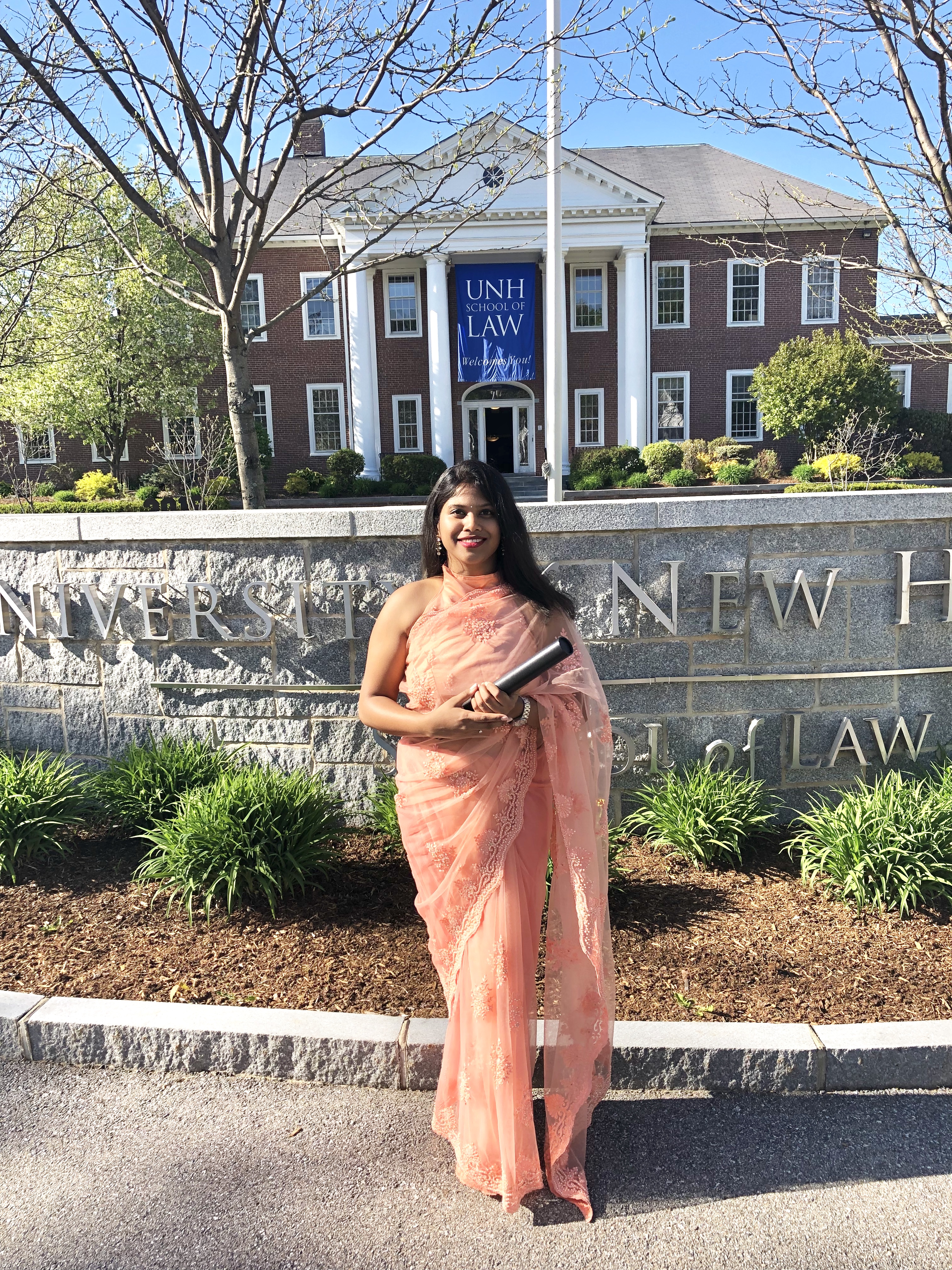
    Stutee Nag, a 2012 graduate of Panjab University, is currently working in New York City.  After five years of working as a counsel in India, Stutee enrolled for the LL.M. in Intellectual Property at the UNH Franklin Pierce School of Law. 
    Stutee Nag

    Stutee Nag, a 2012 graduate of Panjab University, is currently working in New York City.  After five years of working as a counsel in India, Stutee enrolled for the LL.M. in Intellectual Property at the UNH Franklin Pierce School of Law.

    In this FPA, she discusses the differences between working in the US and in India, her own LLM experience at Franklin Pierce, what prospective applicants ought to keep in mind, and a whole lot more.

    Always interesting to learn about the Indian law graduates experiences of working in the US? How has the journey been thus far? What are some of the bigger differences you have noticed in the way in which lawyers work in India and in the US?

    New York City is one of the most diverse cities in the world. Naturally, it has a lot of scope for international lawyers. Unique challenges unfold at work every day and it is very stimulating to perform in a setup which is in stark contrast to the Indian legal system.

    The primary difference between lawyers in India and the U.S. is that in India we still tend to be very “Victorian” in our ways. From our court etiquette to our drafting skills, one can still sense a lingering colonial impact. Lawyers in the U.S. operate in a relatively relaxed manner, which feels like a welcome change. However, whenever I get a chance to speak to lawyers back home, I do notice a shift in the overall demeanour and attitude of the younger lot.

    The functioning of courts is very different here than in India, so that automatically sets American lawyers apart from their Indian counterparts. For instance, we do not have jury system in India. Discovery rules are way stronger in New York than in New Delhi. The amount of time that goes into preparation of one trial is significantly larger than that in India. Fewer cases move up to appellate level and very few cases reach the U.S. Supreme Court.

    “Discovery rules are way stronger in New York than in New Delhi. The amount of time that goes into preparation of one trial is significantly larger than that in India. Fewer cases move up to appellate level and very few cases reach the U.S. Supreme Court.”

    As a result, lawyers put their best foot forward at the trial level. Unfortunately, that does not seem to be the case with majority of the lawyers in India. Instead, we save our very best for the last.

    However, the kind of workload that we, as Indian lawyers, are able to handle at a short notice and our ability to deliver even when under extreme pressure is something that I hope to retain for life.

    Given the specialized nature of your interest, what were some of the schools you had shortlisted during the application process?

    Franklin Pierce is the only law school that I applied to. Before starting the application process, I had various factors in mind and Franklin Pierce met them all:

    • It offers a high-ranking IP program.
    • It has a great alumni network in India and in the U.S.
    • The length of the program is not tediously long.
    • It is cost effective to live and study in New Hampshire.
    • The faculty, the administrative staff and the students are extremely nice.
    • New Hampshire is relatively closer to New York, where I eventually planned to go. So, it was likely for me to get more chances to visit New York even on a short notice. 

    Also, any advice on how one should go about the application itself?

    Knowing what you want and sticking to it, makes all the difference. A strictly defined approach helps save valuable time, money and effort. Applying to ten different law schools and hoping to get through at least one is not the best way forward.

    • Be thorough in your approach. Do the groundwork. Begin your homework at least one year before you hope to join an LL.M. course in the U.S.
    • Narrow down your list of schools based on your requirements.
    • Reach out to the faculty and/or the students of a particular law school. It will give you a chance to fairly assess the functioning of that school and help you take an informed decision.
    • If possible, visit the campus prior to joining the school.
    • Take the application process seriously. Make a sincere effort to write your statement of purpose. Be wary of silly grammatical mistakes.

    How was the LLM experience at Franklin Pierce? What were some of the highlights along the way?

    Franklin Pierce is a tight knit community of students and the faculty. So much so that at times it literally felt like one big family. I spent a very memorable time there and I learnt a lot from this whole experience (and not just about IP law).

    I served as the Student Governor for the LL.M. class of 2018. I participated in moot competitions. I managed to reach out to some good law firms in New York through the faculty. It was a great networking experience altogether. In other words, I built the foundation of my career in the U.S. at Franklin Pierce itself. I made some great friends and I will always look back fondly at the time I spent in Franklin Pierce.

    “I managed to reach out to some good law firms in New York through the faculty. It was a great networking experience altogether. In other words, I built the foundation of my career in the U.S. at Franklin Pierce itself”

    Thanks to the international student advisor at Franklin Pierce, I found wonderful landlords. My house was just a stone’s throw from the law school and things went very smooth for me.

    And lastly, what advice would you have for the Indian law graduate who is considering an LLM abroad?

    Back home we often hear that there is no scope for an Indian lawyer in the U.S. That is not entirely correct. However, having said that, I would also like to add that it is not a cake walk either.

    First of all, get over the notion of “limited scope”. Because what may be perceived as limited scope by some, is exactly what sets you apart. As a lawyer licensed to practice in another country you have rather unique credentials to offer in cities like New York. The key is to create your own niche in whichever field you choose to work in.

    “As a lawyer licensed to practice in another country you have rather unique credentials to offer in cities like New York. The key is to create your own niche in whichever field you choose to work in.”

    Secondly, don’t be in a rush to do an LL.M. as soon as you graduate from your law school in India. It serves more purpose to pursue a master’s degree after having gained some sort of credible work experience. It gives you a much better professional understanding of things and you are probably better placed to secure a job afterwards.

    Be clear from the start as to what your future goals are. That is whether you want to pursue an international career or if you wish to go back to India once you finish your program. There is no wrong choice but a clear-headed approach will make things much simpler for you.

    Don’t be afraid to network.

    Be mindful towards all the immigration mumbo jumbo that you may have to master, especially if you choose to stay in the U.S. after finishing your course. Keep in mind that even after doing everything right there is a huge “luck” factor involved too. One such example is the H1B lottery.

    Lastly, and most importantly, always keep a positive attitude towards things. If you are sincere and professional in your approach, one way or the other, things will eventually work out for you. The secret is to stay motivated.

    Please feel free to reach out to me at sn1056@unhlaw.unh.edu. I’d be happy to help.

  • First Person Accounts (FPA’s) are meant to provide a first-hand account of Indian graduates who have pursued, or are pursuing, a post-graduate course (LL.M. or otherwise) from different universities across the world.

    Vineet Hegde is a graduate of Christ University's School of Law ('16), who enrolled for an LL.M. at the Georgetown University Law Centre immediately after his law degree.
    Vineet Hegde

    Vineet Hegde is a graduate of Christ University’s School of Law (’16), who enrolled for an LL.M. at the Georgetown University Law Centre immediately after his law degree.  After working for a year in the Commerce Wing of the Indian Embassy in the US, Vineet is now a doctoral researcher at the KU Leuven Centre for Global Governance Studies.

    In this FPA, Vineet shares some of his experiences as an LL.M. candidate at GULC, how one ought to go about LL.M. applications, applying for a doctorate degree, and a whole lot more.

    Given your undergrad experience as a student editor, was an LLM always on the cards as soon as you graduated? Did you ever consider working for a bit before enrolling for a master’s degree?

    Funnily, there was no natural transition from my student editor post to an LLM consideration. I hail from a small town* with minimal/no daily interactions in English, as compared to some of my law schoolmates might have had during their high school.

    My motive behind applying for a law review position was simple – to learn to structure my thoughts in English, be able to draft well, and interact in a coherent manner. This, I thought, would help me in a rigorous learning process.

    “My motive behind applying for a law review position was simple – to learn to structure my thoughts in English, be able to draft well, and interact in a coherent manner. This, I thought, would help me in a rigorous learning process.”

    I was involved in the law review since my second year. My considerations to pursue an LLM became concrete only in my final year. I was assigned to assist the faculty in teaching the first year class. It was rewarding – being able to contribute in igniting a love for the law to a bunch of enthusiastic and bright newcomers. This, took a 180 from my initial career plans – corporate law.

    While for four years I had not considered an LLM as an immediate next step, the teaching experience put me on a definitive path to Masters’. Of course, the law review position reinforced this decision.

    Just sticking with the LLM for a bit, how did you go about selecting just where to apply? Given the specialized nature of your LLM, what were some of the other schools that you considered?

    In choosing a prospective alma mater, it is extremely important to be honest with what you really want from an LLM. Are you planning to transition from working in an Indian law firm to a foreign one through the LLM? (using it as a means to an end); or do you intend to specialize in a subject that you are interested in or try new areas?; or do you want to experience a learning environment outside India? (using it as an end in itself). It all depends on what you want, which, in turn, determines the selection process.

    For me, I was fascinated by both corporate law and international law simultaneously. I mixed these two subject areas and tried my hand at international economic law. It worked well, I participated in a moot, and wrote my bachelor thesis on international investment law.

    I intended to further specialize in international economic law, and took a leap of faith. That’s how I chose my LLM program. My applications were based on the courses the law schools offered. I applied to Georgetown, Columbia and NYU because of international economic law specialization; and Harvard and Yale for international law, and perhaps for the glory.

    A word of unsolicited advice, as I get some such queries about pursuing an LLM: if you feel that you are in a rut / are exhausted with your current job, and think that LLM is the next career option, please give that decision a detailed thought. It’s a problem-solution mismatch. In my personal opinion, they are not the reasons to pursue an LLM.

    While “#traveldiaries” and social events on Instagram feeds of your peers who are pursuing an LLM may sound enticing, the amount of library hours that is also put, does not feature there. If you are indeed fed up, please take a break. Take a trip to a place you have always wanted to go. It would save you an enormous amount of resources.

    “If you are indeed fed up, please take a break. Take a trip to a place you have always wanted to go. It would save you an enormous amount of resources.”

    What were the attributes of Georgetown that got you to finalise on GULC? 

    I narrowed my choice to Georgetown because I felt that to experience trade law and policy, it is important to be where the action is – Washington, DC. Considering trade law and policy is closely intertwined with government actions, there was no better place to be. DC, coupled with Georgetown, offered a wide range of opportunities. The law school is in close proximity to prominent offices – the House and the Senate, the Supreme Court, government offices, international organizations like the World Bank and the IMF, etc.

    Practitioners, policy makers, judges, you name it, they were there. Some also shared personal accounts of their experiences in those offices. Moreover, the level of specialization in courses that were offered, was meticulously crafted to encourage comprehensive learning. Looking back now, it seems like a one-stop shop for all the areas I was interested in.

    Even while applying, were you clear that you wanted to pursue a doctorate degree? Or did you come to this realization only during the LLM course?

    Considering I had not worked after law school in India, I had the excitement of channeling my academic learning into practice. Soon after the LLM, I started work with a highly competent team at the Commerce Wing in the Embassy of India in DC. I assisted the Government of India on trade law and policy. It was an interesting and a privileged job, and I had a lot of fun working on government matters.

    But, I also wanted to keep my academic side active. I got involved with the Journal of International Economic Law published by Oxford University Press – another privileged experience to have had. The journal’s editorial board consists of highly accomplished scholars and distinguished authors in the field.

    So, analyzing submissions, reading editors’ comments, etc. immensely broadened my knowledge. It was a fantastic learning experience. That is when I rediscovered my love for academia. This naturally put me on a path to a PhD.

    And once you decided that you wanted to pursue a PhD, how did you go about choosing thesis guides, figuring out where to apply etc? 

    My research interests revolve around international economic law. So, studying at Georgetown Law and working with the journal editorial team, I was more or less clear about the niche sub-specialized areas of the authors in the field.

    I was looking for PhD opportunities and had a list of thesis guides for the topics I wanted to work on. I also wanted to start working on my research immediately, while taking some classes on methodology, and being involved with other tasks like teaching assistance and moot court coaching.

    “I also wanted to start working on my research immediately, while taking some classes on methodology, and being involved with other tasks like teaching assistance and moot court coaching.”

    Many European schools offer this opportunity, without having to spend much of your time in classroom programs. So, there I was, looking into European schools with a strong background in WTO law.

    What got you to KU Leuven, and how has the experience been thus far? 

    My mentors suggested schools like Leuven, Leiden, European University Institute, etc. that offered a rich research experience. So, there I was – googling “PhD”, “international trade”, “Europe”. The first link was that of KU Leuven’s! They were looking for a candidate with a background in international trade law and sustainable development, specifically to research on Indian approaches to these subject areas.

    After some consultations, and thorough research, Leuven was my natural choice. I was lucky enough not to have gone through a tedious selection process.

    So far, the experience has been truly enriching. I work at the Leuven Centre for Global Governance Studies which hosts numerous researchers from different backgrounds (and not just international law), including, political/social sciences, economics, area studies etc.

    The learning from my peers here has been humbling, and has broadened my vision. You also get the privilege of discussing ideas outside of your comfort zone. My lens of looking at an issue may be completely distinct from than that of my co-workers’. So, it is a highly stimulating environment for research and the exchange of ideas.

    “My lens of looking at an issue may be completely distinct from than that of my co-workers’. So, it is a highly stimulating environment for research and the exchange of ideas.”

    Plus, Brussels is next-door, and Geneva is not too far either (these places matter, especially for trade law). The Centre is vastly international, with researchers from different countries and continents. So, the lunch table conversations are always fun.

    Also, a PhD is a self-development process. It can be extremely challenging in the beginning to self-discipline your work, routine, and lifestyle, if you are used to an office-clock disciplining you. But, it can be an enjoyable experience. You get to (and you need to as well, to keep your sanity intact) expand your hobbies, interests, and meet interesting people.

    I know I have also made some friends for life. I have taken up learning a new language, trying my hand at a musical instrument, abstract painting, reading books in my mother tongue etc. Bottomline: zero regrets.

    How do you think Indian law schools can encourage academic research? Any practices that you think Indian law schools can implement to encourage academia? 

    The main quality for academic research is being curious, and develop the ability to ask questions. In my experience, mere prescription of a book for a particular subject does not help in imparting knowledge. There is also no need to repeat what is already written in the textbooks in class. Most students can read the textbook and comprehend the subject on their own.

    A Socratic method of discussion is needed. Those discussions, with a wide range of reading materials, will inspire students to ask the right questions. Once students have some ideas (even if vague) and questions in mind, it is only a matter of time for the magic to happen.

    Not only should the students be encouraged to research, I also believe that professors should be give more time and opportunity to read, write, and think. The more scholarship faculty members produce, the higher is the quality of discussions in classrooms and on corridors.

    “Not only should the students be encouraged to research, I also believe that professors should be give more time and opportunity to read, write, and think.”

    This way, professors also get time to find high-quality materials, evaluate them, and see what shapes the bright minds in a correct direction. This process is cyclic, and improves the quality of the academic research.

    Lastly, any advice for those Indian law graduates considering a career in the academy?

    A cliché method (that works): Read. Organize your thoughts. Write. Repeat. Introspect whether you love doing that. Voilà! You have your answer.

    Academia can be exciting and challenging at the same time. You may start your day with a brilliant idea for research, only to realize at the end of the day it already exists in the exact form. The whole day might seem like a waste. It might be challenging to make the students understand the simplified version of a complex idea. A whole afternoon may be spent in just thinking about what you might want to research on.

    “You may start your day with a brilliant idea for research, only to realize at the end of the day it already exists in the exact form.”

    On the other hand, you might receive multiple publication offers in a single week, boosting your confidence to the moon and back. Then there will times of self-doubt (whether what you are researching on will yield any positive results; or whether your research will make any difference).

    So, it is extremely important to be tenacious, courageous, and make sure you are constantly aware of your wellbeing. Enjoy the experience not just professionally, but also personally. Godspeed.

    * Sirsi, Karnataka. It is on the Western Ghats belt. Quite picturesque, and untamed. Also, it would not be fun for an academic to write something without at least one footnote.

  • First Person Accounts (FPA’s) are meant to provide a first-hand account of Indian graduates who have pursued, or are pursuing, a post-graduate course (LL.M. or otherwise) from different universities across the world.

    Tanya Kalyanvala is currently enrolled in the Comparative and International Dispute Resolution LL.M. at the Queen Mary University of London.
    Tanya Kalyanvala

    Tanya Kalyanvala is currently enrolled in the Comparative and International Dispute Resolution LL.M. at the Queen Mary University of London. A 2017 graduate of ILS Law College in Pune, Tanya worked in Pune for two years before embarking on the postgraduate degree. In this FPA, we get Tanya to share her thoughts on why one ought to do an LL.M., the pros and cons of a specialised LL.M., her own experiences at QMUL, and a whole lot more.

    Let’s get the most fundamental one out of the way – why an LLM? 

    This question takes me back to an interesting conversation I once had with a Partner at a law firm I interned with. While on the topic of the relevance of an LLM abroad to one’s legal career in India he said “If you really want to do it, just go for it! It’s alright if you don’t have a distinct reason and you are doing it merely because you want to!”

    Turns out, in my case this was the reason!

    Pursuing a masters abroad had always been on the cards because it was just something I always wanted to do! However, that said I was certain I wasn’t pursuing a master’s purely for academic reasons and thus my choice of specialism was one of the most crucial factors that I had to grapple with!

    Not having a distinct passion for a particular area of the law right after graduating, I felt it best to spend some time working and as I had hoped it was really my professional experiences that steered me towards my interest in International Arbitration. Thus, once I found my calling the LLM in arbitration was the most obvious next step for me!

    So, one of the questions we get asked a lot is general versus a specialised LLM – did you ever consider a general LLM? 

    You can already guess the answer to this one based on my first response! But to be clear, the answer is NO! As I mentioned earlier, I was very assertive that an LLM for me would have to be in an area I see myself wanting to practice.

    I always thought that the ones who pursue a General LLM are those who lack work experience and are not certain of what kind of law they want to practice. However, I was surprised to find that a lot of the students pursing the General LLM here are ones who have worked considerably and not necessarily clueless as to their interest in a particular avenue.

    “I was surprised to find that a lot of the students pursing the General LLM here are ones who have worked considerably and not necessarily clueless as to their interest in a particular avenue.”

    So, in respect of a Specialised LLM vs. General LLM, based only on my own experience I’ll say this – it again comes down to the reasons you are pursuing an LLM for. If you are pursuing an LLM purely for academic reasons, aren’t hung up on a particular avenue or have the mindset that studying a divergent set of modules/subjects will aid you in identifying an area of speciality for yourself – a General LLM should fit the bill.

    But, if you are looking at an LLM from the perspective of steering your legal career in a particular direction or to enhance your understanding of a particular area – I would strongly advise taking some time off, researching, interning/working (cannot emphasize enough on the importance of this one), speaking to and connecting with people working in the field, identifying an area and only then pursuing an LLM!

    One stands to gain much more from a Specialised LLM particularly when your heart is set in that field!

    And when it comes to specialised LLMs such as the one you have enrolled in, what should prospective applicants keep in mind?

    The most important thing I would say is to be mindful of your choice of specialism! An LLM is hard work, long hours, endless reading, constant academic discussions/dialogues, academic legal writing (the dissertation/thesis included) that not many of us are used to and all of this revolving around your chosen specialism!

    A word of caution here, merely a vague idea or a floating interest in the subject won’t help you cut it! You are literally breathing and living the subject 24×7, so in order to accomplish all of this pleasantly and not begrudgingly you need to be sure of your inclination towards the subject!

    If you are confused regarding whether or not you should opt for a particular specialism simply ask yourself this “Am I prepared for extensive research and writing about 15,000 words on this particular subject?” that could be a starting point!

    “If you are confused regarding whether or not you should opt for a particular specialism simply ask yourself this ‘Am I prepared for extensive research and writing about 15,000 words on this particular subject?’”

    Another thing to be mindful of while choosing a University for a particular specialism is definitely comparing the kind of modules/subjects taught by different universities offering the same LLMs. Of course, you will find plenty that overlap however, if you are keen on a particular subject in your chosen specialism it might be quite disappointing to find out later that the University doesn’t offer that subject.

    To illustrate, as a part of the Arbitration (Comparative and International Dispute Resolution) LLM, QMUL offers modules in Energy Arbitration, Construction Arbitration, Investment Treaty Arbitration, etc. but does not have a module on Sports Arbitration and for someone who is keen on a particular speciality in an area of speciality – that might be a dealbreaker!

    Also familiarize yourself with the course structure – some universities are wider in their intake of students and thus follow a lecture based system of taking classes. However, there are some universities accepting only a handful of students and the classes in those cases are designed to be a lot more intensive and interactive and ultimately you must be true to yourself and decide which course you are best suited for.

    Lastly, probably an obvious one but I’m going to say it anyway – research the faculty for the particular courses. You might find that a particular author/academic/professional whose work you have been following or particularly appreciate maybe a faculty at one of the Universities you choose to apply to and in addition to that being a major highlight of your LLM experience, knowing the same helps in narrowing down the choice too!

    Apart from the LLM course itself, how do you think candidates can make the most of their time? 

    Well, participating in moots, writing research articles, extra-curricular activities and internships are a given! But other than that, look for opportunities that can help diversify your experiences and this doesn’t necessarily have to be related to the law! For example, I am a member of the ‘Design the Law’ group at ‘qLegal’ that is a legal clinic run in association with QMUL.

    The clinic runs various programs such as Student Adviser, Street Lab, etc. of course you have to apply for the position you are interested in but not all of the work/ activities are typically lawyer/law student centric. Each position involves different activities such as working with tech start-ups for legal advisory work or teaching/coaching children in state-run schools or as in my case learning about innovation in the legal space and participating in hackathons!

    As alluring as the legal advisory work and possibility to work with actual clients sounded, I chose ‘Design the Law’ because it presented the possibility of doing something I had never done and probably may never get a chance to do! My experience with the clinic enabled me to collaborate with some really interesting people, participate in projects that I had never even heard of before and introduced me to a whole new spectrum of legal design thinking and potential job avenues.

    “My experience with the clinic enabled me to collaborate with some really interesting people, participate in projects that I had never even heard of before and introduced me to a whole new spectrum of legal design thinking and potential job avenues.”

    Thus, I would firmly recommend including researching about such opportunities in your law school/LLM research!

    Once you start working as a lawyer, you will have a lifetime of research and drafting and negotiations and real-world mooting – now (i.e. while pursuing the LLM) would really be the time to take up something different.

    You will be surprised how some of these unconventional experiences can aid you both personally and professionally!

    What have been some of the more challenging and rewarding aspects of the LLM experience that are not directly related to the classroom? 

    I think ‘Effective Time Management’ is the greatest challenge for any LLM student. While I was working, I used to often joke that if there could ever be 48 hours a day it would definitely be at the behest of lawyers!

    However, I will now broaden that spectrum to include LLM students as well! There are classes, submissions, readings, events/seminars, guest lectures and you want to make the most of everything and coupled with that of course is the bulk of domestic chores that you have no one to turn to for!

    “Planning for an LLM feels like an eternity but the LLM itself goes by in the blink of an eyelid! “

    And the sad part is by the time you get a hang of things and learn to better manage your time it’s all nearly over! Planning for an LLM feels like an eternity but the LLM itself goes by in the blink of an eyelid! So, accept that as much as you may desire to, there is absolutely no way you are going to be able to participate in everything! Having a list of priorities surely helps manage your time better!

    As for the rewarding element, as much as I would like to talk about our phenomenal faculty at the School of Arbitration, since you emphasize on the ‘out of classroom’ perks I’d say the most rewarding element personally for me has been the ability to revisit and refine my views of the working of my own jurisdiction. Being exposed to the nuances of different legal systems first hand has been instrumental in helping me put certain elements in better perspective and develop a more just view I’d say of certain aspects, particularly in the field of arbitration in India. This change of mindset is not something I could have ever arrived at without having gained a truly holistic and international exposure.

    “As most of our professors rightfully keep reiterating, we must look at each other not merely as classmates but also as future colleagues.”

    From a professional perspective I’d say one of the major takeaways of being on an LLM program is like attending one of those networking events where at the end of the day you have made several meaningful connections! As most of our professors rightfully keep reiterating, we must look at each other not merely as classmates but also as future colleagues and for those who are particularly keen to work in the international sphere you will now, surely know of one lawyer at least across ten countries at the very minimum!

    And, since I asked this of your sister as well, what advice would you have for the Indian law graduate who is considering a master’s abroad?

    I would say timing is a very crucial element while planning an LLM. Definitely having gained some practical experience particularly in the area of your specialism helps you to connect better and surely enables you take back a lot more from the course, as is certainly true for me!

    However, I am sure that those coming right after graduation would probably argue otherwise!

    Thus, I’d say this living abroad stretches far beyond adjusting merely with the time difference, the weather, the food, the culture, the lifestyle, at times the loneliness and that coupled with the challenge of pursuing an education in a system you are totally unfamiliar with can really be overwhelming! Hence a certain level of mental preparedness on your own part is also something that needs to be factored in!

    On a lighter note, I’d say that whenever I was generally asked for advice by juniors particularly whist working I used to always say that a career in law is like the ‘make your own meal’ kind of option you get at some buffet counters – there is no such thing as a ‘one size fits all’! What worked for someone else may not necessarily work for you; the same logic applies for an LLM as well!

    Just because someone became a senior associate in an Indian firm after pursing an LLM abroad or got an international placement after pursuing an LLM does not guarantee the same results for you.

    “Just because someone became a senior associate in an Indian firm after pursing an LLM abroad or got an international placement after pursuing an LLM does not guarantee the same results for you.”

    Therefore, viewing an LLM purely as a means to an end and not as an end in itself is something I wouldn’t advise! You may have similar reasons for pursuing an LLM, but find your own reason no matter what it maybe and own it!

  • First Person Accounts (FPA’s) are meant to provide a first-hand account of Indian graduates who have pursued, or are pursuing, a post-graduate course (LL.M. or otherwise) from different universities across the world.

    Aishwarya Mysuru Sagar

    Aishwarya Mysuru Sagar recently graduated with an LLM in Intellectual Property from the University of New Hampshire Franklin Pierce School of Law. In this FPA, the 2018 graduate of JSS Law College, shares her reasons for applying for an LLM abroad, the LLM experience at Franklin Pierce, some advice for prospective applicants and more.

    You enrolled for the LLM right after your undergraduate course. When did you start the application process, and how early would you recommend applicants to start?

    I decided to do my LLM course right after my undergraduate course for various factors. I would like to add that I started giving [the LLM] some thought around the 3rd year, and it took a long time to reach a firm decision.

    I started applying when I finished my 9th semester as I opted for Fall opening which was approximately 8-9 months before the academic start. I shall strongly recommend this time frame for the applicants since that’s when the Universities start their application process either for the Fall/Spring term.

    “Apply as soon as the application process starts.”

    I would also advise the applicants to be never late for the application process as it takes away their chance of getting good scholarships even if they have high academic records. Apply as soon as the application process starts.

    You opted for a specialised degree – what were some of the other schools that you applied to? And what got you to narrow down on Franklin Pierce?

    I chose Intellectual Property Rights as my LLM specialization. I sent out applications to very few US law schools along with Franklin Pierce and received my acceptance offer from all the universities. The other schools were Dayton School of Law, the University of Cincinnati College of Law and the University of Illinois College of Law.

    The prime facts that narrowed me down to Franklin Pierce were its strong academics for IP with extensive courses, and the school’s history. The law school has been ranked 5th amongst the top 10 law schools for the IP program in the US and their strong faculty. Also, Franklin Pierce had been a dream law school for me and my first preference from the initial days of my research relating to IP law schools.

    “Franklin Pierce had been a dream law school for me and my first preference from the initial days of my research relating to IP law schools. “

    Any advice on the application process itself?

    This is the utmost important stage where the applicants shall have to set all documents right. It could be from mailing the required documents to LSAC, writing your own SOP precisely and lastly looking out for the scholarships.

    Please do write your SOP with honesty; write about yourself and your future plans. Remember that the SoP represents you in your absence.

    Once you have shortlisted the desired Universities, start working on the further requirements. Accumulate the transcripts, degree certificate, passport and recommendation letters from the faculty. Also, do not delay mailing the documents to LSAC, which is very important. Lastly, keep a track of the deadlines.

    Did you apply for/receive financial aid?

    Yes, I did apply for financial aid and received it from Franklin Pierce. The financial aid is usually based on merit and overall performance of the applicant in their undergraduate course, and work experience.

    How was the LLM experience at Franklin Pierce? What were some of the most exciting or challenging aspects of the LLM experience?

    My experience was a dream come true since I always wished to pursue my masters in abroad law school and particularly at Franklin Pierce. It was balanced with realistic and theory blended courses throughout. I participated in all lectures where I had the privilege of listening to speakers from all over the US.

    The most exciting aspect was when I took a course taught by Mr. Micky Minhas (Vice President & Chief Patent Counsel at Microsoft), who’s also an alumni. Through his course, all the students had the privilege of having conversations with the Chief Counsel/Patent strategists of Apple, Samsung, Rockstar and Johnson & Johnson through video calls.

    “The challenging part was to cope up with the whole system and getting acquainted with a lot of courses since it was a lot to cover over a year program.”

    The challenging part was to cope up with the whole system and getting acquainted with a lot of courses since it was a lot to cover over a year program. I am extremely proud to have attained my degree from Franklin Pierce which is a highly respected institution globally for IP.

    Given the short length of the course itself, how do you think LLM candidates can make the most of the course?

    Most of the LLM programs are designed for a year which is quite a short term for Masters, but on the bright side, you will get to learn a lot from the several courses being offered by the law school.

    It’s a roller coaster ride as it’s for one year that allows a person to grow personally and achieve great heights in the program. The best part about the Masters is the networking that the candidates get to do and a huge amount of exposure. I would like to tell future candidates to make the most out of the program and utilize the resources available.

    “The best part about the Masters is the networking that the candidates get to do and a huge amount of exposure.”

    Amidst the tight schedule, you’ll also get to have co-curricular, school community’s activity and cultural festivities in every university which will fade away the homesickness.

    Lastly, any advice for the Indian law graduate who is considering a master’s abroad?

    There are several scholarships and funding opportunities available for the students. It entirely depends on the students how they will get it through their application process and SOP.  The main factor is getting the financial options in order. The scholarships play a vital role, so keep in mind every factor, and then go for the Masters.

    Don’t be under the impression of getting a job as soon as you finish the Masters, it’s difficult to have a permanent job right after the masters. I would conclude by saying there are very few job opportunities for foreign LLM graduates in the US as per my knowledge.

  • The Admission Interviews, are meant to provide insights into LL.M. admissions right from the law school itself. The primary idea behind this series is to provide that little bit of extra information that may not be available on the law school’s website.

    In this edition, we speak with Professor Joel P Trachtman, the Executive Director of the LL.M. programme at The Fletcher School, Tufts University. In this interview, Prof. Joel shares his thoughts on what makes the Masters of Law in International Law at Fletchers a unique programme, the benefits of the LL.M. and a whole lot more.

    Professor Joel P Trachtman
    Professor Joel P Trachtman

    A Fletcher alum, Deborshi Barat, had spoken about the collegiality of the Fletcher ‘mafia’ – nomenclature aside, how has the international network of Fletcher alum helped LL.M. graduates? 

    Every year alumni help current students by mentoring them, helping with networking when students are job searching, and coming to campus to given academic lectures as well as share advice about job searching and career progression.

    Alumni also sit on panels and network with students during our annual career trips to Washington, D.C. and New York.

    “Fletcher is a very social school, and students overwhelmingly enjoy their time here and keep in touch with classmates and fellow alumni after they graduate.”

    Fletcher is a very social school, and students overwhelmingly enjoy their time here and keep in touch with classmates and fellow alumni after they graduate. They’re always happy to hear from current students and help folks out as their careers are getting started.

    What are some of the characteristics that make for the ideal LLM candidate at the Fletcher School of Law?

    An ideal candidate has the following characteristics:

    • Is planning on a career in international law, sees the benefit of Fletcher’s interdisciplinary approach, and connects their career goals to the education offered at Fletcher.
    • Has some work experience or extensive internship experience, preferably but not necessarily in the area of international law.
    • Has done well in an LLB or JD program, and has taken some international law coursework.

    Students are evaluated on a holistic basis, so strength in one of these areas could outweigh relative weakness in another. For example, a younger student with less work experience who graduated at the top of his or her class and has a keen interest in international law would still be a strong candidate. Similarly, a more experienced candidate with great work experience could make up for less competitive grades.

    “A more experienced candidate with great work experience could make up for less competitive grades.”

    When it comes to the application process, could you share some successful examples of Essay 2? More specifically, the question relating to “home town”?

    We aren’t able to share student application materials, but successful essays often combine a person’s insights and take-aways about conditions in their home town with global issues and/or their motivation to study international law.

    What is the average amount of financial aid that is offered to LL.M. candidates? 

    The middle 50% ranges from $10,000-18,000. We take into account financial need as well as a prospective student’s competitiveness as an applicant.

    Lastly, in your experience, what have been some of the most valuable aspects of the course based on your interactions with alum? 

    Students in the Fletcher LL.M. program report that the program stands out for a few reasons.

    • The interdisciplinary nature of the program. Students can take classes in our international affairs and international business/economics departments, and report that those classes allow them to complement their legal students in a powerful way. For example, a student focusing on human rights could take a non-law course on migration or gender issues which would help inform their studies in law.
    • The level of mentorship by faculty members is always valued by the students. The program is intentionally small and ranges from 15-20 students per year. Students have both an academic advisor and a thesis (we call it a “Capstone” at Fletcher) advisor from the law faculty, and have the opportunity to get to know their professors on a personal level. Students often work as research or teaching assistant to faculty members as well.
    • The great academic environment available in Boston. Fletcher offers a wide variety of extracurricular activities, conference, and guest speakers on campus. Given our location outside Boston, students often have the opportunity to participate in activities at other area schools, such as Harvard and MIT, and can even cross-register for a class or two at Harvard if they like.