• First Person Accounts (FPA’s) are meant to provide a first-hand account of Indian graduates who have pursued, or are pursuing, a post-graduate course (LL.M. or otherwise) from different universities across the world.

    Kirthana S. Khurana is a 2018 graduate of the Campus Law Centre at the University of Delhi, who then went on to enrol for the Masters Degree in Corporate Law offered by the University of Cambridge.  She is currently a lecturer at Jindal Global Law School.
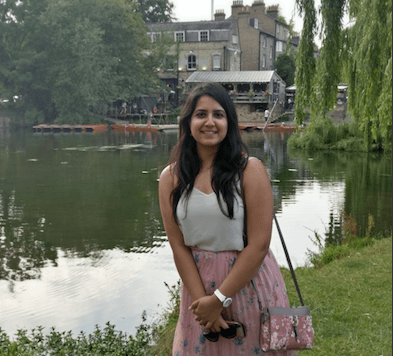
    Kirthana S. Khurana is a 2018 graduate of the Campus Law Centre at the University of Delhi, who then went on to enrol for the Masters Degree in Corporate Law offered by the University of Cambridge.
    Kirthana S. Khurana

    What got you interested in the study of law? And did you ever consider the undergraduate law course? 

    Hailing from a family in which my grandfather was a judge and my father a civil servant, I was always interested in the field of law. However, I also developed a keen interest in business and commerce in the penultimate years of school. I did consider undertaking an undergraduate law course after my 12th grade.

    So, I decided to appear for many law entrance exams (as my back-up options though!) post my board exams. My CBSE Class 12 board exam results and CLAT result were declared on the same day. I topped the Commerce stream in my city by securing an aggregate of 97.2% and was able to achieve a decent rank in CLAT as well.

    Since I had always dreamt of studying at the University of Delhi, I did not want to let that opportunity go. I, therefore, opted to pursue a bachelor’s degree in Commerce at Shri Ram College of Commerce (SRCC). In college, my love for the law was rekindled and I realized that I was inclined more towards subjects like Corporate Law, Corporate Governance and Competition Law, and therefore, I envisioned a career in the same. Consequently, I decided to pursue a three-year degree in law at Campus Law Centre, University of Delhi post the completion of my bachelor’s degree at SRCC.

    Looking back, how do you think your undergraduate studies shaped your LLB experience?

    At SRCC, I was surrounded by students who had been toppers and all-round achievers throughout their school lives. More than the exposure to the studies of commerce during my college days, I learnt how to handle competition in real life and make a differentiated presence among exceptionally gifted students.

    I learnt the values of hard work, determination, time management, and perseverance. These virtues stood by me as I subsequently moved to law school and enabled me to focus and excel academically at college.

    Additionally, a thorough understanding of subjects like accountancy, economics, international business, and financial management helped me understand the nuances of commercial law subjects at the law school in a profound manner. It helped me perform well in my LLB and masters’ exams, and I still make use of this knowledge when I conduct classes of company law as a lecturer.

    What prompted you to look at a master’s abroad? 

    Since I had studied at the University of Delhi for six years, I wanted to top that up with quality exposure at one of the top law schools in the world for my master’s course.

    Moreover, I always believed that to become a successful academician, it was imperative to get adequate international exposure for a broader vision about the subject I intended to teach.

    I wanted to inculcate the teaching methods adopted by leading corporate law professors and mould my style of teaching accordingly.

    The MCL is a fairly specialised course – what got you to look at this course, and what were the other programmes that you were looking at? 

    I applied to Oxford, Cambridge, National University of Singapore, LSE and UCL, and I received offers for almost all the programmes I had applied for.

    However, the MCL was always on top of my list of preferences because of its unique pedagogy.

    What attracted me the most about it was the ‘Deals Course’ in which the students were made to work on actual commercial deals, negotiate for their deemed clients and finally interact with the lawyers from leading law firms in the UK, who were actually involved with the specific deals.

    Also, the smaller cohort of students (18 in my batch), course modules, networking opportunities being offered, and the faculty members on board were the other factors that gravitated me towards this course.

    Did you apply for/receive financial aid? 

    I had applied for financial aid, but since MCL was a relatively new course, not many financial grants were available for the same.

    Just one question on the application process, and one I am sure you get asked a lot – any suggestions on how to approach the “Reasons for Applying” requirement?

    Just be honest! The admission committees of all universities screen thousands of applications every year; so, a generalised answer would not take you very far. The entire application process is all about introspection; you need to tell your own story. It is about identifying what sparks your interest, and in which field do you see yourself working in.

    For me, it had always been academia, and this was the focal point of all my admission related essays. Since India draws a lot of its corporate law jurisprudence from the UK, I could not think of a better place to understand the roots and practical application of this field of law.

    How was the MCL experience? Any big surprises along the way?

    The MCL experience was indeed splendid. As most of my classmates had worked at leading law firms before coming to Cambridge, I struggled to keep up with class discussions due to lack of work experience, at the beginning of the course.

    This motivated me to go beyond the prescribed reading lists and prepare well for lectures in advance. By adopting a methodical studying schedule, I was not only able to contribute constructively to class discussions but also started enjoying the same.

    The MCL course is more strenuous than the LLM course at Cambridge, as we took six courses against four in LLM, and were examined thrice in an academic term. To be honest, this was extremely stressful at times. My course instructors, however, were always available to help and were extremely encouraging.

    My most cherished memories were the times I spent with my classmates and professors outside the classroom, over multiple pints of chilled beer at pubs, discussing our heritage, culture, and life experiences.

    As an Indian academic, how do you think the COVID pandemic will play out? Any predictions on how Indian law schools will react to these current circumstances? 

    The COVID pandemic has jolted the whole world, and the reverberations are being felt across all walks of life. Yet, in my view, mankind’s eternal resilience would help the world emerge out of this gloom.

    As for its impact over the teaching eco-system, social distancing as an imperative has disturbed the existing situation. But I see the present situation as a blessing in disguise.

    Though all of us are used to the age-old method of classroom format teaching, Indian law schools should now adapt fast and proactively introduce online education in their regular teaching system. Communication-related technology was never this supportive and can be leveraged by universities to great advantage.

    We are now being compelled to discover new ways of imparting knowledge effectively with the use of technology, which is really exciting.

    As we still do not know for how long this pandemic will last, law schools may even consider starting fully-online versions of their regular courses, short-term and long-term, and allow those students to join who may not be able to pursue their regular courses.

    Lastly, any advice for the Indian law graduate who is considering a master’s abroad?

    My advice to people who are thinking about pursuing a master’s course abroad would be to start early. Spend adequate time researching universities and the courses being offered by them. Try to talk to recent alumni and analyse whether their career path aligns with what you have in your mind. Prepare multiples drafts of your admission essays and take feedback before finally submitting them.

    Also, do keep in mind that a few scholarship deadlines close much before the course application deadlines. If you have plans to work abroad after your degree is completed, conduct thorough due diligence about the country’s immigration laws and legal job scenario.

    Finally, just be calm. The application process really tests your patience, so be confident and believe in yourself. Things may not go as per plan at times, but you will always get what is best for you. Good Luck!


    We need your help in keeping this blog alive. If you feel that the content on this blog has helped you, please consider making a donation here

  • The Admission Interviews, are meant to provide insights into LL.M. admissions right from the law school itself. The primary idea behind this series is to provide that little bit of extra information that may not be available on the law school’s website.

    In this edition, we speak with John N Riccardi, Boston University Law’s assistant dean for graduate and international programs and director of the Graduate and International Programs Office.

    JR Headshot
    John N Riccardi, BU Law

    We try and ask as many people as we can this question – what do you think is the value of an international LL.M.?

    And how does BU Law deliver on this? 

    I believe that there are at least five true benefits of obtaining an international LLM degree from a US law school.

    First and foremost is the fact that a US LLM degree is a highly valued credential in the global legal service market. That’s because the enhanced skills and knowledge base that graduates obtain is immediately applicable to their workplaces, and because the degree enhances graduates’ marketability to potential new employers. It signals rigorous training, maturity and resourcefulness.

    Second, an LLM program can give students training in specialized areas of global relevance. For example, students in our intellectual property law program learn the US perspective on the protection of intangible rights.  Intellectual property doctrines that developed from US law are seen in the IP regimes of many other jurisdictions. Same with bankruptcy and securities regulation.  Our Graduate Program in Banking and Financial Law, which is quite specialized, prepares students for advancement in the field of financial services, a global industry heavily influenced by US based regulations.

    Many schools such as Boston University offer both specialized programs and also a general program which enables students to take a broad range of courses that touch on a number of different practice areas, so students can, for example, combine intellectual property with corporate and transactional law.  We call our general program the LLM in American Law Program. Students have access to the entire JD curriculum, which features over 200 classes, including, of course, foundational US doctrinal classes, such as constitutional law, civil procedure and evidence.

    Third, an LLM experience will give a student a solid background understanding of what I may call the “US lawyering style.” How do US lawyers go about representing their clients’ interests? We offer in classes which students work their way through real world business deals from the beginning to the end of the semester.  They engage in role-plays — drafting, structuring and negotiating the deal terms of a transaction.

    Fourth, an LLM experience is a once-in-a-lifetime opportunity to create and expand one’s global professional network. The faculty, staff and students you meet during the year is just the beginning.  Our alumni network consists of roughly 24,000 alumni in over 100 countries. It is very common for graduates to contact me, seeking professional references in specialized areas in various countries. I am pleased to help by referring a fellow graduate.

    “Our alumni network consists of roughly 24,000 alumni in over 100 countries. It is very common for graduates to contact me, seeking professional references in specialized areas in various countries.”

    Finally, another major benefit is how the experience can directly enhance one’s overall communication skills in the law. There is a premium on effective communication skills in the practice of law in the US, if not globally, and we take that training very seriously – developing students’ persuasive advocacy skills,  in writing and orally. Even if a student is perfectly fluent in English, as many of our students from India are, learning how to effectively communicate legal concepts in the US tradition requires specialized training.

    Legal writing in the US is very different than in India. If a student anticipates engaging in cross-border work, understanding and being able to communicate successfully and effectively is a highly valued skill.

    As the former chair of AALS’s section of graduate legal education, how do you think US law schools are going to adapt to the changing circumstances? Do you think most will opt for an online Fall semester?

    First and foremost, schools will be focused on safety – for their students, faculty and staff. At the graduate level – meaning, LLM programs in the US – you will see most programs follow the lead of the school’s JD program, which in turn, will likely follow the mandates of its respective university’s leadership (if the school is part of a larger university, as we are), which will be consistent with the policies and procedures that state and local public health officials put in place.

    I cannot say what most schools will or won’t be doing, as the situation is very fluid.  Many decisions will be made later in the summer, perhaps in early July.

    What I can say is that more than a few schools are preparing to offer live classes that will also be accessible remotely through asynchronous and asynchronous technologies to accommodate students who cannot make it to campus, either because their visas are delayed, or are immunocompromised or quarantined.

    This is known as a hybrid model.

    That’s BU Law’s current plan – to be able to engage fully with enrolled students if they are not able to physically be inside the classroom.

    I am also curious to know what you think about online learning as opposed to the more traditional classroom based learning experience? 

    We make an important distinction between “online learning” and “remote learning.”  In general, an online class is one that is specifically made for distance learning. The presentation of the content is built from the ground up, leveraging the use of educational technologies and, often, the expertise of instructional designers to support the instructor’s pedagogical goals.

    The online classes we offer in our Executive LLM in International Business Law Program are developed this way.  In general, remote learning refers to giving students who are not in the classroom the same pedagogical experience that the live students are experiencing, or something that is close to it. It involves interactions between the classroom students and the distant students and between the processor and distance students, all on equal footing.

    So remote learning is much closer to the classroom experience taking place as opposed to a purely online class — because it is based on the classroom experience. Through Zoom and other synchronous technologies, faculty can call on students just as readily as if the students were sitting in the classroom.

    Things get more complicated in our clinical programs, where students work on behalf of real clients in supervised settings – but we have found that some experiential courses, say, negotiation for example, can effectively be delivered to remote students. That’s how negotiations happen in the real world after all, via distance.

    What are the changes that BU Law has implemented over the past few months, and will continue to do so in the near future? 

    When the school was required to deliver its classes remotely during the last portion of the spring semester, the faculty quickly got up to speed on the available technologies – namely Zoom and Blackboard. This includes many instructors who had very little prior experience with these tools.

    I hear that as we revert back to classroom-based teaching, many faculty members are interested in incorporating the technologies in their regular classes,  to create “flipped” classes whereby much of the background learning can take place outside of class, leaving more time in the live classroom for discussion and debate.

    So, some of the lessons learned over the past few months may have a more permanent place in our instructional portfolio.

    Given the short nature of the course, how do you think candidates can derive the maximum benefit from the LLM experience? 

    I get this question a lot. The answer is to resist the temptation to spend every waking moment in the library. The LLM experience is a once-in-a-lifetime chance to immerse yourself in a learning experience that goes way beyond what’s in a book.  Get out and get involved – with student organizations, with networking  and professional development events.

    “The LLM experience is a once-in-a-lifetime chance to immerse yourself in a learning experience that goes way beyond what’s in a book.  Get out and get involved “

    Get to know your teachers outside of class. When we ask graduates about the one thing they’d do differently if they could do it all over again, they often say just that – “I’d spend less time studying in the library.’

    What advice would you have for the Indian law graduate who may be contemplating applying for the BU LLM? 

    Be realistic about post-graduation permanent job opportunities in the US.  Students who want to stay past the end of their period of Optional Practical Training need to have their H1-B visas sponsored by an employer, and also go through a lottery system.  While a good number of our Indian students have made it through this process, there are tremendous uncertainties.

    The hit that the legal services market has taken as a result of the coronavirus will create even more challenges for students seeking to stay for the long-term.  Students should not do the LLM if their main driver is to find a permanent legal job in the US.  The JD degree is the credential for that.

    “Students should not do the LLM if their main driver is to find a permanent legal job in the US.  The JD degree is the credential for that.”

    Some schools, like ours, have policies that allow LLM students to apply to and transfer into the JD program on an advanced standing basis.  If admitted as a transfer student, they would be able to complete the JD in only two more years of study.

  • First Person Accounts (FPA’s) are meant to provide a first-hand account of Indian graduates who have pursued, or are pursuing, a post-graduate course (LL.M. or otherwise) from different universities across the world.

    Bhavinee Singh completed an LL.M. from the Emory University School of Law in 2018. Since then, the NIRMA University law graduate has worked with an advocacy group working on child rights, and is currently an Assistant Lecturer at Jindal Global Law School.

    6bc83f71-e88a-4bb1-ba80-1caddb524b88
    Bhavinee Singh (LLM, Emory University School of Law)

    You opted for a master’s right after your undergrad. Did you ever consider working for a year or two before the master’s?

    I developed a keen interest in the study of Human Rights Law and International Humanitarian Law (IHL) sometime in my fourth year of Law School. It was out of this interest that I decided to go for my LLM soon after graduating.

    The choice of Emory University is an interesting one – what were some of the factors you considered while selecting where to apply, and why narrow down on Emory? 

    My first instinct was to look at Universities which were offering Human Rights and IHL related specialisations. What stood out for me in Emory was the extremely impressive profiles of the Professors. Some of them were Professors whose writings were part of my curriculum during undergrad.

    Another aspect was the range of practicum courses offered by Emory. The exposure to practicum courses leads to hands on experience with real time projects from international organisations and opens up a world possibilities that would generally remain unexplored as students. In addition to this, they have a clinical course in IHL, and the research work they did really sparked my interest.

    Lastly, what really mattered was the diligence in responding displayed by everyone at Emory. They were very patient with me through all my queries and helped me at each step of the admissions process.

    Did you apply for/receive financial aid?

    I was offered scholarship by Emory which helped me meet my academic and living expenses in US to a very great extent.

    How was the LLM experience at Emory? What were some of the more rewarding aspects of the LLM experience?

    I witnessed a sea change culturally and academically in the scholastic environment at Emory.

    As part of the International Human Rights Law practicum, I completed research work for the United Nations Working Group on Enforced or Involuntary Disappearance. As a member of the International Humanitarian Law Clinic, I got the opportunity to work with International Committee of the Red Cross (ICRC) on their ‘IHL in Action’ Project.

    I also worked as a Research Assistant to Professor Johan D. van der Vyver, which offered me a completely new perspective to sincere research. It also helped me hone my skills and work on my methodologies of research and analysis.

    Further, as part of the externship opportunities offered by Emory, under which they offer credits for part time internships, I worked at The Carter Center with their Human Rights Program. Here, we were received by Former US President Jimmy Carter and his wife, Ms. Rosalynn Carter with great warmth and bonhomie.

    I was also the recipient of the David J. Bederman Fellowship Award in International Law in 2018. Pursuant to receiving this fellowship, I attended the Summer Course on Public International Law at The Hague Academy of International Law.

    All of these experiences immensely enhanced my overall outlook about legal education. I sometimes think back to that time and wonder how these opportunities did not just amplify my knowledge base but added so much more perspective to my being. The cultural exchanges, casual conversations and the lifelong friendships with people from across the world is something I will treasure forever.

    Along with these life changing experiences, the city of Atlanta has my heart. Diversity combined with vibrance defines Atlanta which breathes life into an individual’s academic and professional aspirations.

    After the LLM, you decided to join an advocacy organisation focusing on child rights. How did you find your LLM helping you in this position?

    At Emory, I specialised in Human Rights Law. With this specialisation, I was exposed to an extensive academic and scholarly understanding in this field including child rights. Having a holistic understanding of the national and international law framework in terms of child rights placed me in an advantageous in the performance of my duties.

    You are a faculty member at Jindal Global Law School – how do you think the Covid pandemic is going to play out for Indian law schools? Any predictions on what changes Indian law schools will have to introduce when it comes to teaching pedagogies?

    The pandemic has definitely changed our teaching pedagogies. With the switch to virtual classrooms, we have had to rethink our ways of student engagement in discussions and discourse through each classroom session. Students and faculty members are all trying their best to work through this time.

    In terms of what Indian Law Schools have to seriously deliberate is how to combat the differential impact of the shift to online teaching. There are students who face deficiencies in terms of infrastructural resources, such as the lack of internet facilities and do not necessarily possess the connectivity and equipment required for such learning. There is a need to develop a robust strategy for this and the responsibility rests with the Law Schools.

    Lastly, any advice for the Indian law graduate who is considering a master’s abroad? 

    Honestly, it all boils down to the right attitude and whole hearted zeal. My first recommendation is to start early and DO YOUR RESEARCH. One has to be thorough about the course they are interested in, the Law School they want to study at and look up every aspect related to it.

    Start reaching out to alumni and current students from that University and learn about their experience. Look at the courses they offer and assess for yourself if they complement your interest.

    Enjoy the journey and make the most of it!


    We need your help in keeping this blog alive. If you feel that the content on this blog has helped you, please consider making a donation here

  • First Person Accounts (FPA’s) are meant to provide a first-hand account of Indian graduates who have pursued, or are pursuing, a post-graduate course (LL.M. or otherwise) from different universities across the world.

    Pooja Damodaran is a 2019 graduate of the School of Excellence in Chennai.  Last year, she enrolled for the International Commercial Arbitration Law LLM programme offered by Stockholm University.  It was the only programme that she applied for. In this FPA, Pooja talks about the ICAL experience, living in Stockholm, and how one ought to go about the application process.

    Pooja Damodaran has enrolled for the International Commercial Arbitration Law LLM programme offered by Stockholm University. 
    Pooja Damodaran ICAL LLM candidate

    (Edited excerpts)

    At what point of time as an undergraduate student did you decide on an LLM? And when did you start the application process?

    I graduated with B.com, B.L (Hons) from Dr. Tamil Nadu Ambedkar Law University, School of Excellence in Law, Chennai in 2019. I started working on my LLM application process from December 2018. I had a basic checklist and deadlines.

    Did you ever consider gaining some work experience before applying?

    To answer the question, no. I believe gaining work experience is not mandatory for an LLM. However, there are a few ways to look at gaining an LLM. It could be purely for academic purpose or job prospective or to develop research abilities.

    Mine was quite straightforward, having extensively participated in moot court competitions (14 National Moot Court and 1 International Moot Court competition) and interning for about 5 years in various disciplines of law. I wanted to learn more before I stepped into litigation practice.

    Given the specialised nature of the LLM, what were some of the other schools that you shortlisted? 

    I decided to a specialised masters because of my strong interest in dispute resolution and arbitration. I want to establish an exclusive career for myself in arbitration. When I realised an LLM would be my first step towards this goal, I checked for Global Arbitration Review (GAR) LLM ranking and the International Commercial Arbitration Law programme founded by Patricia Shaughnessy was ranked No. 2 globally for arbitration courses.

    I applied only for Stockholm University, as it was my desired school for Arbitration. I believe applying to various schools is a good approach to short-list. But, my strategy was to apply to my #1 priority and if I don’t make it, I will apply for others schools as per GAR ranking in the following years (after gaining work experience). I am thankful, I did not have to. First time was my charm.

    Any advice on how to go about the application process itself?

    The absolute essentials irrespective of where you apply for LLM are:

    • English Requirements- (IELTS, TOFEL, PTE) which ever test is required by your university. Pro tip: Do as many practice tests as you can before the exam!
    • Statement of Purpose- Pro tip: the best paper is always rewritten. Do not expect your first draft to be the one to get you into a dream university. Keep your writing short and really focus on the purpose. Why you feel this course will benefit you? Why should you be the selected candidate over others? What do you intend to do after this course? Also, highly recommend to get someone to proof read your documents. Trial and error is a method which works like magic.
    • Letter of recommendation- Pro tip: Real content is always better than superficial letters. Ask for recommendation letters from teaching staff/colleague/seniors who know you very well. The secret of a good recommendation letter is how well the mentor knows you and your abilities. Remember the admission committee would have seen many standard templates. So, in order for you to stand out, make sure your referee adds your skill sets, your abilities and what drove your interest to the program you are applying for.
    • Time management- Pro tip: apply for universities before well before the deadlines. The later you submit, the lesser chance your application stands. Collect necessary documents – marksheets, provisional certificates, passport scans, other credentials a week before you apply.

    Did you apply for/receive financial aid? 

    No, I did not. One of the special features of the ICAL program and studying in Sweden is, studying with merit. The program fee is least 3/4th times lesser than any LLM aboard. You can find out more information on scholarships for ICAL here.

    How was the ICAL experience? What were some of the most valuable aspects of the course? 

    One of my favourite quotes from T.D. Jakes quite aptly describes my LLM experience, “It doesn’t matter where you start, it matters where you finish.”

    The ICAL experience was absolutely terrific. I would recommend anyone who is aspiring to gain international commercial arbitration knowledge in depth to purse the ICAL program. Some of the highlights for me was, the program structure, we have intense academic requirements. The number academic of assignments,  multiple choice questions and final exam ensures you understand the international commercial arbitration law.

    However, the mock trial week with leading law firms in Sweden (Vinge, Mannheimer Swartling, Baker Mckenzie and Roschier) was the cherry on the cake. It was a great way to sharpen our practical skills.

    The second semester was all about advance international commercial arbitration law with exposure to various lectures, Stockholm Chamber of Commerce and a final thesis. I am currently writing my thesis under my supervisor, Dr. Crina Baltag.

    I must mention, Stockholm is a city built on water and a wonderful destination in the world. It is a Scandinavian city and sees sub-zero temperatures even in summer. So, while your stay here, you have a lot to explore. Also, the friends you make in the program are your real assets. It is a class of top 25 smart minds globally, and I can assure you, they will be a treasure for life-time.

    Lastly, any advice for the Indian law graduate who is considering a master’s abroad?  

    The dilemma: I believe an LLM or any education aboard would expose you to various perspectives. The biggest hurdle for me was to switch from a common law to civil law background. It is important to debate your investment and prepare yourself for what’s to come. I chose Stockholm and Sweden (SCC) because it is a popular seat for arbitration cases. Also, the ICAL program is world renowned and would be a perfect fit to kick-start my arbitration career.

    When you choose education aboard, be mindful that you always have several hurdles to face, could be visa issues, native languages, academic differences, cultural barriers and even also sudden unprecedented pandemics (like COVID 19). It is important to realise irrespective of your challenges, you will benefit from your experience. To think back, T.D Jake’s quote now makes all the sense.

    Current update: Despite Covid-19, I am currently applying for internships with International Chamber of Commerce, (ICC) Asian International Arbitration Centre (AIAC), London Court of International Arbitration (LCIA) and other renowned arbitration institutions. Also, publishing papers, a recent paper of mine published on the renowned Very Yong Arbitration Blog.

    Final words: Pursue an LLM considering the above-mentioned circumstances, there’s absolutely nothing to lose, but only to again. Wishing everyone with their applications in this tough time, best of luck!

    In case of any queries/advise, you can always reach me via LinkedIn.


    We need your help in keeping this blog alive. If you feel that the content on this blog has helped you, please consider making a donation here

  • Ten scholarships that every LL.M. applicant ought to know about

    Muskaan Wadhwa

    One of the most common questions surrounding a foreign LL.M. is that related to finance. When the tuition alone can touch sixty lakhs, this is quite understandable. One of the more common answers to this question relates to scholarships, and how one can go about applying for them.

    For this purpose, we have compiled a list of ten scholarships that you, the LL.M. applicant ought to know about. Please do note that it is always advisable to go through the individual websites of these scholarships; the list below is meant to be indicative at best.

    1. The Rhodes Scholarship [Website]

    If you’re a student, anywhere across the world, thinking about studying at Oxford University, then you would have definitely heard about the Rhodes Scholarship. Rhodes is not only a gateway to Oxford University but provides life-long access to an extremely supportive international community. Each year, there are 5 scholarships available for India, out which usually 1 or 2 are awarded to law students.

    Eligibility: The applicant must be a citizen of India. PIO and OCI cardholders do not satisfy the Indian citizenship criteria. You must have undertaken formal education in India for 4 years in the last 10 years and must be above 19 years and below 25 years of age. The applicant must have completed their undergraduate degree with a First-Class equivalent.

    Important Dates: The applications open on June 1, 2020, and end on July 31, 2020 (11:59 pm IST).

    Application Process: The applicants are required to submit a personal statement along with six reference letters, a CV, transcripts, and other identification documents. Longlisted applicants are invited to a preliminary interview in New Delhi. Following this, shortlisted candidates partake in a social engagement event and a final interview.

    Expenses Covered: Upto three years of study at Oxford University. Rhodes is not only a full-ride scholarship, but also provides an annual stipend, settling-in allowance, and economy class air tickets.

    Interview/FPA: The 2017 Rhodes Scholar, Vanshaj Jain [SCC Online]

    1. Inlaks Shivdasani Foundation Scholarship [Website]

    Available for universities in America, Europe and UK, the Inlaks scholarship is provided to students with exceptional talents to improve upon their skills so they can be future vehicles of change.

    Eligibility: The applicant must be a citizen of India and must hold a first-class undergraduate degree. Candidates less than 30 years of age who have secured admission in a top-ranking University are eligible to apply.

    Important Dates: Due to the COVID-19 pandemic, the scholarship is not being offered for the year 2020. Scholarships will however be available for the next academic cycle.

    Application Process: The application for the scholarship has to be made online. Two reference letters are mandatory, out of which, one must be an academic reference. The shortlisted candidates are invited for a preliminary interview, followed by a final interview.

    Expenses Covered: The scholarship covers full tuition fees, living allowance, one-way travel allowance and health allowance. The maximum funding given to each candidate is USD 100,000.

    Interviews/FPA:  An FPA with Inlaks scholar, Sagnik Das (Harvard LLM Class of ’19)

    1. Commonwealth Scholarship [Website]

    The Commonwealth Scholarship is available to students hailing from Commonwealth countries to pursue a one-year Masters course in the UK.

    Eligibility: The candidate must be a citizen of India and should have attained 60% in their undergraduate degree to apply for Social Sciences and Humanities programs. A declaration needs to be also provided by the candidates that they will not be able to fund their education in the UK without this scholarship.

    Important Dates: Application portal tentatively remains open between August-October for those applying to the next academic year.

    Application Process: Applicants are required to submit two letters of reference, transcripts, identification documents, and a supporting statement from a proposed supervisor in the UK from one institution named on the application form. A preliminary interview is carried out by the Ministry of Human Resources Development (MHRD).

    Expenses Covered: The scholarship covers tuition fees, economy return airfare, and living allowance.

    1. Chevening [Website]

    A prestigious and competitive scholarship, the Chevening scholarship is awarded to students who showcase leadership potential and strong academic background to study in the UK.

    Eligibility: Candidates must be citizens of India and must have preferably attained 2 years of work experience. They should have applied to three different UK University courses and must have received an unconditional offer from one of them. Candidates are also required to meet the English language requirements.

    Important Dates: Applications usually open in August and close in November, with results being declared in June the next year.

    Application Process: Applicants are required to submit transcripts, English language test scores, two letters of recommendation, and a scholarship essay.

    Expenses Covered: The Chevening is a fully-funded scholarship which also provides for living allowance and travel costs.

    Interviews/FPA: Read Chevening scholar Krishan Insan’s advice here.

    1. Fulbright-Nehru Master’s Fellowship [Website]

    This scholarship is awarded to motivated Indian students who demonstrate leadership skills to study in US colleges.

    Eligibility: To be eligible for the Fulbright scholarship, the applicant must have an equivalent of US’ bachelor’s degree with at least 55% marks, three years of work experience and must have experience in leadership and community service.

    Application Process: Applicants are required to submit transcripts, English language test scores, three letter of recommendations, personal statement, study objectives, and a writing sample.

    Important Dates: Applications open in January with the deadline for submitting the application mid-May. Please note that applications open a year earlier, ie for the academic year 2021-22, the applications will open in 2020.

    Expenses Covered: Funding for tuition, living allowance, J-1 visa support, and accident and sickness coverage are provided for by this scholarship.

    Interviews/FPA: Rupavardhini B.R., a Harvard LL.M. graduate, and Fulbright scholar

    1. The Felix Scholarship [Website]

    Felix Scholarship is available for students from India and other developing countries to get a chance to study at Oxford University, University of Reading, and SOAS, London.

    Eligibility: Academically gifted students who hold a first-class degree from a recognized Indian University are eligible to apply.

    Important Dates: The closing dates for application forms this year was in January.

    Application Process: The applicants can apply for only one of the three Universities. Except for Oxford, a separate form has to be filled to avail the Felix Scholarship.

    Expenses Covered: Felix is not only a fully-funded scholarship but also provides a stipend to cover living expenses, allowance for books, clothes, and a return flight home.

    Interviews/FPA:  Read accounts of previous Felix Scholars here [Felix Scholarship]

    1. The Schwarzman Scholarship [Website]

    The Schwarzman Scholarship is an extremely competitive and prestigious scholarship that aims at introducing young leaders to China and its role in the changing global dynamics. These Scholars can pursue a Masters in Global Affairs at Tsinghua University in Beijing.

    Eligibility: Schwarzman looks for students who are not only academically and intellectually gifted, but also those, who have leadership potential, entrepreneurial spirit, exemplary character, and willingness to understand other cultures. Applicants must be enrolled in an undergraduate degree and should demonstrate strong English skills. They must be above 18 years but should not have completed 29 years of age.

    Important Dates: The applications for the next academic year opened on April 15, 2020, and close on September 22, 2020.

    Application Process: Candidates are required to submit a resume, academic records, two essays, three letters of recommendation, and an optional video.

    Expenses CoveredThe Scholarship cover tuition fees, room and board, travel to and from Beijing, in-country study tour, books and supplies, health insurance, and a stipend of USD 4000.

    Interviews/FPA: Arnaaz Nizami Ameer shares her experiences here.

    1. K.C. Mahindra Scholarship [Website]

    Also popular amongst Indian law students is the interest-free loan scholarship provided by K.C. Mahindra Education Trust to pursue post-graduate studies abroad.

    Eligibility: Applicant must be a citizen of India and should have attained a first-class degree from a recognized University.

    Important Dates: The applications for this scholarship tentatively begin in December or January every year.

    Application Process: Candidates are required to submit an admission letter from the University, Letter of Recommendation, personal statement, transcripts, and a CV.

    Expenses Covered: The Scholarship selects a pool of 50 most deserving students. Out of these, the top 3 are awarded a grant of INR 8,00,000 and the remaining candidates are awarded INR 4,00,000

    Interviews/FPA: Sneha Priya Yannappa(BCL, Oxford University)

    1. Commonwealth Shared Scholarship [Website]

    The Commonwealth Shared Scholarship is a result of a joint initiative between the Commonwealth Scholarship Commission and UK Universities to enable students from Commonwealth countries to study in the UK.

    Eligibility: Candidates must be citizens or should have been granted refugee status by a Commonwealth country. They should also have attained a first-class degree and should meet the English language requirements. Candidates who opt for this scholarship are however required to return to their home country after the course completion.

    Important Dates: Application portal tentatively remains open between August-October.

    Expenses Covered: The scholarship pays your tuition fees, living expenses, and airfare.

    Interviews/FPA: Raushan T Jaswal (LLM, Cambridge University)

    1. J.N. Tata Endowment [Website]

    Open to all disciplines, this is a one-time loan scholarship to Indian students so that they can pursue postgraduate studies abroad.

    Eligibility: Candidates who are citizens of India and have secured a minimum of 60% from recognized Universities are eligible to apply.

    Application Process: Besides academic records, this scholarship gives emphasis to the applicant’s statement of purpose, extra-curricular activities, and English test scores. The initial screening process of applications is followed by a Thinking Skills Assessment and a personal interview.

     Expenses Covered: The amount of loan scholarship ranges between INR 1,00,000 to INR 10,00,000. A gift scholarship to students with excellent academic performance abroad may also be awarded INR 7,50,000.

    [Lead image taken from here]

    (Muskaan Wadhwa is a fourth-year law student at Christ University)


    We need your help in keeping this blog alive. If you feel that the content on this blog has helped you, please consider making a donation here