The Admission Interviews, are meant to provide insights into LLM admissions right from the law school itself. The idea behind this series is to provide that little bit of extra information that may not be available on the law school’s website.
In this edition, I speak with Professor Jennifer S. Stevensonthe Associate Dean for Graduate Programs at the William & Mary Law School.
Professor Jennifer S. Stevenson, William & Mary Law School.
In your experience, what has been some of the more valuable aspects of a US LLM when it comes to the international lawyer? And how does WM Law deliver this?
William & Mary has small class sizes and a very interactive, hands-on approach to learning.
Understanding how American lawyers are trained and then practicing these skills—whether oral or written—is one of the hallmarks of our educational experience.
Could you tell me a bit about the profile of LLM applicants that WM Law is looking for? Do you prefer candidates with some level of work experience for instance?
We do like to see LL.M. applicants who have some practical training—whether through serious internships or actual legal practice. The students should be willing to think practically—as well as intellectually—about legal problems.
As a former law review editor, I am curious to know your thoughts on how law schools can encourage legal research and publishing?
I think the key to publishing is discovering an area of research that you actually enjoy and find personally interesting rather than “cashing in” on recent trends. The same goes for choosing an area of law practice.
I am sure this has been asked of you quite often, but what is the plan going forward when it comes to the LLM course? Do you think LLM candidates will be able to attend in-campus classes this fall?
We do not know yet, but we will likely have a hybrid approach with some courses in person and others delivered remotely.
Given the short nature of the course, how do you think the international lawyer can make the most of the LLM experience?
Students need to work hard in class, as well as outside class. International lawyers should make the most of the experience with their colleagues by participating and adding value to classroom debates and activities.
Outside of class, students should join academic clubs and groups where they can learn more about specific areas of law—such as intellectual property—and network with American students, practitioners, and academics.
Lastly, anything you would like to share with the Indian law graduate who is considering an LLM at William & Mary Law School?
William & Mary Law School is the oldest law school in the United States. We offer great support and personalized attention due to our small size and emphasis on teaching.
We need your help in keeping this blog alive. If you feel that the content on this blog has helped you, please consider making a donation here.
First Person Accounts (FPA’s) are meant to provide a first-hand account of Indian graduates who have pursued, or are pursuing, a post-graduate course (LL.M. or otherwise) from different universities across the world.
Disha Bhagwat is a member of the LLM Class of 2020 at the USC Gould School of Law. A 2019 graduate of the School of Law at Christ University, Disha applied to a number of law schools in the US, opting for institutions with a focus on alternative dispute resolution. In this FPA, she talks about the LLM application process, the importance of networking for the foreign LLM candidate, and a whole lot more.
Disha Bhagwat
When did you start considering a foreign master’s as an undergraduate student? When did you begin the application process itself?
I was very sure I wanted to pursue a Masters in Law Degree right from the get go once I graduated in May, 2019. During my 4th year is when I started my research about . Most law schools have a priority application deadline around March-April, so to apply within this deadline, I started my application well before hand in the last week of January, 2019!
How did you go about selecting just where to apply? What were some of the other schools that you shortlisted?
I focused on a course-centric research first, then subsequently applying to the top 20 Universities in the United States that offered my preferred program.
USC Gould is well within the top 20 Law Schools in the United States and has a great reputation with respect to training students interested in Alternative Dispute Resolution. Hence I applied and I got in!
I applied to various other law schools such as University of Boston, School of Law, University of California, Berkeley and University of California, Irvine, Fordham Law School and Penn State. I got accepted into all of the above but chose to pursue my L.L.M at USC.
When it comes to the application itself, any advice for prospective applicants?
My advice would be to plan ahead because there are a lot of formalities and third party document verification procedures and such, through institutions like LSAC, etc., so getting organized and applying on time will give any applicant an edge over the competition!
While submitting your application documents such as your Statement of Purpose (SOP) , ensure that you do your research on the University, what their mission statement and motto is and tailor every SOP to the particular University you are applying to. Always remember that complicated sentences or using big words and complicated grammar won’t do the job!
Your statement of purpose should convey an essence of “YOU” and what you bring to the table! So personalize it, make it yours! They want to know what makes YOU Unique and why they should pick you over thousands and thousands of applicants!
This is what really did the job for me, so much so that I got accepted into every single University I applied to, even got accepted into University of Berkley’s two year professional LLM but decided to pursue USC because they offered a scholarship, stipend as well as my preferred Master of Laws Major in Alternative Dispute Resolution and Business Law.
Did you apply for/receive any financial aid?
I was awarded the Dean’s Academic Excellence Scholarship by the USC Gould School of Law’s Graduate & International Admissions Committee which came with additional Housing Stipend benefits.
This took care of most of my tuition and housing expenses so I am grateful, fortunate and blessed for the same.
For any Indian students who want to pursue a masters, banks like SBI, ICICI, Axis Bank, HDFC, Etc., have great Education Loans and grants that Indian Citizens can apply for, depending on their policies you might be eligible for additional benefits depending on which country you want to pursue a master’s degree in.
Ask about these policies and research other payment options as well and once you comparatively analyse what best suits your financial needs, only then one should arrive at a decision as to whether they want to apply for financial aid or not.
How has the LLM experience been at USC Gould? What have been some of the biggest learnings along the way?
My overall LLM experience has been an exciting eye opener filled with exposure to new teaching and learning methodologies as well as enriched interaction experiences with peers from all over the world and a rich resource for networking opportunities which helped me land my career expanding internships.
I was able to build strong connections through the USC Alumni network which is a resource I urge every international student to always pursue. Not shying away from introducing yourself confidently will do wonders for students looking for job opportunities and there will always be somebody who will recognize your true potential.
You never know when that could happen, so always bring your “A” game and give it your 100%!
The unprecedented time occurred during the Spring semester when the world was tragically hit with the Coronavirus Pandemic! Post spring break, USC announced a shifting of the teaching platform from in-person to online and this, although reduced the overall masters experience just to an online medium, it paved the way to a wholesome discovery self-reflections and teaching myself how to navigate these tough times away from family.
Despite all the rapid and unexpected changes, I am glad for the short-lived fall-semester I got to enjoy with my peers and professors, during a time when hugs and shaking hands was, in no way, a potential threat to our lives. But all in all, it has been nothing short of a life-changing experience for me here at USC.
At USC, you have taken up a number of roles including that of the Vice President of the Dispute Resolution Society – any advice for future LLM students on how to make the most of the LLM experience?
Networking is the number one skill that all aspiring LLM applicants must take advantage of. It has given rise to a multitude of opportunities in the short span of time within which I pursued my LLM especially because you have hardly 8-9 months to do everything you can to set yourself apart from the crowd!
The best way to do this is to build your network and reach out to alumni and attend luncheons and other organizational gatherings which students can participate in. USC constantly updates the student body about these fruitful opportunities, how you utilize these resources is in your hands! So make the most of it.
Lastly, any advice for the Indian law grad who is considering a master’s abroad?
Like Nike’s motto says, JUST DO IT! It will expand the horizons of what your perceived notion is about the education system, it is not only an exciting journey but it teaches you so much about yourself as an individual!
It would be my sincere recommendation that every Indian student explores the possibility of a master’s degree abroad. It is a once in a lifetime experience and I am glad I was fortunate enough to see myself grow through it all!
We need your help in keeping this blog alive. If you feel that the content on this blog has helped you, please consider making a donation here.
The Admission Interviews, are meant to provide insights into LLM admissions right from the law school itself. The idea behind this series is to provide that little bit of extra information that may not be available on the law school’s website.
Adam, I know it has been quite a while, but could you tell me what prompted your decision to enrol for an LLM? And, from the perspective of an international lawyer, what are some of the valuable aspects of a U.S. LLM?
Adam Chodorow, Sandra Day O’Connor College of Law.
Adam Chodorow: I had practiced law for quite a while before I decided to go back to school for an LLM. For me, the LLM offered an opportunity to learn a new area of law (in my case tax) and to change the course of my career.
Of course, if you have a job that requires you to learn a new area of law, it is possible to do so without going back to school.
What makes an LLM beneficial is that you get a broad and systematic overview of an area of law, as opposed to the ad hoc learning that goes on in the workplace. This would be especially important for an international lawyer trying to learn about U.S. law. Our common law tradition, court system, regulatory regime, and hierarchies of legal authority differ from those of other countries, and it is important to get a broad view of both the system and the individual areas of law and how they all interconnect.
Such a background will position international lawyers to identify potential legal risks or issues that might arise under U.S. law, do their own research, and advise clients about how best to mitigate those risks.
Eric, You have been driving online learning at ASU since 2012. What are some of the changes that ASU has implemented over the past few months, and will be doing so in the near future as the world adapts to the Covid pandemic? What have been some of the challenges in shifting to an online teaching/learning experience?
Eric Menkhus, Sandra Day O’Connor College of Law
Erik Menkhus: ASU Law was in a good situation to quickly react to the changing environment due to Covid-19. Our faculty reacted quickly and offered high quality instruction via zoom.
It was important to take the time, as a faculty, to consider issues regarding methods of instruction, examinations, and fairness in grading fully and move forward in a way we felt was both responsible and fair.
For the future, ASU has already announced that we will be face-to-face for our campus-based courses. We are now considering what steps we will need to take. Depending on how the local infection numbers go, we could be close to back to normal or having significantly reduced capacity for classroom meetings. We can’t make that call until we have more data, unfortunately.
In your experience, what have LLM graduates found to be the most beneficial aspect of the ASU Law LLM experience?
Erik Menkhus: Interacting with our other students (LLMs generally sit in with our JD students in courses) and faculty. Also, Phoenix, Arizona is a very attractive place to live, which is why it is in the fastest growing county in the us.
When it comes to LLM applicants, do you prefer those with some degree of work experience? What are some of the factors that you think a successful candidate must have?
Erik Menkhus: Having some experience can help in the classroom, but is not required. When reviewing LLM applications, we look for success in past academic pursuits, the reason the LLM is being sought, and English proficiency if an applicant’s home country is not primarily English-speaking.
Adam Chodorow: We do not require work experience, but those with a few years work experience often do better in school and get more out of the experience. Working helps students solidify what they learned in their undergraduate law programs and understand at a basic level what lawyers do on a daily basis. This, in turn, informs how they study and approach the LLM.
Having said that, we have had many students come straight through, and they have done well, as well. Successful candidates will have a good command of English, both spoken and written, will have done well in their undergraduate studies, have a strong work ethic, and have a clear notion of what they hope to get out of the experience.
Last question on the admissions front, what do you look for when it comes to an applicant’s written requirements such as a statement of purpose?
Erik Menkhus: A well written statement of purpose that communicates to us why the LLM degree is being sought and why at ASU is very helpful to us. Our most successful LLM students have a purpose behind their studies and goals they want to use the LLM degree to achieve.
Any advice you would have for the Indian applicant who is currently evaluating whether or not to apply for a US LLM?
Erik Menkhus: The world is much more complicated now than it was at this time last year, so the decision to apply for a us LLM is also more complicated. But ASU Law has every intention of providing face-to-face instruction for the upcoming academic year. Phoenix is not a hot spot in the us for Covid-19.
If something unexpected happens, we are adept at providing high quality online instruction or, if the applicant decides they are not interested in that, we also offer deferrals of admission for up to one year.
Adam Chodorow: Law school is hard work, and living abroad can be difficult. I would advise anyone considering a U.S. LLM to have a clear idea of why they want a U.S. LLM.
For some, it may be to learn a new area of law that will help with a current career or perhaps facilitate a career change. For others, it may be the opportunity to spend a year in the U.S., becoming familiar with both U.S. culture and law generally.
Whatever the reason, be sure that you have one and that you show up ready to seize whatever opportunities present themselves. A year sounds like a long time, but it will be over quickly, and it would be a shame not to take full advantage of the experience.
If you would like to learn how to build your India recruitments, reach out to us at contact@amicuspartners.co.in. We can help.
First Person Accounts (FPA’s) are meant to provide a first-hand account of Indian graduates who have pursued, or are pursuing, a post-graduate course (LL.M. or otherwise) from different universities across the world.
Chetna Chandel is a lecturer at Jindal Global Law School, who completed an LL.M. from PennState Law (Class of ’17). A 2014 graduate of IP University, Chetna worked for two years before enrolling for the LL.M. In this interview, she shares her reasons for taking up a foreign master’s, the LL.M. experience itself, and a whole lot more.
Chetna Chandel
Did you ever consider applying for the LLM right after your undergrad? Or was the plan to always work for a while and then apply?
Indeed, it was my long drawn plan to pursue LLM, but I was keen to understand how the legal industry works and to grow permeable in the environment before applying for masters. So I decided to work for a while in a law firm and then go for LLM. I feel that having work experience always comes handy for master programs.
Due to my gained experience in the field of corporate litigation for two years, I was vivid about choosing my specialization subject, which was Merger & Acquisitions and International Commercial Law.
How did you go about narrowing down the list of schools to apply to? What were some of the schools that you had shortlisted?
In my case, things were very unruffled as I had a clear picture of applying to only those colleges, which could offer subjects of my interest, so I applied for two more American Universities beside Penn State Law. These were Fordham University and the University of Washington, and I was selected in both of them.
As I researched the faculty of M&A and ICL, Penn State Law had an exceptionally great professor like Prof. Samuel Thompson and Prof. Marco Ventoruzzo. They were well-learned people in their respective fields. I also got in touch with Penn State Law alumni, which helped me to finalize my decision.
Also, they granted me an excellent scholarship on my tuition fees.
Was it difficult to apply while also working full time? How early do you think one should start with the application process?
As I reminisce on those days, it is a bit strenuous for people who have demanding jobs where it’s challenging to meet the balance of work and research about the Universities. The primary stage of shortlisting the Universities can be up to one’s neck. I read a lot about colleges and universities while traveling to my office in the metro/cab, and I had swamped weekends working on SOPs and LORs.
It is advisable that candidate should start the process as soon as possible once they decide which semester they have to apply for (fall or spring) it should be followed with intense work on universities their faculties & more importantly how you see yourself in few year.
Did you apply for/receive financial aid?
Yes, They granted me with excellent scholarship. So, more than eighty percent of my tuition fees were waived off.
How was the Penn State LLM experience? Looking back, what were some of the most valuable aspects of the course?
A lifetime experience of learning and exploring.
I not only expertise myself in the field of law but also grew personally as to live alone in entirely a different continents can be challenging and worn-out, but in the end, it will be worth it.
The teaching culture was distinct, as more focus was on the research done by students to understand the analogy of respective subjects. All the faculties were benevolent towards each student, and dedicated. They honed our inquisitiveness to ask tough questions because no change can occur without questioning.
I would certainly believe that Penn State helped me to overcome my shortcomings, pushed me to think beyond the clouds, and choose a non-conventional method. I am indebted to Penn state for introducing me to the diversified classroom because our batch had students from across 40 countries, met amazing people, and we all are still in touch.
All thanks to Penn State.
As an Indian academic, what are the practices followed in Penn State that you think ought to be introduced in Indian law schools?
Well, on the note I should tell you that I never planned to be in academics before my LLM because of conventional method of schooling in India, but when I was working as a research assistant to one of my professor in Penn state. I was intrigued by the method of teaching, which was interactive and expeditionary form of learning.
My major take away form my experience was:
Academician should focus on certain methods of teaching like student centered approach or expeditionary approach and that method can be varied class to class.
Textbook knowledge should be incorporated with the variable of ideas that students can experiment and learn from mistakes.
Most importantly, the conventional way of teaching to make the students learn without understanding the nuance of the subject should be corrigible into intense research and understanding the core of whatever they read or write.
I believe “no great teacher become great without their students” and it’s important for a professor to bridge communication and acknowledge the inquisition of the students.
Lastly, any advice for the Indian law graduate who is considering a master’s abroad?
Of course, I strongly will recommend graduate students to consider LLM from abroad for a lot of reasons like
They get global exposure, which will benefit them for future job prospects in India and abroad.
Adapting new methods of learning can unwind and frame their ideas and knowledge.
Lastly, one should just flow with the process and eventually enjoy the journey because it will be the most sought-after memory.
We need your help in keeping this blog alive. If you feel that the content on this blog has helped you, please consider making a donation here.
First Person Accounts (FPA’s) are meant to provide a first-hand account of Indian graduates who have pursued, or are pursuing, a post-graduate course (LL.M. or otherwise) from different universities across the world.
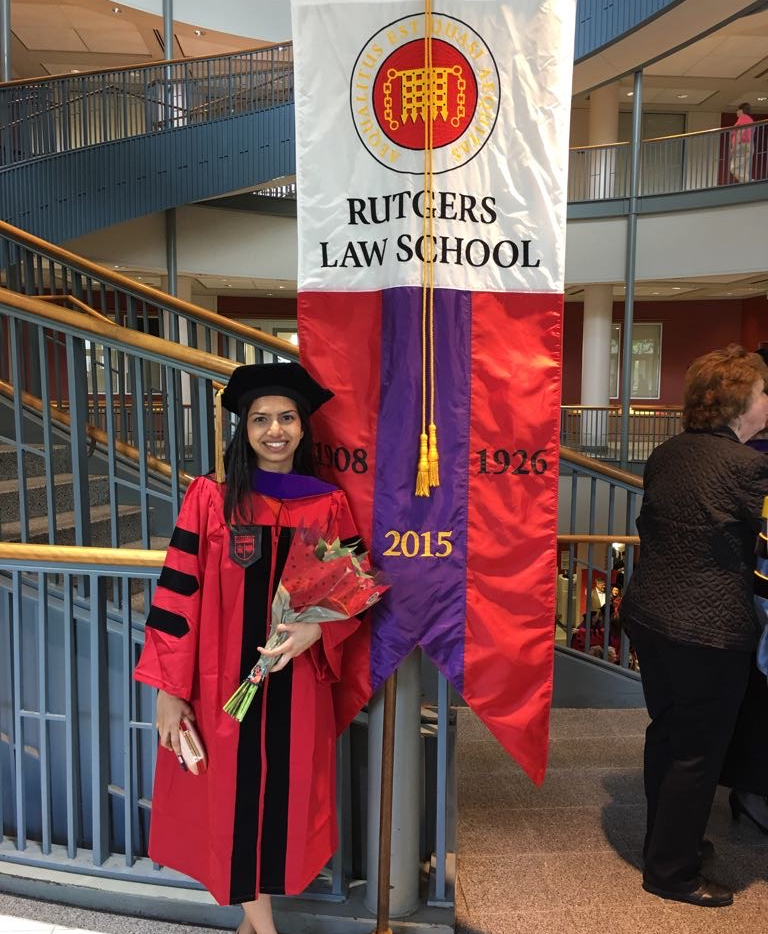
Vidhi Shah is a 2014 law graduate of the Government Law College Mumbai (BLS LLB) who enrolled for the 2-year accelerated JD at Rutgers Law School in 2015. In this email interview, Vidhi shares her reasons for opting for the JD as opposed to the more popular LL.M., why she chose to study at Rutgers Law School, the JD experience itself, and a whole lot more.
Vidhi Shah
What got you looking at the Accelerated JD program? Were you also considering an LLM at that point of time, or only the JD?
It was always my plan to go for an LL.M after my studies at Government Law College (“GLC”). I wasn’t looking into the JD program because it is very expensive and would have taken me 3 years to complete it. I was ready to start my career after 5 years of law school in India. In fact, out of the 10 odd schools I applied to, Rutgers was the only one which was for the JD program.
When I began my research on the schools I wanted to apply to, I came across the 2-year JD program at Rutgers. I was apprehensive at first because I was ready to go charging through the finish line of sending applications during my final year at GLC and this program would require sitting for the LSAT, which is administered only 3-4 times a year.
This was going to change a lot of my planned timelines.
But my family, in India and the US convinced me to hold off for a year and take the LSAT and apply to all my schools post my graduation from GLC, with some work experience, as they knew that I wanted to pursue my legal career in the US as a long term goal. I acted on their advice as I wanted to be dual-country lawyer in the true sense and a JD (as opposed to specialized LL.M) would give me a more in-depth knowledge of the law of the land.
“I acted on their advice as I wanted to be dual-country lawyer in the true sense and a JD (as opposed to specialized LL.M) would give me a more in-depth knowledge of the law of the land.”
Once you had decided that it was going to be the JD, how did you go about shortlisting schools? How did you narrow down on Rutgers?
I had not decided that it was going to be a JD for sure until much later. I knew I wanted to keep all my options open. Apart from the uncertainty of the admission process, the financial burden was one important factor. Coupled with the fact that it would take an additional year was something that needed to be mulled over.
There were only a handful of schools in the US that offered the opportunity to complete the JD in 2 years while I was applying to schools in the US. Rutgers is one of the best law schools out there. I have family members who have studied at Rutgers and they spoke very highly of their experience at the school.
“Rutgers was perfect with what it’s location, the professors, the curriculum, the illustrious alumni and the reputation.”
Further, for the kind of law I wanted to practice, Rutgers was perfect with what it’s location, the professors, the curriculum, the illustrious alumni and the reputation. I was sure that I wanted to practice corporate law with a focus on securities law and what better than a school providing me an opportunity of a 2 year JD program, right across the river from the NYSE and the NASDAQ.
Could you share a bit about the application process itself? Presuming that there is no LSAT/GRE requirement, what are the things that a prospective applicant ought to keep in mind?
There is an LSAT requirement for the JD Program and your application needs to reflect that you have completed the requisite coursework and showing some work experience in the field helps to make the application even stronger. If they are going to give you credits for a year, they want to be sure that you show a strong grasp of the law.
Your grades, the LSAT score, you extra-curriculars, internships and work experience, all are taken into consideration. The application process is similar as for the LL.M but you are required to take the extra step to speak to the Admissions Dean once you have received the acceptance letter to provide them with the information on your prior legal education and experience for them to be able to evaluate your eligibility for the 2-year program.
“For any student wanting to apply, not just for the JD program but also for the LL.M, it is key to have a strong resume. Grades are not the only thing matter. Schools are looking for a complete package.”
For any student wanting to apply, not just for the JD program but also for the LL.M, it is key to have a strong resume. Grades are not the only thing matter. Schools are looking for a complete package. There are a limited number of seats and a lot of people applying to these schools. You have to keep in mind that you are competing with people all around the world.
Did you apply for/receive financial aid?
No, I was not eligible for the financial aid that the school provided as I was an international student.
How was the AJD experience? When it came to internships/RA ships were you at a disadvantage as compared to those enrolled in the 3-year JD program?
Picking the JD program at Rutgers has been the best decision of my life. The education, the exposure and the entire experience was amazing. I am a much better lawyer today because of the opportunities Rutgers offered me. The practical experience coupled with a very different classroom set up, gave me in-depth knowledge and wholistic view of the law in the US.
I was never at a disadvantage as compared to other students in the JD program and was at par with them at all times. I had a great summer internship at Wyndham Worldwide after my first year, worked at a non-profit organization in my 3rd semester and was part of a clinic in my 4th semester.
Rutgers has one of the finest Field Placements and Legal Clinics programs in the country. Further, big law firms visit Rutgers regularly to recruit students for either internships or full-time positions. The Career Development team at Rutgers is hands-on and they take personal interest in helping students succeed in their careers.
What were the kind of employment opportunities available to you once you completed the program? What is your reading of the US recruitment market for international lawyers in the current scenario?
It was difficult to find employment in the US even after completing the JD because most of the law firms/companies are not comfortable applying for an H1 visa. More so now, than before. But I kept applying and giving interviews and finally was able to get a great job with a tech company in their in-house legal department.
The US recruitment market for international lawyers may be in a more precarious position than even during my time because of the Covid-19 outbreak and President Trump taking a hard stance on immigration during these times.
Lastly, any advice for the Indian law graduate who is considering a master’s degree (JD or LLM) abroad?
I would tell all graduates considering a master’s degree abroad that they should go for it. The kind of experience they will get, not just in terms education but in a more wholistic sense. It will be one of the most enriching experiences of their life where they will get a chance to be immersed in a completely different environment.
But, as stated before, they should make themselves a complete package. Law Schools are not only looking at grades. They want to know how you behave and react in real life scenarios.
We need your help in keeping this blog alive. If you feel that the content on this blog has helped you, please consider making a donation here.




 Amicus Partners