• First Person Accounts (FPA’s) are meant to provide a first-hand account of Indian graduates who have pursued, or are pursuing, a post-graduate course (LL.M. or otherwise) from different universities across the world.

    Roshni Mandal completed an LL.M. from the Singapore Management University this year, with a focus on Cross-Border Business and Finance Law in Asia. In this FPA, the Christ University law graduate shares her reasons for choosing this particular course, the experience of studying in Singapore, and a whole lot more.

    Roshni Mandal completed an LL.M. from the Singapore Management University this year, with a focus on Cross-Border Business and Finance Law in Asia. In this FPA, the Christ University law graduate shares her reasons for choosing this particular course, the experience of studying in Singapore, and a whole lot more. 
    Roshni Mandal (LLM ’20, Singapore Management University)

    SMU is quite an interesting choice – what were some of the factors you considered while selecting where to apply? How did SMU meet your requirements?

    I never topped my classes during law school, I wasn’t close to the top either. I was always an average student, but that didn’t dissuade me from dreaming big. If you can dream it, you can definitely do it. It was always at the back of my mind to follow the field of business and finance and as a graduate, I felt that a masters was my next stop. I went on to pursue my masters degree fortunately at my choice of university and subject.

    To put it in simple words, I was a law graduate with a dream but still as confused as a woman trying to choose a lipstick shade. Initially, the conundrum was that I couldn’t find a course that fits my expectation, to focus on cross-border transactions and all the legal complications that come with it. My interest was to explore the novels of business, strengthen my academic and legal knowledge in order to understand business practices better and for this the course on Cross-Border Business and Finance Law was an apt choice for my LL.M. degree, which was available at Singapore Management University (SMU).

    Apart from the state-of-the-art city campus, another factor that appealed to me was the well-loved Kwa Geok Choo Law Library. It is a symbol of inspirational learning in a green setting that sat smack dab in the middle of my favourite – Fort Canning Park. SMU is a relatively young university and the prospects of research and community engagement are highly notable.

    During my weeks of research on the University, I became more familiar with it. I realized that this rather young University with a new mindset towards legal business studies, gelled well with my thinking and ambitions.

    Intellectual Property Law, Mergers & Acquisition, International Mediation, and Chinese Contract and Business Law were some of the core subjects that I focused on. Since this LL.M. was of an academic endeavour to me, I promised myself to make the most of the next 12 months in Singapore so I started applying to law firms as a legal intern, prior to the commencement of the course.

    Interning during my course and on the holidays was an opportunistic choice that I strategically opted to do. The training, teachings, pleadings, tonnes of Kopi, court proceedings, preparation proofreading and analyzing awards wouldn’t have been gained if it wasn’t for these internships that I am so grateful for.

    Apart from the academic opportunities, I was eager to attend literally every event arranged by SMU, to sign up for as many conferences and additional lectures that were offered in order to step out of the tiny comfortable box that I clenched onto till the day I graduated from law school. I always knew at the back of my mind, in order to be successful in life, you have to be able to relate to people from all walks of life.

    Were there any other schools that you applied to?

    There were only two law schools that were on my list, where I wished to pursue my masters degree – National University of Singapore (NUS) and Singapore Management University (SMU).

    NUS being a well-known University with its roots stretching back to 1957 had over seven specialized courses for the LL.M. course. Whereas, I was more keen on pursuing a business oriented course which was available at SMU. Always knew that I would pursue this field of law and always knew that my determination and trust in myself would come to my aid.

    How early did you begin the application process itself? Any suggestions on how to go about writing the SoP and sourcing the recommendation letters?

    The application deadline for SMU was at the end of February – early March of 2019, if I remember correctly. It is a huge advantage if you start months in advance as it gives you more time to revise before submitting the applications.

    I started gathering all my documents and transcripts on December 2018, requested my professors for the Letter of Recommendation (LOR) prior to the December vacation and started on my Statement of Purpose (SoP) at the same time. Another requirement is to submit your TOEFL IBT or IELTS score. The specifications on the same will be mentioned in details in the University brochure.

    My advice would be to first answer whether you want an LL.M. which is course-centric or university-centric then prepare a tentative short list of the universities and gather the necessary documents. So research is extremely important. This will make it easier for you to sit back and write your Statement of Purpose and Personal Statement for the admission process.

    After this stage, every small or big detail that comes to your mind and is remotely connected to the masters program should be put down on paper. Brainstorm and jot down everything you think is relevant, irrespective of the word limit at this point.

    For the SoP, I realized that it’s all about story telling as its more of an art, than a science. Tell them YOUR story! Invest time in your SoP and try to tailor it around you. Make at least six drafts, proof read it and get second opinions from your parents, teachers or seniors. Don’t stress on your academic scores and achievements alone. Introspect and talk about what really interests you in the what are your motivations, your ultimate dream and what is your personality built around. After which, write about the University in which you are applying to and why you want to pursue this course. Dedicate days of delving into information on the university, the subjects, read reviews and watch interviews of the students/professors. Answer the following in one sentence or two (for better understanding), before you begin to draft it:

    • What motivates you to apply for the LL.M. programme at the University and the location?
    • Why have you chosen this course which specializes in the particular subject?
    • Why do you stand out at this University, from the rest of the applicants?
    • How will this University help you achieve your future career goal/s?
    • What will be your next step after the LL.M. course?

    Do remember that a SoP is a specific piece of writing. Do not mention the generalized importance of law and do not take anything from the internet in order to make your SoP more interesting. It has to be your story, based on your life. Before you sit down to write it, read the specified instructions on the SoP of that University as it varies. During the admission season, there are numerous SoPs read for months on end. In order to catch the eye instantly, start with an interesting introduction. Don’t hold the best for the last. One way is to start off with a quote that you believe and ensure that whatever you state in your SoP has good backing.

    With respect to sourcing LORs, you may approach the professors with the specific specialization that you are opting for. Sometimes Universities provide different guidelines for the LORs so do follow them. If not, then two academic and one professional should be fine. It absolutely does not matter who you are requesting the LORs from, as long as it is someone who has seen your work/performance academically or professionally and can provide an insight of your overall abilities as well as defeats. SMU accepted the LORs directly from the professors where they will have to upload it directly on to the link sent to them. It is your duty to inform them on the same.

    Did you apply for/receive financial aid?

    Singapore is known for removing any economic hurdles faced by international applicants in order to pursue higher education. There are over five different scholarships provided for postgraduate students administered by SMU.

    However I did not apply for any of the scholarships, but if there are interested applicants, they will find details of the same on the University brochure and website. It’s always good to grab the opportunity due to its availability. The tenure and benefits for the scholarship awards are excellent.

    How was the LL.M. experience itself? You specifically mentioned that the Professional Development workshops were quite helpful – could you tell us a bit more? 

    I knew it would be a distinctive and fruitful experience but truly, it was just unexplainable! I am more confident than I used to be. Apart from academics, I have developed my management skills, strengthened my critical thinking and autonomous intellect.

    The Professional Development Series (PDS) workshops enabled us to meet with the other masters students from the other six departments at SMU. Every masters student is to attend a minimum of three workshops during their candidature. It started off with my complaints due to the early timings of some but ultimately I was thankful for attending them. SMU ensured that none of them was specifically academically related. The options varied from Business Etiquette to AI-related ones.

    The Postgraduate Professional Programmes organized what is known as the PG Weeks every year. Sports activities are organized, volunteering opportunities and various other activities to get in touch with some of our hobbies like photography, design and so on. Tours were organized to visit Gardens by the Bay, Maxwell Chambers (an integrated ADR complex), the Parliament of Singapore and everyone’s favourite place – Sentosa! I ensured to take roughly eleven workshops (apart from the PDS workshops) during the time of my course and you must take it from me, they were simply marvellous, especially the Wine Appreciation session which left me a bit tipsy!

    How did SMU react to the Covid pandemic? What have been some of the more challenging aspects of moving online? 

    Luckily I had to attend only one class via online platforms which also happened to be my last class for the elective subject, Compliance and Risk Management for lawyers. It was truly an overwhelming experience and slightly different to accept that this was the last time I’d attend a class at SMU, from home. SMU provided us with several WebEx sessions, virtual conferences, and webinars on legal and non-legal issues during the phase of the normal redefined.

    SMU has however been very effected with the preventive measures in a safe and timely manner. There were strict rules enforced, declaration of temperature taking, social distancing measures, seating arrangement, and the like. There was an SMU Financial Assistance Scheme (SMUFAS) arranged alternatives for students to minimize disruptions to their academic progression, to help defray the financial costs incurred and cover valid and irrecoverable expenses caused due to the pandemic.

    As we all struggled to get accustomed to the new normal, it was ensured that the students must take advantage of this period and make the most of it. When the going gets tough, we must however keep going!

    An important task during the Circuit Breaker, as termed in Singapore, is Personal Branding of the law student, law graduate or lawyer during this time. The internet as we all know can make a huge difference to your career in the long run. This generation can make use of it as a personal brand is a promise. One needs to find a way to distinguish from every other attorney.

    Build your personal legal branding. Sign up for online courses. Volunteer. Control your future. It will not only ensure respect and recognition, but it will also build trust, which is an important aspect for a lawyer.

    The pandemic has left some of us anxious about our future but it shouldn’t have the power to affect our mindset and attitude. There were a few aspects that I wished never happened during my course here, such as, trips to the library during the last month, interacting with our professors, bidding goodbye to our friends, and most disappointedly our graduation ceremony! Though SMU has assured us that an additional physical ceremony will take place in 2021.

    What are the kind of employment opportunities that you are looking for post the LL.M.?

    An LL.M. degree comes with a great opportunity to build a network of fellow lawyers as well as other professionals. I cannot emphasize enough to Network, Network, and Network! I would highly advise every prospective candidate to make use of the opportunities to network with anyone they come across, in the legal field, business and banking practitioners as well.

    I have decided to use my time post-graduation to search for more internship opportunities, to apply for relevant legal training or work as a legal assistant. As this course has broadened my horizon and therefore I am willing to gain any type of knowledge, be it law-related or otherwise. Attending career law fairs arranged by the Postgraduate Career Services at SMU has helped. I am eager to take any many opportunities as I can and that would be my advice as well. There’s always something to learn from everyone you interact with.

    During these trying times, it becomes difficult to meet with people at events and conferences but I did not let it sidetrack my focus. Thereby, I’ve made a list of law firms whose work genuinely interested me and started connecting with the partners on LinkedIn or E-mail. It is important not to interact with various professionals with the sole motive to land a job. I can say that this way I’ve had engaging conversations with a few and gained valuable advice at the same time. Don’t ignore the magical power of asking for help. Though the job prospects for a foreign lawyer in Singapore can be difficult, it isn’t impossible.

    Pro bono and volunteering work have been a priority for me and so I have signed up for such related positions. It is important to see how lucky we are with the education that we’ve undertaken. I believe that I still have a lot to learn before I can provide my assistance and I am eager for the next challenge. To work, fail, learn, and strive are my goals for the next few years until I am confident to step into the legal and business world where my service will be valuable and worthwhile. I am definitely not ready to rest.

    Lastly, any advice for the Indian law graduate who is considering a master’s abroad? 

    One needs to be certain before applying for an LL.M. Consider if you want to specialize further in a particular area of law, if interested to dwell into academia and after the LL.M. degree to be able to gain a license to practice in an additional jurisdiction apart from India. This is another step closer to internationalizing your law career.

    I can assure you that, if nothing else, a masters degree will be a mountainous conquest in your life. It can be a great experience, if you make it one and the only way to do that is to be confident, take the step and just send out your applications. Put your whole trust in your struggle, have faith that it will all end up being for the greater good as I’ve mentioned earlier, be not ready to rest. Do not compete for what you really want, rather create it.

    In today’s competitive market, specialization, and dept of the subject is critical. But, in case after all the research and reading, you are still unsure about the course or the university or any other reason, don’t step back from asking for advice. People do not realize that they have the power of asking for advice from their parents, mentors, professors, or alumni. You can reach out to anyone who has already done what you aspire to do and ask them to offer advice. So do not stop to aim as high as possible.


    We need your help in keeping this blog alive. If you feel that the content on this blog has helped you, please consider making a donation here

  • First Person Accounts (FPA’s) are meant to provide a first-hand account of Indian graduates who have pursued, or are pursuing, a post-graduate course (LL.M. or otherwise) from different universities across the world.

    Pavani Nagaraja Bhat is a graduate of NLU Orissa ('17)  who enrolled for an LL.M. at Harvard Law School in 2019.
    Pavani Nagaraja Bhat (LLM, Harvard Law School)

    Pavani Nagaraja Bhat is a graduate of NLU Odisha (’17)  who enrolled for an LL.M. at Harvard Law School in 2019. In this FPA, she talks about her work experience right after her undergrad, the schools she applied to in addition to HLS, the LL.M. experience itself, and a whole lot more.

    After you graduated from NLUO, you joined the Commonwealth Human Rights Initiative, an organisation you had previously interned with as well. What was the kind of work you did at CHRI?

    During my final year at NLUO, I interned with the Access to Justice team on Prison Reforms. I assisted the team conduct a study on the status of prison under-trial review committees.

    On graduating from NLUO, I worked as a Project Officer with the Access to Justice team on Police Reforms. I primarily conducted research and advocacy on police accountability. I assisted CHRI pursue litigation in the Supreme Court and Delhi High Court to ensure that every state and union territory sets up Police Complaints Authorities as mandated by the Supreme Court. I also conducted research on arrests, custodial torture and mainstreaming women police in India.

    As part of this research, I created a training module on the role of judicial magistrates during the first production of arrested persons and organized training sessions at judicial training academies. My work involved a mixture of research, advocacy and writing.

    Did you contemplate an LLM as an undergrad as well? Or was this a decision you made only after working for a bit?

    I have been interested in a postgraduate degree since I was at NLUO but applying to the LLM was a long process. Since my undergraduate degree gave me a general foundation of law, I thought of an LLM as an avenue to build my expertise in public interest law, my broader interest area. While I was attracted to the public interest field since my initial years at NLUO, I tried my hand at private law by interning at litigation offices and corporate firms.

    These experiences helped me understand why I was interested in public law and not private. But I did not want to hurry into the LLM as soon as graduating from law school. The LLM program is a substantial investment and I wanted to take my time in making the investment. I wanted to ensure that I choose a program and specialization that would not only build my knowledge but also help me secure employment.

    “The LLM program is a substantial investment and I wanted to take my time in making the investment. I wanted to ensure that I choose a program and specialization that would not only build my knowledge but also help me secure employment.”

    I realized that relevant work experience would help me better identify whether my interests were practical. Apart from my academic training at NLUO, my work experience (at CHRI and at offices I had interned at previously) substantially contributed in deciding that I wanted to specialize in access to justice and human rights.

    The relevant work experience enabled me to justify why I wanted to specialize in this field and how I was equipped to specialize in it. Also, the public interest career is not as financially rewarding. In the absence of work experience, I may have had to study on a higher loan amount and the repayment is extremely difficult.

    Considering that I have wanted a public interest career, I realized that relevant experience would help me secure more financial aid and better work opportunities after the LLM.

    Apart from Harvard, were there any other schools that you applied to?

    I applied to the LLM programs at Harvard, Yale, Columbia, NYU, Cambridge and SOAS. I also applied for the MSc in Criminology and Criminal Justice Policy at Oxford and the MSc in Criminal Justice Policy at LSE.

    In total, I applied to graduate programs at eight law schools. I applied to schools that I believed to be (1) out of my reach, (2) where I could possibly get in and (3) where I was confident of getting in.

    Eight is understandably a large number and applications require a lot of work. But I wanted to ensure that I would ultimately have a choice between at least a few of them. More importantly, I wanted to secure as much financial aid as possible. For me, it made sense to apply to as many law schools as I could and gauge which option made most sense professionally and financially.

    When it comes to the HLS LLM application in particular, any advice on how to approach the Part A and Part B writing requirements?

    In Part A of the personal statement, the applicant is required to describe a current legal problem in their area of interest and propose a framework to resolve the issue. Since I wanted to specialize in access to justice and human rights, I drew from my work experience and described a legal problem in India’s criminal justice system.

    I chose this issue because I wanted to justify my area of interest by displaying my knowledge of the current challenges to improving access to justice in India.

    In Part B, the applicant must give reasons for pursuing the Harvard LLM, how it relates to their past experiences and future aspirations. I made a natural connection between the legal problem I had described in Part A, my work experience and what I expected from my LLM at Harvard. To write this part, it is important for applicants to thoroughly research courses, faculty specialization, potential research opportunities (through clinical work or academic research) and employment.

    I was particularly interested in combining academic work with practical experience during the LLM (at the International Human Rights Clinic). Applicants need to extensively research these issues and display clarity of thought in their interests, binding it with their future aspirations at HLS and later.

    Writing the personal statement, both part A and B can be extremely daunting and time consuming. Law schools want to see applicants make a compelling story for pursuing an LLM. An applicant’s story can arise from their past experiences, personally and/or professionally. I started working on the statements in July, if not earlier, and had several drafts before submitting the final application at the end of November.

    A lot of applicants look at other personal statements before writing their own. This can be a huge mistake because your personal statement should be your own. Looking at other personal statements can influence your language and writing style. A more useful way of ensuring that your personal statement is actually compelling is to ask opinions from trusted friends, colleagues and previous LLM candidates on how to improve your statement.

    “A lot of applicants look at other personal statements before writing their own. This can be a huge mistake because your personal statement should be your own. Looking at other personal statements can influence your language and writing style.”

    Apart from the subject matter, personal statements should be simple, clear and concise. Law students are often conditioned to be extremely verbose and use unnecessary legal jargon. Instead of using excessive jargon, applicants should utilize the word limit to bridge the gaps in the CV.

    Also, being extremely verbose is off-putting to the reader since the statement seems less natural. To avoid these mistakes, applicants should start working on their statements as early as possible so that they have enough time to refine the contents of the statement.

    Did you apply for/receive financial aid?

    Yes. HLS has a need-based financial aid policy and I received significant financial aid. The committee assesses the need for financial aid by evaluating the candidate’s resources.

    I also received a loan scholarship from the J.N. Tata Endowment for the Higher Education of Indians. There are several organizations funding masters programs and applicants should look up these organizations as early as possible.

    What were some of the expectations from the LLM? Were they met?

    I expected the LLM to add to my subject-matter specialization and also expose me to a culturally diverse environment. Although I have travelled extensively during my schooling in India, the LLM offered me the opportunity to interact with people from different nationalities and learn in a radically different academic environment.

    I had learnt from my colleagues about the extremely challenging nature of the program due to its short duration. I also looked forward to engaging with human rights practitioners from different cultural contexts and learning from them about their work.

    On the subject matter specialization, I had the opportunity to only choose courses and seminars I was actually interested in. This enabled me to study courses that were solely related to access to justice and human rights. One of my primary expectations from the LLM was – to be in an academic environment – and it was met.

    Is there anything about the LLM experience that you were unprepared for? Any pleasant (or not so pleasant) surprises along the way?

    I think there is only so much you can prepare for when you are moving continents and to a different academic setting. The one-year LLM program is extremely rigorous from the absolute start – the orientation. It is very important to be able to multitask in the extremely demanding environment at HLS.

    Although I never planned to sit for the NY bar exam, my courses, clinical work, job search, the LLM paper and exams were extremely stressful. It was always difficult to take a break from work because there was always more to do, whether coursework or lunch/dinner/coffee chats or extra-curricular activities.

    One of the great things about HLS is the infinite amount of lunch/coffee talks on so many interesting contemporary and historical legal issues. Not only that, you can also cross-register for courses at other Harvard schools. It is very easy to be enticed by the amount of opportunities to learn something new. At the same time, there is always something you cannot attend.

    “One of the great things about HLS is the infinite amount of lunch/coffee talks on so many interesting contemporary and historical legal issues. Not only that, you can also cross-register for courses at other Harvard schools.”

    We need to make peace with the fact that we cannot do everything we would love to commit to. I was pleasantly surprised at developing the ability to set boundaries for myself, whether to stop myself from having the fear of missing out or in forcing myself to take a break even if it meant that I gave up on study time. Or sometimes, giving up on socializing to meet deadlines or to just prepare for the next day’s class.

    Coming from an environment of pure lectures, I also had to adjust to the Socratic style of teaching. All of us had to participate extensively in class discussions not just because we were cold called or because our grades depended on it, but also because the discussions were purely engaging. LLMs and JDs took classes together.

    This meant that the JDs generally had a better understanding of where the US laws came from. But the LLMs always brought out the comparative aspect, especially those who had work experience in our home countries.

    We not only learnt from our faculty, but also from our peers who were litigating lawyers, firm associates, human rights practitioners, judges, prosecutors, public defenders, academics and so on. In this intimidating environment, I have worked harder and seen friends also working extremely hard to be prepared for class.

    Most importantly, I was pleasantly surprised at the amazing bonds I formed with my peers. I am constantly inspired by my peers’ passion and commitment for their work and causes. Despite this passion, a lot of us suffered from “imposter syndrome” and we constantly had each other’s backs.

    This became even more crucial when the law school practically emptied after the pandemic outbreak. We certainly did not prepare for the added uncertainty of not knowing when we’ll be with our families again, of hiring freezes or of having to uproot our lives in a moment’s notice. Throughout this time of social distancing, we supported each other, formed an even stronger community and helped each other grow professionally and personally.

    “Throughout this time of social distancing, we supported each other, formed an even stronger community and helped each other grow professionally and personally.”

    Looking back on my LLM, I am thrilled to have gone through this experience. This year was much more than a degree.

    Lastly, any advice for the Indian law grad who is considering a master’s abroad?

    A masters can be a great value addition to your profile because it offers you the opportunity to engage in a different environment, dedicate your time to specific fields and goals. Although a master’s can be as short as a year, the year is packed with many experiences. The environment helps you push yourself harder and probably change your career goals, at least for the foreseeable future.

    At the same time, an LLM is also a huge investment. Any law student considering a masters should think through it extensively to understand what they want from a master’s degree, especially if you need to take up loans. The career prospects will not be as great as you expect, and you need to have alternatives.

    “Any law student considering a masters should think through it extensively to understand what they want from a master’s degree, especially if you need to take up loans.”

    Also, a master’s degree requires you to be in a rigorous academic environment for a large part. You may be able to work on clinical projects or short term internships, but academic work consumes most part of your time. Harvard, for example, has a writing requirement to complete the LLM irrespective of which field of law you are interested in.

    To get the most value from this experience, anyone looking to pursue a master’s abroad needs to know what they’re setting themselves up for. Having said that, I would put myself through this process all over again.


    We need your help in keeping this blog alive. If you feel that the content on this blog has helped you, please consider making a donation here

  • The Admission Interviews, are meant to provide insights into LLM admissions right from the law school itself. The idea behind this series is to provide that little bit of extra information that may not be available on the law school’s website.

    In this edition, I speak with Daria Kozlowska-Rautiainen, the Director of the International Commercial Arbitration Law LL.M. (ICAL) offered at Stockholm University.

    Daria Kozlowska-Rautiainen, the Director of the ICAL LL.M. programme offered at Stockholm Universit
    Daria Kozlowska-Rautiainen, Stockholm University

    Given your experience with teaching academic writing, how do you think law schools can encourage and build interest in research and writing? Any advice for law students who want to build research skills but don’t quite know where to start? 

    Exposing the students to different types of writing, building their confidence to critically analyze the text and allowing them to have a voice are the aims that I focus on when I teach academic writing.

    In the ICAL programme, students work a lot with text, not only with books and articles written by top academics and practitioners in the field, but also court decisions and arbitral awards.

    It all starts with knowing how to read the text: questioning what the author is saying, noticing the gaps in the analysis, arguments that are not supported by sources, information that is superfluous and elements that are the missing pieces of the puzzle.

    “It all starts with knowing how to read the text: questioning what the author is saying, noticing the gaps in the analysis, arguments that are not supported by sources, information that is superfluous and elements that are the missing pieces of the puzzle.”

    We have seminars where we dissect the texts, seminars on research ethics, methodology and use of sources.

    This helps the students to learn how to write and when they notice that they understand the ingredients of a good writing and they have something to say, they are much more eager to express their opinions. The teaching has to be interactive and allow the students be creative and critical, even towards the greatest authorities in the field.

    Throughout the academic year, the ICAL students will have written at least some of the following: a report, a case-comment, a few argumentative essays, a statement of claim or defence, a procedural order, an arbitral award, and of course, a master’s thesis.

    In my view, encouraging the students to perfect their skills in research and writing is not a challenging task. Many of the ICAL students have been interested in the arbitration field long enough to notice that publishing a good quality paper is a strong advantage for one’s career.

    Many top arbitration practitioners publish regularly. In the area of international arbitration, there are many prestigious academic writing competitions and we make sure to send the invitations for submissions to our students.

    What are some of the characteristics of the ICAL LLM which make it particularly beneficial for the international lawyer?

    First, the ICAL Programme focuses solely on international commercial arbitration. The approach to teaching is systematic and based on progression. All key aspects of arbitration are covered and the difficulty of the topics and tasks grows as the academic year progresses. But the curriculum is only part of the learning experience.

    Second, as the teaching is interactive and gives space for students to discuss and work on projects together in groups, the learning comes not only from us, the academic staff and the prominent guest lecturers, but also from the other students. Hence, in my eyes, the ICAL students are the key element of the quality of education. Our students consist of top candidates from all over the globe.

    The ICALs (as they like to call themselves) are a unique mix of talented individuals. We have students who are already experienced attorneys and those who are fresh out-of-law school graduates. All students are very interested in the field of arbitration, but some have a background in company law, transactions, politics or even engineering.

    Third, the ICAL students go through the courses together, as one group. It is a special experience that cannot be measured just by the academic achievements of the students. My philosophy in teaching the ICAL students is based on tilsammans – the Swedish word for together.

    How do you think LLM candidates can make the most of what is a relatively short course?

    When you study in an international programme it is important to stay open to new, different ideas, be inquisitive, not make hasty assumptions and take this learning experience as a whole. This means participating in all activities that are offered, being active in recognizing what advantages you get when you study at Stockholm University – they go beyond having access to excellent legal databases.

    Daria Kozlowska-Rautiainen, the Director of the ICAL LL.M. programme offered at Stockholm Universit
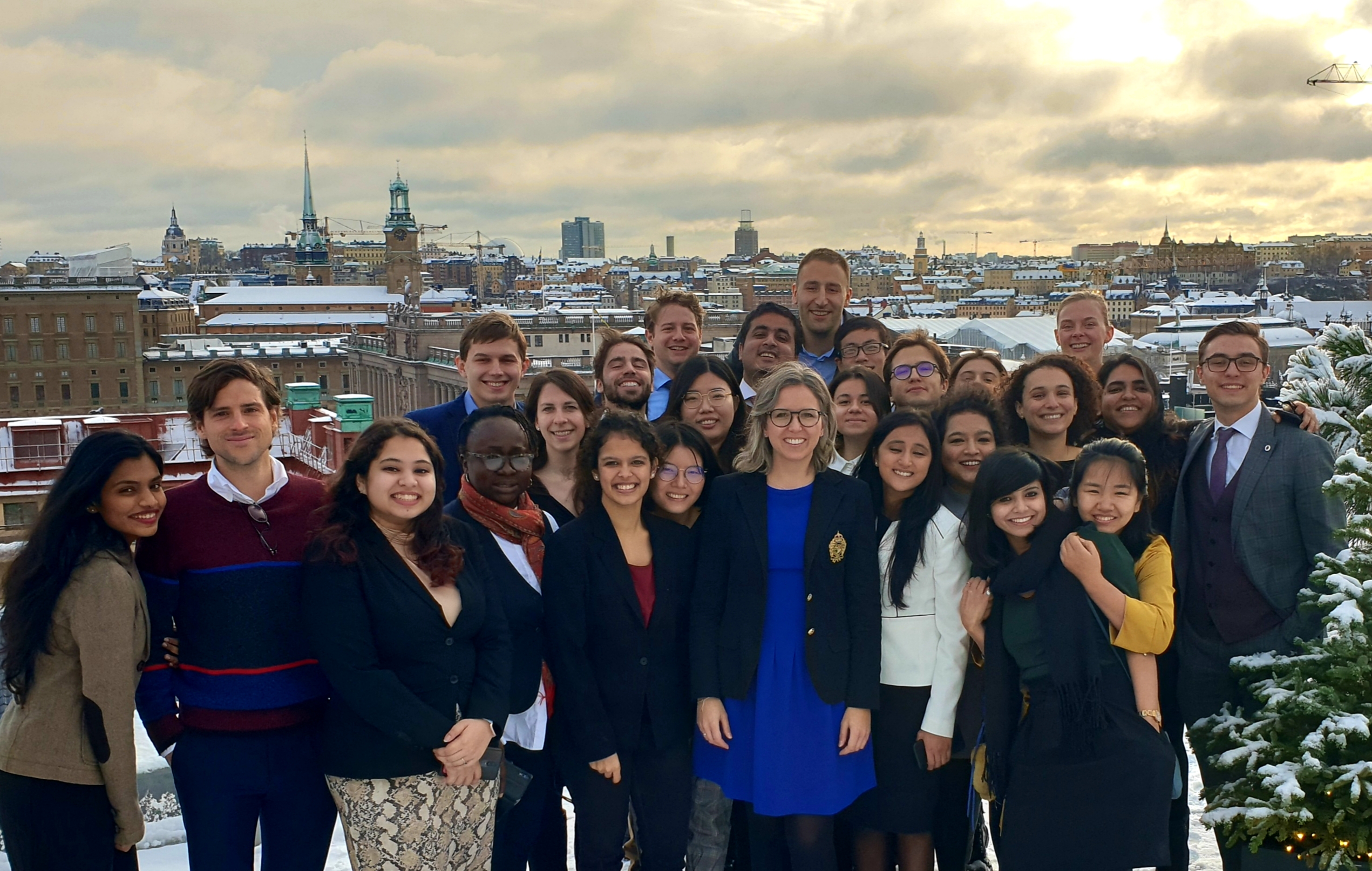
    Daria with the ICALs of 2020

    The ICAL students are often invited to participate in international arbitration conferences and other events.

    Finally, when you are studying, it is about much more than just learning what has been assigned; it is about researching on your own, searching for the information, and broadening your knowledge to satisfy your genuine academic curiosity.

    From an admissions point of view, any advice one should go about drafting the statement of purpose?

    It is wonderful to read all the various styles of statements of purpose that we receive from the students.

    The advice I would give is to focus on what motivates you to study in this particular programme: why are you interested in arbitration, what knowledge or experience you have in this area, and why did you choose Stockholm University.

    Do not forget to say something about yourself that we cannot read from your CV.

    Is there a particular profile of candidates that you are looking for when it comes to the ICAL LLM? For instance, would you prefer to have candidates with some work experience?

    As pointed out above, we admit both those candidates who have already worked in the area of arbitration for some years as well as fresh graduates with no previous experience in the field.

    If one could say that we have a profile of candidates, then those are talented individuals who have excellent academic achievements and who are highly motivated to study international commercial arbitration.

    Lastly, any advice for those who are looking to build a career in International commercial arbitration, either pre or post LLM?

    Never stop learning. Arbitration is an ever-evolving area. Stay connected with the arbitration community and be active.


    We need your help in keeping this blog alive. If you feel that the content on this blog has helped you, please consider making a donation here

  • First Person Accounts (FPA’s) are meant to provide a first-hand account of Indian graduates who have pursued, or are pursuing, a post-graduate course (LL.M. or otherwise) from different universities across the world.

    Shakha Jha graduated with an LL.M. in Corporate and Financial Services Law from the National University of Singapore in 2017.
    Shakha Jha

    Shakha Jha graduated with an LL.M. in Corporate and Financial Services Law from the National University of Singapore in 2017. In this FPA, the Symbiosis Law School graduate (’16) shares her thoughts on the value of a foreign LL.M., the LL.M. application process itself, and a whole lot more.

    As an undergraduate student, when did you start considering an LLM? And how early did you start the application process?

    Pursuing LL.M was never a plan until fourth year, when I got an opportunity to present a paper at a conference on International law, held in London, U.K. and during the course of writing the paper, I interacted with several academicians and legal professionals and I happened to speak with an alumnus from college who had, at that point of time, completed her LL.M from an esteemed university in UK.

    I was really fascinated and intrigued by her experience and I began researching on the LL.M course, the kind of universities I would want to apply to, the coursework, world rankings, fee structure, etc.

    I started the process almost a year in advance as there are a number of documents required to be procured from your university which are to be submitted as a part of the application.

    How did you go about selecting just where to apply? What were the factors that worked in favor of NUS?

    I was certain about two things, one, I wanted to pursue Masters in corporate and finance laws and second, I wanted to study only in a country that has common law jurisdiction so I decided to go only for the UK and Singapore. The next step I undertook was an exhaustive research over the coursework offered by each of the top notch global universities (as per the world university rankings for LL.M).

    I found the course offered at NUS as the most unique and challenging one owing to the fact that it is a combination of both corporate and financial services and gives you a range of modules from both the streams to choose from, thus, well-suited with my area of law preference (as stated earlier).

    Although I applied at a few other universities in the UK, I was very much keen and looking forward to getting a place at NUS and thankfully, by God’s grace, I managed to get through.

    Any advice on how to go about the application process?

    It is always better to apply well in advance (more than a year in advance) so that you have enough time on you to research and apply for scholarships. Also, procuring your transcripts from your university is quite often a time consuming process, so I would suggest one should plan that way ahead of their applications.

    Having well drafted Letters of Recommendation from your Dean/Professors or current boss and also a strong CV are extremely helpful.

    Did you apply for/receive financial aid?

    Due to paucity of time, I only applied for the NUS scholarship which unfortunately, I was not able to secure.

    How was the LLM experience at NUS? What were some of the most challenging aspects of the course?

    It was an extremely insightful and an invigorating experience. The amount of reading material that was provided to us as a part of each of the courses, was humongous so reading all of it was very challenging and even the assessments were very much in contrast to the traditional way of taking handwritten exams back in India.

    At NUS, we used to have 24 hour open book exams, video making, preparing opinions for real life cases at hand, surprise quizzes, etc. which were although demanding, but absolutely interesting and fun.

    You also interned at Sidley Austin for a month as an LLM candidate – how did you go about this? Was it difficult to balance the internship as well as course requirements?

    I was very keen on getting some practical international exposure so I prepared a list of the popular local and international firms based out of Singapore and began applying through their respective official websites.

    I initiated the process sometime in October, two months ahead of the designated winter break in December. I was fortunate enough to intern at one of the best international law firms and work under some great partners. It was not difficult to balance it with the course requirements as I interned only during the winter break.

    Looking back, how has the LLM shaped your professional growth?

    The LL.M helped me procure an international internship during my course and later, I was able to get a job offer at a boutique law firm based out of Mumbai, within a month of my graduation.

    Moreover, having a deeper understanding and learning of some of the subjects pertinent for the corporate and financial law practice such as International commercial arbitration, project finance, advanced contracts, securities law, corporate tax etc., which are not taught in so much detail at the undergraduate level, have over the period of time helped me expand my mental horizons and at the same time given me a global academic perspective which I often tend to apply while dealing with both domestic as well as cross border transactions at hand, on a day to day basis.

    Lastly, any advice for the Indian law graduate who is considering a master’s abroad?

    I would like to reiterate that applying for scholarships will save you a lot of money so if you are considering a masters from abroad, please start your research beforehand and also, prepare a common checklist for the documents required to be submitted for the purpose of application.

    Lastly, some of the universities require a TOEFL/ or an IELTS score, make sure you take a buffer for taking the exam and the release of the scores so that you do not end up missing any of the deadlines for application.


    We need your help in keeping this blog alive. If you feel that the content on this blog has helped you, please consider making a donation here

  • First Person Accounts (FPA’s) are meant to provide a first-hand account of Indian graduates who have pursued, or are pursuing, a post-graduate course (LL.M. or otherwise) from different universities across the world.

    Gitanjali Kapur completed an LL.M. from the University of Cambridge in 2016. The Delhi University law graduate (LLB ’14) also holds a B. Com (Hons) from Sri Venkateswara College, Delhi University. In this FPA, she talks about her reasons for applying for an LL.M, how the course has helped her build her professional practice, and a whole lot more.

    Gitanjali Kapur completed an LL.M. from the University of Cambridge in 2016. The Delhi University law graduate (LLB '14) also holds a B. Com (Hons) from Sri Venkateswara College, Delhi University.
    Gitanjali Kapur

    Looking back, what were some of the advantages of the 3-year LLB course over the 5-year law course? Or, if comparisons are difficult, what were some of the more enjoyable aspects of the LLB at Delhi University?

    A 3-year LLB course can be pursued only after one has done an under-graduate degree of 3 years. After completing under graduation in B. Com (Hons) from Sri Venkateswara College, Delhi University I got placed at S&P Capital IQ (a subsidiary of Standard & Poor’s). I started my LLB post one year of work experience at S&P.

    Though working in the finance sector has no direct nexus with law, that year taught me a lot about disciple, work ethics and problem-solving skills. Our education system does not always prepare us to think practically. However, working for a year opened my mind and helped me develop many soft skills that education institutions cannot provide. For me, the biggest advantage of doing a 3 +3 rather than a direct five-year law course has been my stint of working before I did law.

    Also, a five-year course is great if one is sure about pursuing law. However, if one is uncertain then it is better to do an under-graduate course in another subject. I was initially inclined towards taking the route of finance and law was not on my radar. It is much later that I realized I wanted to study law. Hence, the 3 +3 worked perfectly for me.

    Having knowledge in another field apart from law is a useful tool. I have always found my background in finance to be a useful tool in briefs of commercial nature. A wider knowledge base always gives you an edge in dealing with certain kind of matters.

    Why an LLM? What were some of the expectations from the LLM?

    I always aimed at getting a degree from a top educational institution. It was not something that I decided keeping in mind professional opportunities. There are certain goals you have for yourself and for me this was one of them. There are a lot of lawyers who do perfectly well without an LLM.

    I did not go with the expectation that the degree will help me professionally. I went with the aim of personal growth and learning and hoped that the degree will also aid my professional goals. Another reason for choosing to go for an LLM was that I am a first-generation lawyer. I felt an LLM will add more credibility to my practice.

    I went for an LLM while I was in my first-year practice as a litigation lawyer. Frankly, work did not leave much time to ponder over my expectations from an LLM. I was new to litigation and I was busy understanding the nuances of the profession. However, I did expect the experience to be more holistic than a mere academic one.

    How did you go about selecting where to apply? And why narrow down on Cambridge?

    I cannot deny that the name of the University and the prestige attached to it was a major factor to apply for an LLM at Cambridge. I had applied to Kings University, UCL etc. and secured admission there as well.

    However, once I got through Cambridge it was an obvious choice.

    All top Universities in U.K have some of the best faculty and therefore I will not say that the same was a reason to choose Cambridge. It was more to do with the idea of staying in a student town rather than in the middle of London. I did not want to limit my learning to a mere degree. I felt a student town will have a lot more experiences and avenues of diversified learning.

    Any advice on how to go about the application process itself?

    The first advise I would like to give to anyone applying abroad is regarding the scholarships. Many scholarship application submission deadlines are prior to the deadline for submitting the main application for the university. Therefore, it is advisable to start planning beforehand if one wants to apply for any scholarships to prevent missing deadlines regarding the same.

    The process is relatively simple and well explained on University websites. However, it is important to have clarity regarding your purpose and reasons to choose a course and university. Though it is not always easy to have figured out one’s goal while applying for an LLM, it is imperative you have a rough idea of how you will use your LLM for your future goals. If you are completely aimless and confused it will reflect in your application.

    A certain amount of introspection is essential before you start the application process. Each university has its own benefits and therefore you will have to tailor your SOPs for each university. One cannot apply a straitjacket formula for every application. Each university application will require work and effort. Cambridge did not have an SOP unlike other universities. The application process entailed a set of questions which was time consuming.

    Take your time in understanding the differences in the experiences in each university and use that in your applications.

    How was the LLM experience? What were some of the more challenging aspects of the course?

    My time at Cambridge went by with the blink of an eye. The LLM is a 9-month course and therefore it is short and quick. One must grasp the maximum in the limited time one has. The University has a plethora of lectures on myriad topics every day. The experience of exposing myself to knowledge beyond my subjects has been of great value. I have never played sports and yet I took classes for squash when I was at Cambridge.

    There are so many new experiences that one can benefit from apart from just legal knowledge. It instills a certain amount of faith in navigating through the unknown and challenging oneself beyond one’s comfort zone.

    The LLM was challenging in terms of the vast amount of reading one must do. I had studied for six years in Delhi University (3 years B. Com (Hons) and 3 years LLB). The idea of reading material prior to a class was alien to me as Delhi University did not follow that concept of teaching. Social life at Cambridge was also always thriving and is a big part of the experience. One had to balance the same with preparing for the classes beforehand.

    Another challenging aspect of the course can be the regular reference to the domestic laws in U.K and Europe in some subjects. It can take some time to understand the same. However, the faculty is extremely approachable and that makes it easier to navigate through the challenges.

    As a litigation counsel, how has the LLM helped you in your professional growth? Would you say that an LLM is a useful tool to have for the litigation professional?

    I think my stint abroad gave me certain confidence to take clients independently. Being a first-generation lawyer, I worried about client acquisition and was doubtful about continuing with litigation. The experience of an LLM instilled a new- found sense of self conviction. I have seen many lawyers do exceedingly well despite not having an LLM and therefore I would not say that the same is a guarantee of success. However, if one has the resources to go for an LLM then it is a long- term investment.

    The knowledge I acquired during my year in Cambridge was used not just in litigation but also in my love to take up teaching along side litigation. Post my LLM, I have done some amount of teaching and the same would not have been possible if I had not gone for an LLM.

    Litigation is a lot about networking, so it is difficult to attribute client acquisition to an LLM. But there is no doubt that the experience has enhanced my abilities as a lawyer. As a female and as a first-generation lawyer, an LLM from a University like Cambridge helps me get the attention of a client and differentiate myself from the many other lawyers.

    Many times, while drafting I will pick on some aspects that I learnt during my time studying abroad. Though it is difficult to pinpoint exactly how an LLM has helped, in subtle ways one realizes the impact it has made on you as a professional.

    Lastly, any advice for the Indian law graduate who is considering a master’s abroad?

    While the name of a University is important, I do believe if you want a specialized degree within law then choose a university which is known for that field. For e.g.: many universities are known for IP law specifically.

    I also suggest certain amount of work experience before going abroad. I had been litigating before I went for an LLM. I was clear I wanted to come back to India and practice. If one goes without any experience it can be difficult to choose between coming back to India and taking on further opportunities abroad.

    Universities are constantly having events for students who want to stay on. It is only worth investing time in the same when you have an intention not to return to India in the near future.

    Work experience also prepares you for certain amount of pressure which at times law colleges cannot provide. For e.g.: Delhi University is more relaxed as compared to five-year law schools. Multi-tasking is the essence of your experience abroad. Working before going abroad helps develop these attributes that makes the experience more fruitful.

    It is advisable to start planning more than a year in advance to get access to the best scholarships. It is also great to look at the subjects offered in each university to choose where to apply. A lot of people stress on having your SOP etc. read by many people. The same is useful to correct grammar and to get inputs on structuring your application answers.

    However, clarity and diversity in your application is something no one can fix. The same has to come from you and it will need time. Therefore, it is not a good idea to apply last minute in a hurry. If time is less, it is better to apply the following year than do a half-hearted job with your applications.


    We need your help in keeping this blog alive. If you feel that the content on this blog has helped you, please consider making a donation here