• First Person Accounts (FPA’s) are meant to provide a first-hand account of Indian graduates who have pursued, or are pursuing, a post-graduate course (LL.M. or otherwise) from different universities across the world.

    Monika Bashyam completed an LL.M. in Admiralty from Tulane University in 2019, three years after her law degree from Saveetha School of Law.
    Monika Bashyam (LL.M. ’19, Tulane University)

    Monika Bashyam completed an LL.M. in Admiralty from Tulane University in 2019, three years after her law degree from Saveetha School of Law. In this interview, she talks about choosing such a niche area of law, the LL.M. experience itself, and advice for other Indian law graduates who may be interested in maritime law.

    Maritime law is a fairly niche practice area – what got you interested in this branch of law? And when did you decide to enroll in an LL.M.?

    I was in the 3rd year of my B.A., B.L., (Hons) program when I started to figure out my interests. My peers were into Taxation law, Business law and IPR, whereas I was sure about not pursuing fields that everyone was getting in line for. I wanted to navigate a less beaten down path. An opportunity to participate in an International Criminal Law moot helped me realize my intense fascination for International law.

    Cognizant of my interests, one of my professors nudged me towards Maritime Law. Although I was not very keen on International Commercial Law, diving deep into the International Maritime Organization’s website threw light on other streams within Maritime Law. I loved the fact that it offered a wide range of practice areas, like – Vessel Documentation and Financing, Insurance and Re-insurance, Marine pollution, which could be of interest for attorneys interested both in Commercial law and Environmental law.

    Such a wide array of practice areas piqued my interest.

    After my graduation in 2016, I held back from immediately pursuing a master’s degree as it was a huge commitment given that I would have to move to a different country. Also, some of the maritime experts I had consulted said that getting a foot in the door of maritime law firms in Mumbai required a family background or prior experience in the shipping industry, of which I lacked both.

    And to be honest, I also wanted to kick-start my maritime practice in countries, like the UK and the USA, whose courts have been pivotal in shaping the Admiralty common law.

    What were some of the other schools that you applied to?

    I looked into the International Maritime Law Institute (IMLI) in Malta, Swansea University in the UK, University of Southampton in the UK, National University of Singapore (NUS) in Singapore and Tulane University.

    I was very particular about the faculties and every module they had to offer, as I had to brace myself for competition from other graduates who had maritime law subjects and specializations in their under graduation in law. That left me with Tulane University, that offers one of the most highly renowned Admiralty courses offered in the US and internationally.

    Hence, it was the one and only school I applied to.

    Any advice on how to go about the application process itself? How much time do you think one should devote to the application?

    I consider myself a late comer to the admissions party. It was March by the time I initiated the process, but Tulane’s admissions department was very accommodating to international applicants. I would suggest the applicants look at the timelines of other organizations that they may have to go through before submitting their application to their list of universities.

    For instance, I had to submit all the documents necessary for admission to LSAC (Law School Admission Council), which included my transcripts, graduation certificates, SoP and reference letters. LSAC would then submit the application on my behalf to all the universities I choose to apply.

    This was news to me as my friends (most of whom attended universities in UK and Europe) submitted their applications directly to the concerned university.

    I have also observed that some universities, especially the ones in the US warrant international students to complete an introductory course on the laws of their country. Such introductory programs start earlier than the regular LLM start dates.

    Sometimes the applicants may need to plan their application process to accommodate the working timelines of different consulates. Some consulates might be over-burdened with a lot of applications, while some just have a longer processing time. This is crucial so that the applicant has enough time to obtain their visa, look for accommodation close to campus and settle in time for the course start.

    Why narrow down on Tulane?

    Like I had already mentioned, the major factors were the faculty, the modules offered and the fact that it suited my interests and fulfilled my expectations from an LLM course.

    I was also excited to experience the culture of New Orleans, which is special and will forever remain an unforgettable experience filled with beautiful memories.

    Did you apply for/receive financial aid?

    I did not apply for it, or at least Tulane did not have a process through which I could apply. I am told Tulane automatically considers all their international applicants for scholarship and assesses the financial aid to be granted based on their prior academic performance, strength of their resume, SoP and the reference letters submitted. I did receive financial aid through the Harry F. Stiles scholarship which sponsored 60% of my tuition fee.

    How was the LL.M. experience at Tulane? What were some of the most rewarding moments of the LL.M. experience?

    It is one of the best learning experiences I have ever had. The way law schools function and operate in the US blew my mind, especially their Socratic method of lectures. It kept me on my toes to be fully prepared for all my classes, do my own research, and analyze cases by myself before the classes.

    The first time I did my reading assignments, I thought to myself that there would be very less left for the professor to share on the topic, but I was taken aback by the wealth of information that was still left to be offered. I thoroughly enjoyed my time learning both in the classes and at the library (Fun fact: Tulane has the most collection of Maritime & Admiralty books in the US.)

    Tulane offers a few courses as a part of their LLM, which prepares international students to draft and present cases in the Courts of the Unites States. The course required us to submit briefs and present mock oral arguments, which helped me understand the nuances of persuading a judge in the US legal system.

    Tulane professors also arranged for lectures and mock negotiations with real-time practitioners and lawyers. It was a great way to build my professional network and it in fact helped me in setting-up countless meetings, three interviews at various maritime law firms including the one that got me a job last year.

    What is your reading of the employment opportunities in the field of maritime law for an internationally trained lawyer in the US?

    I initially had my doubts that US students might have an advantage over an international graduate, but the international nature of maritime and admiralty laws made me realize that it is to my advantage that I can now be a part of two countries’ admiralty cases, transactions and issues.

    The firm with which I am working at, expressed their interest in expanding their office locations to India when they hired me. Being licensed in more than one jurisdiction has its own perks and always pays off.

    Lastly, any advice for the Indian law graduate who is considering a master’s abroad?

    Every applicant’s dream or goal of pursuing an LLM is unique. Some do it to move their practice to that jurisdiction, some to expand their practice areas and specialties, some pursue an LLM in a foreign jurisdiction and come back to India to practice the skills and experience they acquired during the process.

    So, I would suggest that they also explore their post-LLM options and make an informed decision.


    We need your help in keeping this blog alive. If you feel that the content on this blog has helped you, please consider making a donation here.

  • The Amicus Interviews are meant for broader discussions on legal education, and the legal profession at the global level.

    After a decade and a half as a lawyer, Jolene Blackbourn, Esq. followed her love for teaching, and now devotes a lot of her time advising pre-law students in the US. She also helps lawyers with their professional interviews, and has set up a series of online courses on interviews within specific fields of law.

    After a decade and a half as a lawyer, Jolene Blackbourn, Esq. followed her love for teaching, and now devotes a lot of her time advising pre-law students in the US.
    Jolene Blackbourn, Esq.

    Given her expertise, I was quite keen on getting to know her thoughts on legal education and the legal profession, US law schools, as well as how to go about planning one’s professional growth.

    (Edited excerpts)

    In this remarkably candid piece, you write about the perils of pressure and how so many of “us” (if I may use that term) are not even aware of this pressure. Do you think things are changing now? Are more people questioning the purpose of going to law school?

    I don’t think so! I think especially first generation students are very eager to make their families proud and feel like they need to prove they are amazing! Also, those from families of lawyers can feel that pressure too (even if unintentional or really self-created)!

    Just sticking with that article, you also write about student debt – do you foresee US law schools addressing this at all? Do you think Covid has pushed law schools to rationalise and/or reduce tuition? 

    I have talked to a few entering law students and it appears the tuition is the same. They will not be getting 100% of their education (the networking and in-person experience) and yet are paying full price!

    I think that’s wrong but sadly, it’s happening!

    Given your vast experience of counselling pre-law students in the US, what are the most commonly held misconceptions about the law school experience? 

    Most pre-law students think that one, they can take out all the student loans and easily pay them back when they start working. This is simply untrue and makes many attorneys depressed as they struggle to pay their bills!

    And two, [pre-law students think] that they will practice in the area of law that they went to law school for.  Most end up in some other area of law and not necessarily by choice.  They simply cannot find a job in their favorite field and have loans to repay!  So they move on so they can pay that bill.

    And once in law school, do you think there are any bits of advice on how to get the most of the law school experience? 

    Each school has a law school counselor. I recommend getting to know them and check in with them regularly. I would also get to know the people who run the larger organizations on campus. They usually know all the great stuff that is happening in the school.

    I would also try to network on social media with people who attended that school recently or are attending.  Sometimes their posts will be very helpful!

    Not just pre-law, you also advise law students and lawyers on how to go about interviews? And again, what are some of the more common mistakes made here?

    In interviews, you need to be honest, but not too honest! For example, if you are applying for a very boring area of law, the attorneys know it’s boring. So don’t pretend you are excited to work there! Say something more real. Like, you know someone who is working in the field and they like it so you thought you would apply and see if you like it.

    I do offer some insight into various areas of law at the Legal Learning Centre to help show the interviewers that you have gone above and beyond to research that area of law which would show some extra level of interest. That would impress an interviewer too so any way that you can show that you have really done your research into the firm and area of law, you will have a better chance of success.

    How do you see the US legal industry shaping up over the next few years? Do you still see employment opportunities for the foreign trained lawyer? 

    I think a lot will depend on our November elections!  If Trump is still around, it may be worse.  He just created a new rule (subsequently rescinded) that international students cannot attend college if it is 100% online.  So that does not hold well for the next 4 years if he is reelected!

    But, if he is voted out of office, then I think things will move in a much more positive direction for international students.

    Lastly, what is one of your favourite pieces of advice  received over the years?

    I think the best advice I have received is “Begin with the end in mind”. This means that you should not only look at your desire to be an attorney, but what else you want out of life.

    Do you want a good salary? To help others? To be respected? To have a nice home and car? To have time to travel? To be able to spend time with family? To be your own boss?  Whatever your end goal is (think 10 or 20 years down the road), you then need to evaluate how to best achieve those goals. Then you would decide whether law school/LLM is right for you.  Then you would decide if being a lawyer fits into that model.

    As a lawyer, you may not be able to attend every school play your child is in.  Is that OK?  As a lawyer you may have to work 80+ hours in a week, just so you can take a full week off.  Is that OK?  If you know what you want your future to look like, the informational interviews you conduct should not be about what a day in the life is like.  It should be asking the person whether they are able to live the life you want.  If they can’t, why can’t they?

    Then you can evaluate whether you want to pursue that area of law (or law at all).


    We need your help in keeping this blog alive. If you feel that the content on this blog has helped you, please consider making a donation here

  • First Person Accounts (FPA’s) are meant to provide a first-hand account of Indian graduates who have pursued, or are pursuing, a post-graduate course (LL.M. or otherwise) from different universities across the world.

    In 2017, Garima Prakash completed the University of Barcelona's Master of Laws in International Economic Law and Policy (IELPO LL.M.
    Garima Prakash, IELPO LL.M. ’17

    In 2017, Garima Prakash completed the University of Barcelona’s Master of Laws in International Economic Law and Policy (IELPO LL.M.) The RMLNLU ’16 graduate  then went on to spend the better part of the year working at the World Trade Organisation before returning to India. Garima is currently a consultant for the Trade Policy team at EY India.

    (Do note that although the course was subsequently discontinued,  it has seen a revival of sorts, now being offered in Athens.)

    The IELPO LL.M. is a very, very interesting choice – how did you come across this program? What were some of the factors of the course that appealed to you?

    I got introduced to this LLM programme when the IELPO team had presented in one of the ceremonies of the 12th ELSA Moot Court Competition on WTO Law, 2013-14, in Geneva. Although, at that point in time, I was not sure that I will pursue an LL.M. at all, nonetheless, I remember taking note of this programme then.

    A year later when I had started considering pursuing an LL.M. in the field of WTO law seriously, and started exploring my options, looking at different universities, I re-visited this programme. I got in touch with the admissions team and found out exactly what the course is about. I was very happy with the way they explained the structure and objective of the course and decided that I will apply.

    What I liked best about this course:

    • That the courses are fast-paced, and it made me used to being on my toes throughout the year, which is what is needed in this fast-paced highly competitive world. We used to have an intense week of classes followed by quizzes and assignments on the weekend. And this was pretty much the routine for the entire year.
    • That it covered almost 30-35 short courses, bifurcated in an intelligent manner, rather than the traditional 6+6 long courses spread over two semesters.
    • That the professors teaching each course were the best of the best in their field; because the courses were short (1 to 2 weeks), the professors did not necessarily have to be based in Barcelona. They would be based in Geneva or the UK or anywhere in the world, and would fly-in, teach the course, take a quiz, evaluate our assignment and fly back. The constraint of accumulating all professors in one university was not there, which basically, enabled us to learn from the best of the best.
    • That it was based on Barcelona, which meant significantly less cost of living, as compared to the programmes that were based in other cities, for example, London and Berne.

    Now, the administrative ownership of the IELPO LL.M has changed a bit. It is now hosted by the Academy of International Economic Law and Policy, European Public Law Organization, based in Athens, Greece. All information about the programme can be found here.

    Any other schools that you applied to?

    My main plan was to focus on WTO laws, so obviously, I had applied to IELPO and the MILE program (at University of Berne). I had also applied to Queen Mary School of Law, University of London; and Dickson Poon School of Law, King’s College London.

    I had gotten acceptance letters for all the programmes that I applied to. My plan was to focus specifically on all aspects of WTO Law with a flavour of economic law.

    So, after carefully considering what each of the universities offered in terms of courses, faculty, scholarship, career-counselling etc., I picked IELPO.

    Any advice on how to go about the application process itself? How much time should one ideally devote to this process?

    The essay and recommendation letter are the two most important aspects of the application process. The rest of the information that one has to submit is pretty standard and does not need any application of mind, for example, academic transcripts, details of work experience etc.

    I always tell everyone who asks me about the importance of the essay/application letter for LLM, to think about it in a way that two pages of your essay/letter will determine whether you will be one of the 30 students who get selected, out of tens of thousands who apply. So surely, it’s not just two pages, it holds a lot of weight. It has to showcase why you stand-out, it has to bring out your personality, and who you really are. In order for that to happen, one has to spend considerable amount of time on it.

    I remember the first essay that I wrote, took me 4-5 revisions, spread over an entire week, until I was satisfied with the final version. There is no ‘ideal’ amount of time that needs to be spent, it may be different for everyone. It just has to come out in a way that the applicant has well thought of each and every word and sentence that has gone in the essay/letter, that the word-limit has been put to good use.

    I would say, it requires a lot of thinking about who you are and who you want to become, and how the university will help you achieve that.

    One tip for future applicants is to try to get to know the faculty/professors of the university you are applying to. It will give an insight about who you are going to be taught by, what they have to offer, what are their areas of expertise etc., and more generally what the university values.

    There’s a good chance one of those faculty members will be evaluating your application essay, and everyone likes to read about things that interest them. I would spend at least 2-3 days in going through each and every piece of information given on the website of the university in general and about the programme in particular.

    It helped me to understand what impresses me about the university and how I can contribute to them.

    The second aspect is the recommendation letters – since I had no work-experience at the time of my applications, mostly I was supposed to submit to academic recommendations.

    What worked in my favour was that I picked those professors who I had a close connection with, in the sense that they had seen my work enough and closely to be able to write one page about me. I chose one professor who I had a strong academic association with (for example, who had taught me for at least 2-3 semesters, or I had done a specific project with them) and one that I had interacted with in a more extra-curricular set-up.This came fairly easy to me as I was very active with all extra and co-curricular activities during law school.

    One has to carefully pick professors for a recommendation. Sometimes, it makes more sense to ask the Head of Department or Vice Chancellor of the University for the recommendation letter. It all depends on which aspect one wants to highlight through the recommendation letter.

    Did you apply for/receive financial aid?

    Yes, I received the ELSA Scholarship which granted me a 75% tuition fee waiver.

    How was the LL.M. experience? What were some of the highlights along the way?

    My LL.M. experience was all that I had hoped for and more. It was one of the most significant experiences in defining who I am today and what I am doing. It shaped me in a way that I was much better equipped to pursue a career in international trade law and policy.

    Particularly, I would highlight:

    • Meeting and interacting with the genius professors, including Peter Van Den Bossche, Arthur Appleton, Pierre Sauve, James Flett and many more. It’s an endless list. Each one of them made us think hard and in ways that we had not before. One culture that IELPO followed was that we would take the professors out for lunch on the last day of their class, as a gesture of thanks and to interact with them outside of a classroom environment;
    • The classmates – interacting with people from all over the globe, being competitive (some of us were really competitive!), trying to bring out the best in each other when working in group projects. I learnt some really interesting perceptions about India and of course learnt about life and ways in other countries. It is a part of a lobal exposure and its wonderful. It makes us wise us in ways that we cannot learn in textbooks. And I made some really good friends along the way;
    • The regular career orientation sessions with the academic board – they would guide and show us direction towards the options we can explore;

    And of course, the beautiful, lively and distinct city that Barcelona is. It was especially satisfying to sneak out time for some city fun with the intense course structure that we followed.

    After the LL.M. you spent the better part of a year at the WTO – how was this experience, and was it facilitated by the IELPO?

    Being associated with the WTO had been my dream since a long time, and this LL.M. was one step towards that. My internship application had gone through the IELPO academic board and I got a call for an interview form the WTO.

    Some of our professors were working at the WTO, so they already knew me. In all, my association with IELPO helped me get that first connect that is needed to get into any organization. The reputation that IELPO had at the WTO along with my merit, got me into the WTO.

    I was working with the SPS team at the Agriculture and Commodities Division. I was also assisting the panel in one of the SPS-related disputes at the time. I started as an intern, and later on a short-term work contract.

    In fact, I was the first person in my entire IELPO class to have gotten a work contract at the WTO. For someone like me who is deeply into international trade law and all aspects of the WTO, it was a fulfilling experience.

    How do you find the LL.M. helping you in your current role?

    For me, professional work and growth is like building a chain – linking current skills and developing new ones. What I am doing currently is linked to what I have done in the past, and that includes the IELPO.

    My current role as a consultant for the Trade Policy team at EY India, requires me to understand the interaction between WTO law and national policies, and the impact on businesses.

    For this, the absolute first requirement is to be well verse with WTO obligations and to be able to analyse a policy from a WTO-compatibility perspective. IELPO, of course, has formed the basis of my understanding and knowledge about all things WTO. IELPO has also exposed me to experts in this field and institutions.

    In my job, being on top of current developments and discussions really makes a difference, and I am able to do that better by following through with the IELPO network.

    Lastly, any advice for the Indian law grad who is considering a master’s abroad?

    In my opinion, to fully take advantage of an LL.M. from abroad, one should already have a fair idea about their end goal. LL.M. should be taken as a mean to achieve that end goal.

    A one-year programme is short, and one has to adapt fairly quickly. It is helpful if one has done their research on the opportunities that can be explored or the people that need to be reached out to in order to build upon the career that one wants to pursue.

    Having an action plan ready right from the beginning gives a head-start which can help in utilising the time there in a more productive way. For example, one can research and explore the job opportunities they might be interested in, the institutions they would want to be associated with, the law-firms or lawyers of their area of interest that they would like to build contact with etc.

    Of course, along the way, the basic action plan can be enhanced and adjusted as one moves forward. The underlying idea is to engage in some kind of future planning and goal orientation before starting the course, and then take full advantage of the platform that the LL.M. programme offers to achieve the set goal.

    The other important aspect, in my opinion, is building a network. The most valuable thing that an LL.M. offers is the network that it gives access to, in terms of faculty, alumni, associate programmes, student clubs and other activities. Expose yourself to as many opportunities as you can, don’t hesitate in reaching out to people, asking them about how they got where they are, build a connect/relationship with them etc.

    It is also important to experience new things as much as possible, be it course-related or even otherwise, like cultural clubs, language-lessons etc.

    For example, to me, it made a big difference that I could already understand and speak Spanish at an elementary level before moving to Barcelona. It helped me to do things in the city in general that other students could not because of the language barrier.

    The underlying idea is to make the most of your time by doing the things that you like to do and grow as a person as well as a professional.


    We need your help in keeping this blog alive. If you feel that the content on this blog has helped you, please consider making a donation here

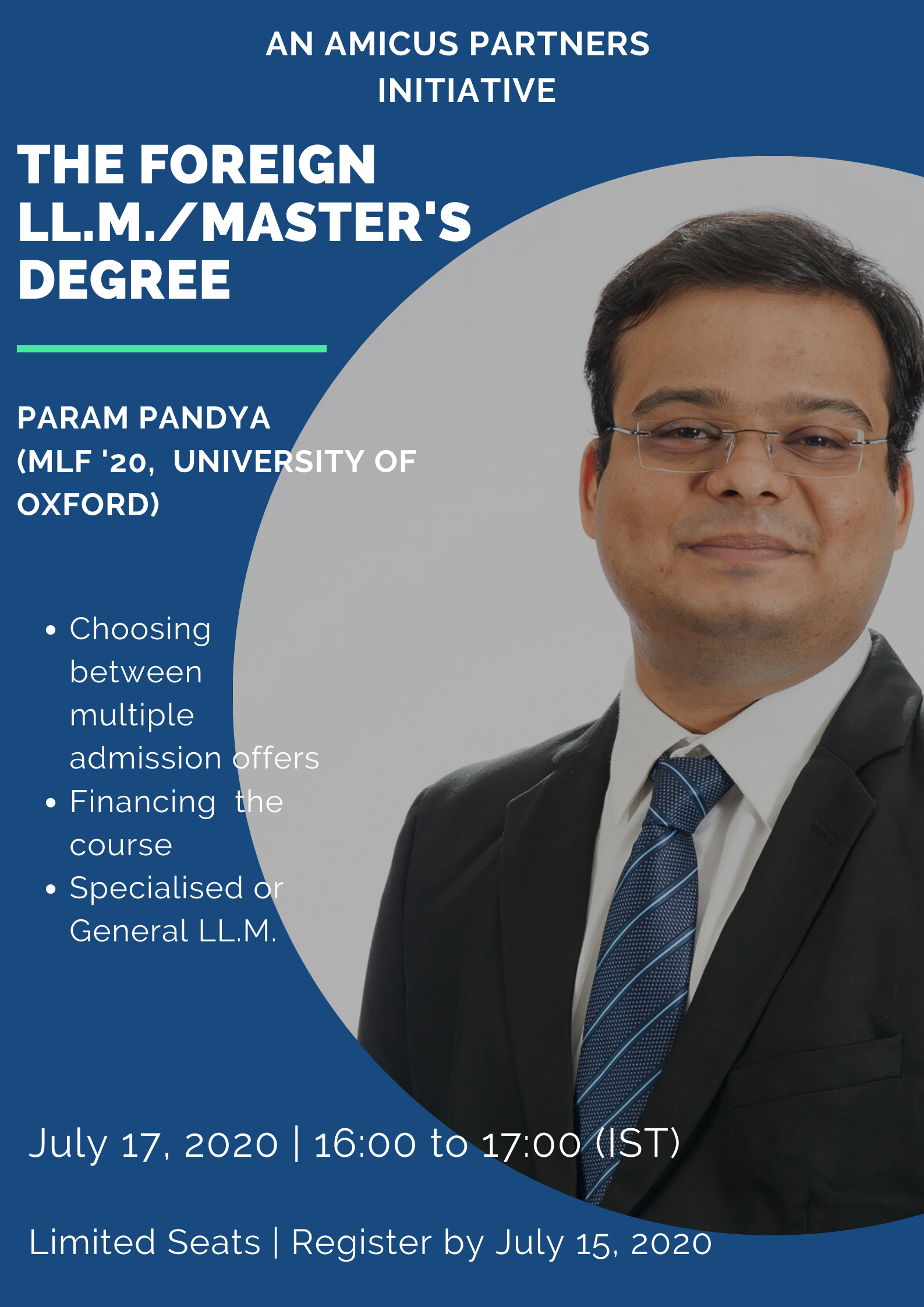
  • If you would like to learn a bit more about the master’s application process, do register for the “fireside chat” that we will be organising with Param Pandya, a current candidate of the MSc in Law & Finance (MLF) at the University of Oxford.

    As we have noted in the past, the MLF is an interesting alternative to the more popular LL.M. and we are quite sure that Param will have some valuable information to share. Seats for the event are limited, so please do register here as soon as possible.

    Preference will be given to those who have already applied for a master’s course.

    More details in the flyer below.

    Param P Amicus Partners.png

  • First Person Accounts (FPA’s) are meant to provide a first-hand account of Indian graduates who have pursued, or are pursuing, a post-graduate course (LL.M. or otherwise) from different universities across the world.

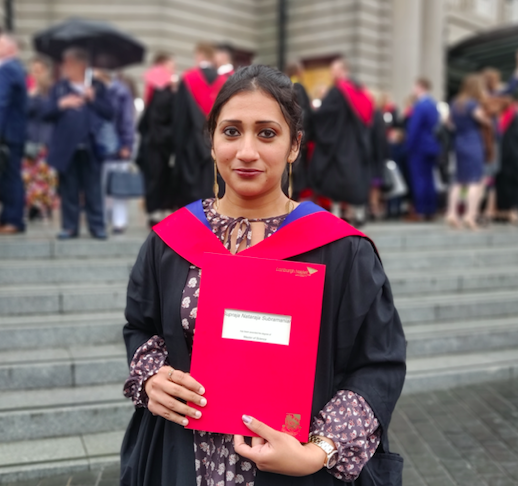
    Supraja Subramanian is an Indian law graduate who has pursued two post-graduate courses outside the country. The first of these was an MSc in Applied Criminology and Forensic Psychology at Edinburgh Napier University, Scotland. The second, the  LLM. (Hons.)Forensics, Criminology and Law at Maastricht University.

    Supraja Subramanian is an Indian law graduate who has pursued two post-graduate courses outside the country. The first of these was an MSc in Applied Criminology and Forensic Psychology at Edinburgh Napier University, Scotland. The second, an  LLM. (Hons.) Forensics in Criminology and Law at Maastricht University.
    Supraja Subramanian (MSc, Edinburgh Napier University & LL.M., Maastricht University)

    In this FPA, the ’16 graduate of Saveetha School of Law discusses the reasons for her slightly unconventional choices, the differences between her MSc and LL.M. experiences, and a whole lot more.

    Your first master’s was an MSc in Applied Criminology – what got you looking at this particular degree? Once you knew that you wanted to study criminology, how did you go about selecting just where to apply? 

    While pursuing under graduation in Law, I realised that I enjoyed studying criminology the most but also, that litigation was not my cup of tea. During my final year, I wanted to utilise my free time by discovering my interests and looked for short, distant certificate courses.

    It was then that I stumbled upon International Forensic Sciences, Pune which offered an array of certificate courses, all related to criminology and forensics.

    After deep contemplation, I enrolled into their six-month course on Forensic Psychology and Criminal Profiling. Although I had always wanted to pursue my higher education in a foreign country, this course helped me decide what I wanted to specialize in – criminology integrated with forensic psychology.

    I researched on universities in the USA as well as in the UK. I found the universities in the UK to be more suitable for me who did not have an academic background in science/psychology but wanted to study forensic psychology.

    I narrowed down to pursuing Applied Criminology and Forensic Psychology at Edinburgh Napier University because I found the course extremely intriguing and also because it was in Scotland, one of the most beautiful places!

    To your mind, what were the advantages of the MSc as opposed to the more popular LL.M.?

    An LLM is the most obvious and pertinent masters that an LLB graduate would opt for and it builds upon the existing knowledge. For my area of specialization, I would compare the MSc and LLM to being two sides of the same coin.

    While the MSc focused on the root cause and science behind crimes – criminological theories, psychology, neuroscience, effects of imprisonment, importance of rehabilitation and reintegration of offenders; the LLM focused on dealing with the effects of crime from a legal perspective – forensic evidence in the court, flaws committed in the criminal justice system, testimonies and confessions and the psychology behind them.

    In my opinion, the advantages of pursuing MSc were learning about the less popular methods of dealing with crime, namely, treatment and rehabilitation as opposed to LLM, in which we learn more about the most favoured deterrence and retribution.

    Any advice on the application process itself? How did you use your past work experience and education to support your application? 

    During my undergraduate days, I utilised as many opportunities as I could by taking part in moot competitions, attending seminars and volunteering. These activities definitely made my application stronger as I was able to prove my inquisitiveness and enthusiasm along with soft skills like teamwork and time management.

    Moreover, the certificate course I had done during my final year equipped me with better chances of securing admission since it proved to be a bridge between my LLB and the MSc I was aiming for.

    Regarding the application process, I would advice the prospective students to watch out for scholarship deadlines, some of which must be met months before the course application deadline. The application procedure overall is straightforward and simple.

    Did you apply for/receive financial aid from Edinburgh Napier University?

    No, I did not apply for any financial aid. The university offered a concession on the condition that the full tuition fee must be paid in a single payment before the start of the course. I availed this concession.

    How was the MSc experience itself? What were some of the more challenging aspects of the course? 

    For someone who had opted for commerce stream even in high school, I found the MSc course extremely new, interesting and thought provoking. Most of the lectures were delivered by special guests such as police officers, ex-convict, forensic psychologists, diversion centres and other practitioners from the criminal justice agencies which made the entire course all the more exciting.

    Another aspect of the course I enjoyed the most was the field visit to the court and prison; the summer school I was able to participate in through which I went to Florida Atlantic University, USA; and the optional work placement module. In addition, I learnt many practical skillsets like using facial recognition software and working on violence risk assessment.

    What was most challenging was the difference in the educational system compared to India! Studying before and preparing for classes, critically analysing the given problem and writing assignments with plenty of references was indeed very challenging.

    In addition, my course was assessed only through written assignments – essays and reports, which was quite a test since it required intense research and I was used to the Indian written exam method.

    After you completed the MSc, you opted for an LL.M., this time at Maastricht University. Again, what were the reasons behind this move, and why narrow down on Maastricht? 

    Although I followed my passion and secured the MSc degree, being a student of law, I felt incomplete without pursuing LLM. I was determined to find a university offering an LLM course specializing in forensics or forensic psychology.

    I came across two universities – West Virginia University, USA offering an LLM in Forensic Justice and Maastricht University, Netherlands offering LLM in Forensics, Criminology and Law.

    Maastricht University is highly ranked and reputable for law courses. I also felt that the course offered by them was very unique and yet relatable to my previous masters from ENU, which helped me narrow down to it.

    What were some of the differences in the learning experience between ENU and Maastricht? 

    Three points are worth mentioning. Firstly, at ENU, students had to prepare before classes. This was followed by a few questions and the lecturer summarizing the readings. In contrast, UM follows the system of Problem Based Learning in which students prepare for classes based on themes and the discussion that follows is moderated by students themselves. This method allows for exchange of knowledge, personal experiences and kindling of critical analysis.

    Secondly, the study load at UM was thrice more than it was at ENU. Although being strenuous, at the end of the year, I find this more rewarding. Thirdly, ENU offered many workshops aimed at helping international students get acquainted with the facilities offered at the university and to feel more comfortable overall.

    On the other hand, UM’s focus was only academic and they also offered an honours track to all high performing, motivated students. Both universities offered several extra-curricular opportunities.

    Lastly, any advice for the Indian law graduate who is considering a master’s abroad? 

    Remember that an LLM is not the only option out there! In depth research is necessary as every degree, every university and every course offers something different. Consider what the university has to offer and read reviews by former students.

    Once admitted, quickly familiarize yourself with the concept of critical analysis and start working on the thesis on time to avoid last minute hassle.


    We need your help in keeping this blog alive. If you feel that the content on this blog has helped you, please consider making a donation here