The Faculty of Law of the National University of Singapore (NUS Law) is one of the premier places for legal research in Asia. It has an active research culture with seven research centres, an intense and diverse array of research events and seminars, and large numbers of eminent researchers visiting it from around the world.
In 2020, it was ranked the top Law School for research in Asia by the QS and Times Higher Education rankings, and 11th and 25th globally.
NUS Law is inviting applications for Post-Doctoral Fellowship positions commencing in AY2021-2022.
These Post-Doctoral Fellowship positions may be held generally within NUS Law or, for candidates with appropriate backgrounds and expertise, within the Asia Pacific Centre for Environmental Law, Centre for Asian Legal Studies, Centre for Banking & Finance Law, Centre for Legal Theory and the EW Barker Centre for Law & Business.
Successful applicants will commence their Fellowships at the start of August 2021 and conclude them at the end of July 2022.
The closing date for applications is 31 December 2020.
In this interview conducted by Shifa Qureshi, Wajahat Jilani discusses his reasons for opting for Kings College London, the LL.M. application process itself, and a whole lot more.
Wajahat Jilani
At what stage of your career did you decide to do LL.M.? Was it always the plan since you were an Undergrad student in AMU, or was it something else?
It was always part of the plan. Since the first year when I started my BALLB in India, I planned to pursue the LLM from abroad.
Given the specialized nature of LLM, i.e. Competition Law, what were there some of the schools you shortlisted?
I developed my interest in competition law as a matter of coincidence in the fourth year of my bachelor’s degree. I was asked to participate in a moot court competition based on competition law. As we didn’t have much support from the university, my teammates and I had to learn everything from scratch.
At the end of the process, I knew I wanted to study this further. That’s where King’s College London (KCL) comes in.
KCL has a sterling reputation in the legal field. However, it has a particularly well-regarded competition law course and well-renowned faculty. The opportunity of being taught by Professors David Bailey, Alison Jones, William Kovacic, Renato Nazzini etc. whose books are used worldwide, was especially attractive. I was not disappointed.
I also applied to LSE, Oxford University, Cambridge University and Queen Mary University of London.
I didn’t apply to any American universities.
How has the LL.M. experience been thus far? What were some of the more challenging and rewarding aspects of the LL.M.?
The LL.M. experience is great!
It’s been a different level of academic rigour. The amount of hard work you need to put in is challenging, but this is what I was looking for when I applied for the masters. I wanted a more rigorous and more specialized sort of academic experience. And that’s being fulfilled.
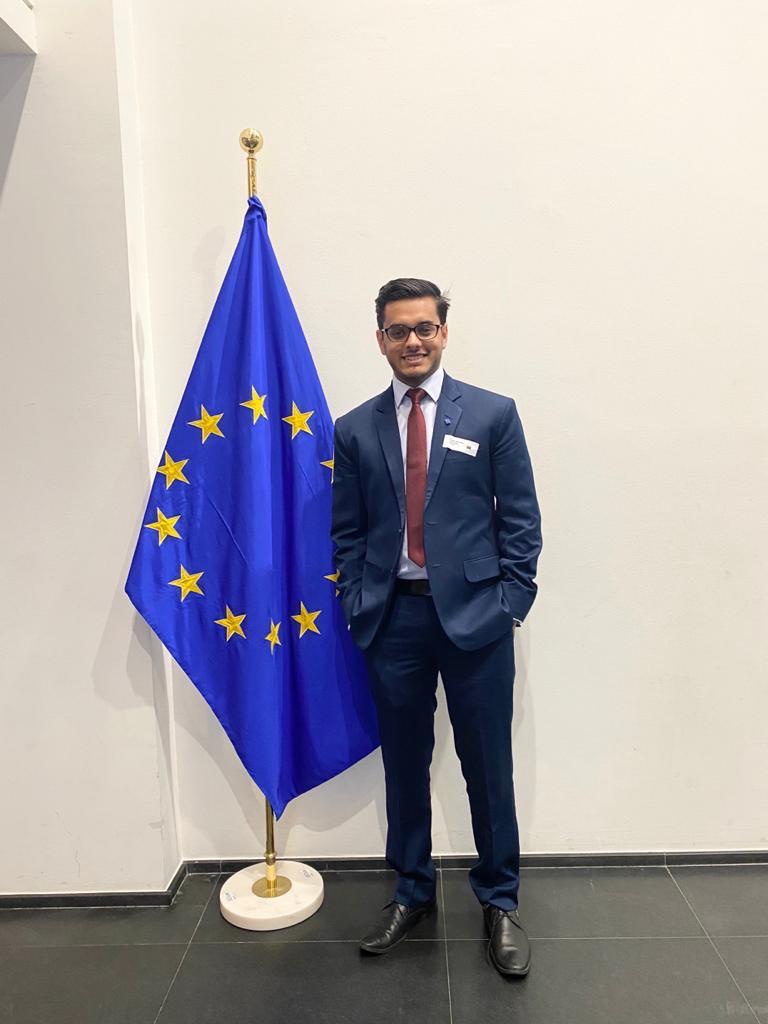
Additionally, having the opportunity to participate in all lectures given by the previously mentioned professors was an enlightening experience. We even got the opportunity to visit the European Commission in Brussels, for a week, where we had a series of 5-day special lectures from the European Commission officials and leading European lawyers. It is a unique opportunity only available to King’s competition law LLM students.
The sheer diversity of our cohort – as with most LLMs – combined with the academic and practical experience of different jurisdictions was just as influential. Therefore, I not only learnt from the formal lectures but also from my interactions with my much-experienced colleagues.
There are cultural differences, of course. However, that is not a hindrance. The atmosphere is extremely conducive for furthering one’s goals. The university and other students are all very welcoming.
Any advice on the application process itself?
The resources and recommendations of the application are already provided in detail on many online platforms.
First, it is important to research the courses, faculty, specializations, and scholarships offered. Most of these details are easily available on university websites. That is the starting position. No advice can replace some research done by the prospective student.
Secondly, be aware of the entire application cycle. The schedule is slightly different from that in India, so you need to apply one year before. For example, if you want to apply for September 2021, you need to start applying now (applications usually open in September and close around January for the top-ranked universities).
So, aspirants must start as early as possible to understand the complexity of the application process. Be early and pay attention to your choices.
Also, remember that most applications ask you to write a statement of purpose and provide references. My personal experience was that these things need time. I cannot stress enough on the importance of writing well and avoiding grammatical errors. They really do matter!
You have had the experience of living in one of the most expensive cities in the world. Was this difficult to manage? Additionally, can you share with us all the opportunities offered by KCL to its students?
London is very expensive, but you can take this as an opportunity rather than being burdened by it. The experience was amazing and fun. There are various ways in which you can manage the cost issue. For instance, I stayed in an accommodation nearer to the university (i.e. at walking distance), which saved my transportation costs. You just need to make smart decisions.
I did a part-time job which aided my finances. It doesn’t cover all your expenses but can help your finances.
There are lots of opportunities to learn, as there are many societies in KCL which you can join, like Debating Society, Law Society, General Law Society, Postgraduate Law Society, etc. These societies organize various events. There is even an ‘India society’ which routinely organizes vibrant events.
There are societies for various aptitudes by nationality, by objectives, etc.
Due to the limited time during the LLM, I only took part in a few activities and chose to focus on my studies largely. There are classes, assignments, projects, reading, etc., so the schedule is jam-packed. Quite often, you need to read 100-150 pages for one lecture. Similarly, you have 3-4 subjects per week.
Having said that, there is always something happening, and opportunities exist. Unsurprisingly though, there is high competition. One of the opportunities I got was to represent King’s in the Herbert Smith Freehills Competition Law Moot 2020.
At AMU, unfortunately, we did not have the opportunity to participate in international moots. Therefore, being selected in itself was a piece of positive news. I thoroughly enjoyed the experience, and eventually, we secured the 7th position worldwide.
Unfortunately, the part I look forward to the most in a moot court – oral pleadings – is not something we were able to do due to the oral stage being curtailed from top 12 to top 4 teams. Nevertheless, I learned a lot during the moot and am thankful for the opportunity.
I also reached the semi-final of an intra-university debate competition. While doing UG, I participated in many competitions, so I deliberately decided not to take part in too many competitions.
Moreover, it was quite nice to compete as a newcomer for a change!
One of the more common questions we all have, is when a good time to apply for a master’s – any thoughts?
It depends; this is a very subjective concern. I too struggled with this question, but one advice I would give is that each person must assess their own circumstances and goals when deciding when to pursue an LLM. There is no one-size-fits-all answer to this.
In making my decision, I realized that once I got into a full-time job, I would be completely dedicated to my work. So much so that with time my career priorities may have changed. I was in a fortunate situation where I had the opportunity of doing the LLM immediately and looking back. I am happy with my decision.
What is your reading of the employment opportunities in the field of Competition Law? More specifically, from the point of an Indian trained lawyer?
Competition law is a very niche area.
Therefore, not every law firm has a Competition practice but will most likely have corporate or litigation work. Tier-1 firms definitely have excellent competition teams.
As the competition law is still evolving, more and more opportunities are coming up. There are a number of boutique law firms engaged in competition law practice. The Competition Commission of India is another option.
It is a very interesting area of law and requires good one to grasp basic commercial know-how and economic principles.
Lastly, any advice for the Indian law graduates who are contemplating Masters abroad?
Work hard.
It is not difficult as long as you plan ahead, research, and remain organized. This will be particularly useful in deciding your specialization if you wish to have any. Sometimes universities have specific entry requirements which you need to work towards well in advance.
Assess all the factors. While the reputation of the university is important, particularly from the employability perspective, there are other equally important factors. These days some of the best LLMs are offered by universities may not necessarily be a household name in India but are leading centres for those fields.
Universities will almost always require good undergraduate marks. So work hard to achieve the results. As mentioned earlier, if you have already shortlisted some courses, knowing the marks required will help you plan accordingly. You can also demonstrate your interest in your chosen course/specialization through relevant internships, moot courts, good quality publications etc.
(Shifa Qureshi is a law student at the Faculty of Law, Aligarh Muslim University and a mentee at the Upeksha Education’s Mentorship Programme)
We need your help in keeping this blog alive. If you feel that the content on this blog has helped you, please consider making a donation here.
Momina Zahan is an Assistant Professor in Law in Banasthali Vidyapith, and has completed a B.Sc. with Zoology (Honours) from Guwahati University and an LL.B. from Campus Law Centre, Delhi University. She then travelled to the United Kingdom in 2006 to do her Post Graduation studies, completing an LL.M. in Criminal Justice Administration and returned to India in 2009.
In between her LLB and LLM, she also completed an MBA in HRM and Marketing. Ms. Zahan is presently pursuing her PhD in Women Studies and Law.
Momina Zahan, Banasthali Vidyapith
In this interview conducted by Upeksha mentee and law student at Banasthali Vidyapith, Vani Tripathi, Ms. Zahan discusses some of her experiences in the study of law thus far, doctoral studies, and a lot more.
(Edited excerpts)
You have a diverse area of interests, like science, management, social issues and law. How did you end up choosing them, and how was the journey been?
Thank you for noticing that. Regarding my diverse interest, I would like to say some fields were my choice and some came by chance. I believe that variety is the spice of life.
Regarding my interest in Science, I would say that I always wanted to be a doctor and serve humanity. In fact, I was on the verge of joining medical college but due to some problem, I could not join the same. So, I did my B.Sc. in Biochemistry with Zoology as Honours from Guwahati University.
And because of my paternal uncle late Justice Baharul Islam, I chose to join the legal fraternity and pursued my LLB from Campus Law Centre, Delhi University.
Shifting from Science to Humanities was tough as I could not remember things just because it is written unless I understand the why’s and the how’s. Thus, during the studentship of Law, I am more comfortable in relating to those subjects which are related to the society. After all, I am people’s person who likes to work for the betterment of society.
As for the MBA, it just happened as a mode of leaving India and reach the United Kingdom for my studies. However, I enjoyed learning Human Resource Management and Marketing Management and scored good marks in my MBA degree.
So, if I summarise the diversity of my choices, I would say Science, Law and Social Science were my choices with the hope that even if I could not become a doctor of human being and cure their disease, I can be a doctor of the society so as to cure its illness. And management just happened by chance.
When did you decide to pursue LL.M. and how you started applying for universities?
I did an LL.M. in 2007-08 from the University of Aberdeen. I started applying for LLMs from London in 2006 during my MBA through an Educational Consultancy in London. I applied to 2-3 Universities, comprising of Birmingham University (Birmingham) and University of Aberdeen (Scotland).
Out of three, I completed the whole procedure for the University of Aberdeen and got the call from the same within a few months. For this, I have developed my SoP for almost a year.
Have you applied for any financial aid, and how would you advise students to manage their LoR and SOP?
I did take financial aid in form of an educational Loan from SBI as I did not have much time in hand for pursuing any scholarship. The scholarship application requires time and effort for a successful grant.
Regarding Letter of Recommendations, always approach the teachers who have a good rapport with you, as a good reference plays a positive role in the confirmation of the admission process. If the teachers are renowned ones, then their connection with your proposed place of study do play an important role.
As for the Statement of Purpose, this is one major consideration for your successful application process. The Admission Committee must understand your capabilities after reading your Statement of Purpose. Hence a student must give his/her best efforts in writing the SoP and it must reflect her personality, her sincerity and genuineness in her application.
A student must put more efforts in the Statement of Purpose than Letter of Recommendation because her individuality is more showcased in the SoP.
You have supervised NRC project in Assam and also served as HOD in Management. What different aspects you saw in these roles and what appeals more to you, working on ground level or being an academician?
I joined the NEF College of Management and Technology, Guwahati as Head of Department of Management and worked in that capacity for more than three years. Then I joined the all-new NRC Updation Project as District Supervisor and successfully completed the first phase of the project.
But I had to leave that job for my daughter who was only 6 months then.
Every experience teaches a new lesson every day. However, I love to be in academics more than in administrative roles because of enriching nature. I love to work amidst people in a conducting environment rather than behind closed doors.
But I must add here that there is no strict distinction of roles these days, there is always an overlapping of functions in almost every role you choose.
Therefore, I will suggest everyone that adaptation and adjustment is the key to be satisfied with your work-life.
Criminal Justice Administration was your specialisation. How did you choose your specialization and what are your other interests in Law?
Yes, Criminal Justice Administration is my specialisation and I chose the area as I always to wanted to come back and serve my nation. As I told you earlier, I am a people’s person, hence I wanted to study a subject which I can use after coming back to India.
Rest of the courses like International Business Law, International Arbitration and International Human Rights Law have more scope internationally rather than in India. So, I found that this subject is one with which I can do something after coming back to India.
Beside Criminal Justice Administration, other interest areas are Women Studies, Intellectual Property Laws, and Health laws. Being a student of Science, I feel more connected to IP Laws and Health Laws.
How should one go about choosing a PhD thesis guide? Also, please do share how was your LL.M. journey and what are your future plans.
There is no such trick or step to be followed while choosing a PhD guide, it depends upon your area of study, the university where you chose to pursue your PhD and the available research guides in that university. However, in case you get a chance to choose your guide, then always give priority to the similarity of your area of research with that of your guide’s.
My journey of Post Graduate studies was very fruitful and enriching. I learnt a lot and met new people from across the globe. I stayed in the United Kingdom for over 4 years and during that period, my life was enriched in every little way. My thought process broadened because of this visit and this period has taught me to see life from a new and positive perspective altogether.
Regarding my future plans, I just want to give something back to society in the form of my research and my academic writings and remain a people’s person forever. I hope to make my parents feel proud of me.
All the best to everyone for all their future endeavours!
We need your help in keeping this blog alive. If you feel that the content on this blog has helped you, please consider making a donation here.
The Faculty of Law of the National University of Singapore (NUS Law) is one of the premier places for legal research in Asia. It has an active research culture with seven research centres, an intense and diverse array of research events and seminars, and large numbers of eminent researchers visiting it from around the world.
In 2020, it was ranked the top Law School for research in Asia by the QS and Times Higher Education rankings, and 11th and 25th globally.
It is offering up to three fully funded places for its PhD programme starting August 2021.
Successful applicants will receive:
A monthly stipend of between S$2,000 and S$2,700 per month, and
A full tuition fee subsidy for a maximum of four years.
PhD students who successfully pass the upgrade processes will receive an additional monthly stipend of up to S$500 per month. We will also provide, in addition, funding for research expenses and conferences up to a maximum of S$8,000 during the period of the programme.
Outstanding applicants in any field of law are strongly encouraged to apply.
The closing date for all applications is 15 November 2020. Application instructions and requirements can be found here
Professor Patrick Osode is a professor of law at the Nelson Mandela School of Law, University of Fort Hare. He completed his LLB and LLM at the University of Lagos in Nigeria, and then completed his doctoral degree in law from the University of Toronto, Canada.
In this interview conducted by Zibalule Mdeni, Prof. Osode shares his experience from having completed his education in an international university and some wise words for prospective legal scholars, amongst other things.
Prof. Patrick Osode, University of Fort Hare
What do law lecturers/scholars do besides teaching?
Being an academic allows to develop advanced skills and expertise, and it allows to address high-level audiences in particular subject areas. Through this, you will find some academics having to work for international organisations such as the United Nations, the African Union, African Development Bank, to mention a few.
Legal academics can be also be appointed to become judges. In addition, legal academics can take up the role of being special advisors in government agencies where special expertise are required.
Young people must know that the academic track allows players on that track to develop high-level expertise which is acknowledged. For instance, academics publish work and through your published work you get recognition beyond your university.
Through your recognition, you can get external invitations to be part of other academies.
What interpersonal skills should a prospective academic look for in themselves or develop?
While in university, a student can identify a number of skills that would give her an indication that she will not only be effective but be happy as an academic. You won’t last long in the academy if you are not happy about being an academic.
Academy is not just a job, it’s a calling.
Firstly, to be an effective academic, you must love learning. Be passionate about obtaining more information. Secondly, you must curious. You must ask pertinent questions. Thirdly, you must love the process of learning. You must enjoy the process whether you are on the learning side or the teaching side. Fourth, academics feel strongly about what is just and unjust. Academics have a strong sense of fairness.
Lastly, you must love excellence. You must love to see excellence being done in schools, society and in all human spaces. If you possess the above attributes, you might be effective in future as an academic.
Do you think practical experience as a lawyer is necessary for one to be a successful legal academic?
Practical experience in law is useful for the academic. As to how much, would be an issue of debate. I would recommend an aspirant legal academic to get a minimum of two years of practical experience.
If you aim to do a Masters’ degree or PhD, the lack of practical experience beyond LLB can present a challenge. Practical experience after your LLB can open your mind. It allows your mind to understand how the law works in the real world.
Practical experience can help you challenge the current thinking of the law. It is not helpful to have an academic who has no idea how the law works in practice.
Be that as it may, too much practical experience can be also a problem. The work of legal academics is distinct in a lot of ways from what is done in practice. Therefore, you must not go too far.
Academics focus more on research and are rarely exposed to the day-to-day issues dealt with by practising lawyers. But there are scholars who are successful without any legal experience.
Does the way in which the LLB program is structured from one Law School to another have a bearing on the quality of the qualification?
Not necessarily. A course can be done from the second year or final year in various law schools, respectively. A lot depends on the individual student, not so much at the arrangement of the qualification of the curriculum.
If a student is diligent, they can do well and obtain a quality qualification. The key is that you as a student must learn it well. A student must focus on the quality of the work taught, not so much on how the curriculum is structured in their university.
Would you advise students who wish to enrol for a postgraduate degree to complete their degree at an international university (like you did)?
There’s a lot of factors that attract student to pursue their postgrad studies to prefer an overseas opportunity. Completing your studies overseas can expose you to an environment with more resources.
As an assumption, most international universities have more resources to support the work of a postgraduate student. The opportunity to study overseas can help you learn more about the world. It exposes you to a more diverse world than the one you’re familiar with. This can be useful, as you will work with different people, from different backgrounds as a professional.
Studying overseas can help you develop new coping mechanisms and capacities as a person. This will help fast-track your personal development, as opposed to you being in a familiar environment. Studying overseas can offer you a more financially beneficial opportunity. Scholarships can be very generous when you study in an international university.
Additionally, studying overseas can help build your competence. This can help a student become a global player and produce work for global consumption. If you study in your home country, you won’t stretch yourself enough as international opportunities can influence to write differently about your chosen subject.
Are you happy with female representation in the legal academic space?
I will say that things are improving. There is an upward trajectory. In the next five to ten years, [female representation] will be in a better position. There are good initiatives in place to support the recruitment and progression of legal academics in South Africa.
If the leadership of universities can stay the course, the next five to ten years will be good. It’s an ongoing process.
The status quo is not one which can be celebrated yet.
![#Alert: NUS Law inviting applications for Post-Doc Fellowships [Apply by Dec 31]](https://amicuspartners.co.in/wp-content/uploads/2025/06/c6876-nus-law.jpg?w=1024)


 Amicus Partners