With the spiralling costs of foreign education, it is more important than ever before to take into account the financial aspect of an LLM. And, when the destination of choice is the US, this can become a daunting aspect.
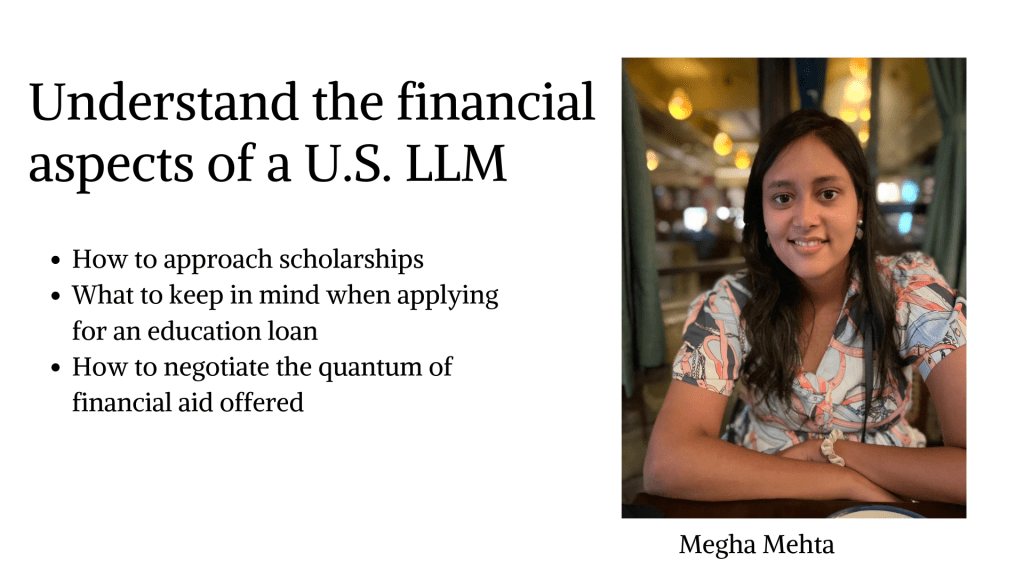
To help you in this regard, Amicus Partners is hosting a webinar on US LLM scholarships, educational loans, negotiating the quantum of aid offered by law schools etc.
The speaker for this webinar will be Megha Mehta, a recent LLM graduate of Harvard Law School, who is currently teaching at her alma mater, the National Law School of India University in Bangalore.
The one-hour webinar will be held this Sunday (September 25, 2022) at 11 am.
The fees for the webinar are INR 1,500/-with a limit of 15 participants.
If there is one thing that I have learnt working with law schools over the last four years, it is the fact that no law school is the same. Sure, the end goal might not be too different i.e. getting high-quality (or at least high paying) applicants to enrol for their graduate programmes.
But there are so many other factors at play here.
For instance, how familiar are Indian applicants with your law school, have you received any applications from India or is India a completely new market, what is the level of buy in from the school leadership, what are the kind of resources (monetary and human) that can be devoted to the India market etc.
A quick point here – the human resource angle is one I think a lot of law school managements either fail to acknowledge or are unaware of. The fact of the matter is that graduate admissions teams are stretched thin and have been for at least a few years now. Is it reasonable to expect them to take on one more market, especially one that is as large and complex as India?
But that is a discussion for another day.
Coming back to the various factors that differentiate your law school from the next- why are they so important? Because every single decision on the marketing side will flow from the answers to the above questions. As any service provider will tell you, clarity from the client is crucial.
Absolutely crucial.
So, even before deciding to embark on a marketing campaign, a round of introspection would be in the best interests of all parties involved.
As for the answer to the (mildly) clickbaity headline, here are three possible answers, divided as per the marketing budget.
With an annual budget of $6,000
With limited funds, it is imperative that you stretch that dollar as far as you can. In real terms, what this means is using sponsored posts on popular Indian websites and/or social media channels a few times across the year.
When it comes to social media, I see LinkedIn as being one of the most effective at least in the Indian market. And, in an ideal world, use these sponsored posts for an extremely specific call to action. This CTA could be a webinar, or an online conference, or even a talk with the career services office.
In my experience, interest in LLM applications peak twice a year – so you should work this into your plan as well.
With an annual budget of $6,000 – $24,000
This is the sweet spot in terms of marketing spends.
Not only can you pick up some of the more expensive (and highly visible) banner advertisements, but you can also team up with organisations such as Amicus Partners (subtle) to manage, review and fine tune the marketing campaign.
Popular websites I have worked with in the past include Bar & Bench, Lawctopus, and SpicyIP. The last is particularly useful for IP-focused programmes.
A consistent, and long-term ad campaign, aided no doubt by the size of the budget, can help achieve significant results – for one US law school, for instance, we saw application numbers shoot up by 150% in a year’s time.
The higher visibility (through more expensive banners) is particularly useful for those schools who have not traditionally seen Indian applicants.
With an annual budget $24,000 or more
This is where things can get quite interesting. The funds not only mean that you can lock-in long term campaigns (and negotiate a lower price) but also explore offline options as well.
For example, you can look at hiring human resources in India to connect with Indian law schools, entering into collaborative agreements and the like. These agreements can be crucial in the long run, building closer relationships that benefit all parties involved.
Other offline options include essay competitions, sponsoring moot courts etc – all of these are fantastic (but investment-heavy) ways to build your brand in India.
Of course, like I said at the start, budgets and funds are just one part of the equation. To set up truly effective campaigns, not only should you know the pros and cons of studying at your law school, but also have clear (hopefully measurable) goals in mind.
Failure to do so will only result in money wasted.
And that would truly be a crime.
Finally, a few lessons I have learnt along the way:
Keep your goals clear, and preferably quantitative.
Invest long-term. There are no short-cuts to building recruitments. None.
Nothing beats peer review. India alum are an invaluable asset – use them.
(If you would like to have a chat on how your law school can create and execute an effective marketing campaign, reach out to me at anuj@amicuspartners.co.in)
We need your help in keeping this blog alive. If you feel that the content on this blog has helped you, please consider making a donation here.
First Person Accounts(FPA’s) are meant to provide a first-hand account of law graduates who have pursued, or are pursuing, a post-graduate course (an LLM or otherwise) from different universities across the world.
Sunny Shah
Sunny Shah graduated with a law degree from NLU Jodhpur in 2012. After spending two years of working in a law firm, he opted for the LLM at Cornell Law School. In this FPA, he discusses his reasons for opting for this LLM, thoughts on the Return of Investment of a foreign LLM, and more.
Nearly seven years after completing the LLM at Cornell Law School, how have you seen the LLM play a role in your professional growth?
The LL.M. has played an important role in my professional growth. I went for the LL.M. after two years of work experience with the intent that I would come back to India and continue my litigation practice in India.
During my LL.M. at Cornell Law School, I focussed on subjects relating to Dispute Resolution and Trial Advocacy. I believe the learnings during the LL.M. play an important role in my approach towards preparation for a case. Apart from that, the tag of LL.M. from a reputed university also plays an important role.
For some clients, knowing that you have done an LL.M. from a reputed university, brings trust and belief in you. Many clients show their appreciation of me having done an LL.M. from Cornell Law School, and at times is the reason for them engaging me. Further, LL.M. has also helped me develop valuable connections with lawyers from different parts of the world.
All in all, LL.M. from Cornell Law School has definitely played an important role in my professional growth.
And going back those seven years, how did you know that it was a good time to apply for an LLM? And once this was decided, how did you go about selecting just where to apply for the LLM?
From my days at National Law University, Jodhpur, I was always keen to pursue an LL.M. abroad. My parents, who are doctors, and who had also gone abroad for further studies, strongly believed that it helped them in their practice. They always encouraged me to go abroad for further studies.
While I was quite determined to go for an LL.M., I was not so sure whether to go immediately after completing my law or after some work experience. As my college placements were before the applications for LL.M. started, I decided to sit for college placements, not sure whether I would even get a job offer.
I happened to get an offer from one of the most reputed firms, Amarchand & Mangaldas & Suresh A. Shroff & Co. (now divided into CAM and SAM), and thus decided to work for a couple of years, and put my LL.M. plans on hold.
I must admit that once I started working, taking a break for education became a difficult decision than what I had anticipated. I discussed this with my Partner, Ms. Shaneen Parikh. Not only was she very supportive, but she also wrote a wonderful recommendation letter for me.
I was in touch with my professors from National Law University, Jodhpur, who also encouraged me, and wrote me recommendation letters. All reasoned that this was a right time to go, and that I have the rest of my life to work. With the blessings of the seniors in my professions and the support of my family and friends, I decided to apply for the LL.M.
As my elder brother was in US at that time, I was keen to go to US for further studies, and thus only applied to universities in the US. With the guidance of my college seniors who had gone for an LL.M., I decided to apply to Harvard, Cornell, Columbia, NYU and University of Chicago. Fortunately, I got an offer of admission from Cornell Law School.
With a few years of work experience under your belt, did you find it difficult to make the switch to student life once again? Any other aspects of the LLM that were challenging (but rewarding?)
Yes. As I said, though I was quite determined to go for LL.M., it turned out to be a more difficult decision than what I had anticipated. I had it in the back of my mind that after two years of work experience, I would go for an LL.M. However, once I started working, it did not feel like a very easy decision. Not many people took a break from work or pursued an LL.M.
Also, I was enjoying the work life, beginning to earn money, and thus was not sure about going back to student life. I discussed with a lot of senior people in the profession, and they all encouraged me to go, reasoning that I have my entire life to work.
Once I was in the Bombay High Court, waiting for my matter and sitting next to a senior partner of a well reputed law firm in Mumbai. We started talking, and he said that the only thing he regretted was not going for an LLM abroad when he was young.
Similarly, a well-known Senior Counsel of the Bombay High Court, when told that I had an offer from Cornell Law School, but I was in doubt, told me that the decision was a no-brainer, and that if I have the means, I should go.
Once I was in Cornell, I quickly got adjusted to student life again, and had some of the best moments of my life. It is now seven years since I am back, and I am glad I went.
The LL.M. from Cornell Law School has been rewarding in more than one way. Cornell University is in a small town called Ithaca in upstate New York. It has one of the best campuses in the world, which would be difficult to describe in words. It has resources which are difficult to imagine.
Just the experience of staying there for about a year, engaging with professors and students from different parts of the world, taking part in activities not easily available in India, was a very enriching experience. It took me some time to adjust to the place, and found it difficult to make the use of all the resource within a short span of 9-10 months that I was there, but overall it was very rewarding by the end of it.
A lot of LLM applicants make their decisions based on the RoI aspect – any thoughts on how this calculation ought to be made?
It is a very difficult question to answer. The LL.M. is very expensive, unless you have some scholarship. Further, it does not even guarantee a job abroad or an increase in salary once you return to India. Thus, calculating RoI is very difficult. Eventually, after many years, I believe one would feel that it was worth it, but there is no immediate RoI.
In my case, before leaving for LL.M., I had decided to move into Counsel Practice (akin to Barrister practice in UK) from Law Firm practice. I had joined the Chambers of Mr. Gautam Ankhad, and intended to continue with that upon completing my LL.M. In Counsel Practice.
There is some gestation period before work regularly flows your way.
While the LL.M. from Cornell Law School has definitely helped me in my professional growth, it is difficult to calculate from RoI perspective. But, seven years down the line, I am really glad that I went as I will experience benefits of it throughout my career.
I would say, if you have the means, then go. If not, then there is no need to regret. An LL.M. is not a necessity, but definitely a very enriching and rewarding experience.
Lastly, any advice for the Indian law graduate who is considering a master’s abroad?
Definitely go for it, if you have the means.
As regards the process, LL.M. Applications can be time consuming, so start early in the process, especially if you are working and do not have much free time. As regards where to apply, both US and Europe have wonderful universities.
However, I believe that if one is looking to get a job abroad and settle abroad, Europe provides better opportunities. As regards the finances, there are many scholarships which one can try for. It is a time consuming process, but considering that LL.M. is really expensive, it is definitely worth exploring as many scholarships as possible.
We need your help in keeping this blog alive. If you feel that the content on this blog has helped you, please consider making a donation here.
A recent article [paywall] in The Ken analysed the 2022 placements at Jindal Global Law School, arguing that GLS has gradually become a “worthy rival” to the older, more traditional National Law Universities.
Now whether recruitment numbers are an accurate marker of quality legal education, I leave it for the experts to ponder upon. Suffice to say that a lot of debate and discussion when it comes to law school rankings rests on recruitment numbers. And I don’t think this is likely to change in the near future.
What I found more interesting was how the article highlighted JGLS’s aggressive campaign to hire faculty from foreign universities, many of whom were Indian law graduates or JGLS alum.
Of course, some aspects of this hiring have come in for critique, like this anonymous post here:
This aggressive hiring has meant two things – one, it provides attainable employment opportunities for Indian law graduates who have pursued a master’s abroad. The high salary is especially crucial for those who have student loans to repay.
Two, it means Indian law students are being exposed to faculty who have pursued higher education outside the country. As a result, higher education decisions will not only be based on peer and family networks, but on faculty networks as well.
And this is a crucial point – students now have direct access to those who have pursued higher education abroad. Theoretically, this will not only inspire students to follow similar pathways, but also result in greater access to information on higher education abroad.
Just as it did at other Indian universities as well.
More than a decade ago, the then VC of NUJS, Prof. MP Singh managed to attract faculty who had studied outside India. Which in turn, aided no doubt by Prof. Singh’s gentle guidance, encouraged many an NUJS graduate to follow a similar path.
The same could be said about other law universities such as NLU Delhi, Symbiosis Pune, NLU Jodhpur and NLSIU as well. In fact, NLSIU under the relatively new leadership, has started investing quite heavily in building a feeder route for faculty. This will be interesting to watch over the next decade or so.
But let us come back to JGLS – there is another aspect of this private law school that will continue to play a role in the Indian law graduate and aspirations for a foreign education.
The MoUs that JGLS has entered with foreign universities allow for the granting of dual degrees. An Indian law student can get a BA LLB from JGLS and a JD from a US law school (such as Cornell) in six years, instead of eight.
A lot of Indian law universities have entered into MoUs with foreign universities, but this has largely been limited to semester exchange programs or joint research activities at the most. The granting of a dual degree, as far as I know, is unique to JGLS.
But this can change and change quickly.
Newer law schools (and there have been a fair few of these) may very well see MoUs as a means of building institutional profile. In fact, a number of JGLS faculty have gone on to lead these newer schools, BMU and DY Patil are just two examples. Replicating the JGLS model, in terms of international collaborations, could very well be on the cards.
The national law universities, many of whom have a fully functioning placement and recruitment cell, may soon set up a cell to aid students who want to apply for a master’s abroad. From an institutional perspective, this would require minimal financial investment, and the benefits (higher prestige value) would be almost immediate.
What all of this means is that an education abroad is becoming more and more common amongst Indian law graduates, and these numbers are only going to grow. If ever there was a time for foreign law schools to look at India as a significant recruitment market, the time would be now.
And this is not hyperbole.
A recent ICEF report indicated that India outbound students might number to nearly 1.8 million by 2024. That is a staggering number.
Of course, LLM or JD candidates will form a tiny (tiny) fraction of this number. However, as is the case for a lot of India, this tiny (tiny) fraction can still translate into large numbers.
I won’t be surprised if foreign law schools double down on their India recruitments in the next five years or so. And reap some handsome rewards in the process.
We need your help in keeping this blog alive. If you feel that the content on this blog has helped you, please consider making a donation here.
First Person Accounts(FPA’s) are meant to provide a first-hand account of law graduates who have pursued, or are pursuing, a post-graduate course (an LLM or otherwise) from different universities across the world.
Kavya Lalchandani
Kavya Lalchandani completed her undergraduate degree in law from NLU Odisha in 2021, and enrolled for the MCL at the University of Cambridge that very year.
In this FPA she discusses the reasons for choosing the MCL, the MCL application process and MCL experience, and much ore.
The MCL is a fairly interesting choice – did you look at traditional LLMs and/or the BCL as well? What were some of the factors that made you choose this particular course?
I did look at traditional LLMs.
I also got an offer for the LL.M. course from the University of Cambridge, among other UK universities such as LSE, UCL etc. However, I had made up my mind for MCL before even getting the offer for the LL.M. course.
The MCL is a more specialised corporate law-oriented Master’s and more strenuous than the LL.M.
In the LL.M. course, a student has to choose 4 subjects for which the exams happened at the end of the year and in the case of dissertations as well, it was supposed to be submitted towards the end of the year.
In the MCL, we had to read 6 subjects. We could choose 4 MCL modules out of the 6 available MCL-specific modules for which there were semester-wise examinations in Michaelmas and Lent Terms.
In addition to this, we had to take the compulsory Deals course and choose one of the corporate law oriented-LL.M. full-year modules for which the examination was at the end of the course.
Moreover, the MCL had a unique pedagogy where the focus of the subjects was multi-jurisdictional and not just the UK laws. I took Comparative Corporate Governance, Corporate Taxation, International Merger Control and Shareholder Litigation as my 4 MCL modules and Corporate Insolvency as my LL.M. subject.
Did you ever consider working for a year or two before enrolling for this programme? And how early did you begin the application process?
When I started researching and talking to people about pursuing my Master’s from abroad, I got divergent opinions on this aspect.
However, I chose to pursue it right after my undergraduation.
I understood it was a big commitment at an early stage, but I was ready to take up that challenge. I wanted to make the most out of my LL.M. at that stage itself and go on to pursue my career in academics and research.
I had started preparing for the applications in the middle of the year in which the applications were due. Managing and justifying each application is not an easy task. Systematically planning around the deadlines is extremely important.
I had very supportive referees from National Law University Odisha, therefore gathering references was not that challenging for me. However, this part is beyond your control so therefore it is advised that you start approaching people early on, once you have made up your mind.
The MCL application process requires one to be fairly concise – any advice for future applicants on how to go about the applications?
In my experience, the things that are within your control, i.e., the CV and the answers to the application questions need to be to the point.
The questions that will most probably be asked for the Cambridge applications would be your career goal, reasons for applying and any other information that might be necessary for supporting your application.
The questions have a limitation on the characters that you can use, therefore put as much information as you can in the initial drafts but be ready to shorten them later on.
You should know which points are crucial to your application and your story and which could be let go off.
When it comes to the CV, try to build a holistic one. There is no one correct answer to what a ‘perfect’ CV should look like, but it always helps to show a well-rounded personality. Y
our marks do matter, the basic minimum criterion for Cambridge is for you to be in the top 3-5%, especially for fresh graduates.
It might not matter that much for experienced professionals, but it always helps.
Did you apply for/receive any financial aid?
As a part of your application, you can also apply for the Cambridge Trust Scholarships.
I did apply for them but instead, I received other merit-based scholarships from Nehru Trust for Cambridge Society and Becker Law Studentship from my college- Lucy Cavendish College, University of Cambridge.
Since there is a Collegiate system, some of the colleges can provide you with funding according to the Course. I had made an open application with regard to filling preferences the Colleges, but you can research on what scholarships are available in different colleges and choose accordingly.
What were some of the bigger differences in the learning experiences at Cambridge as opposed to your undergrad at NLU Odisha?
NLU Odisha is a wonderful place to learn and grow. The difference comes in the teaching methods and the technology used in universities outside India generally.
In Cambridge, we focused on a multi-jurisdictional perspective and tried to find out what the law is seeking to achieve in a particular context and also delved into various policy questions. In India, we tend to focus more on what law is and how it is applied by the courts.
Furthermore, we already had reading materials uploaded beforehand, and the lectures are planned in such a way that we knew exactly what is going to be taught and could raise questions if any.
Looking back, what have been some of the most rewarding aspects of the MCL course?
I met many wonderful people on this journey, without whom I could not have enjoyed the Cambridge Experience. Cambridge taught me how to handle 10 completely different things at a time and yet enjoy at the same time. It helped me broaden my horizons of interest and research and threw things at me that even I didn’t know I could handle.
Lastly, any advice for the Indian law graduate who is considering a master’s abroad?
My only advice is that you need to choose your path wisely. You may or may not need a Master’s to reach your end goal in life. Do not take up Master’s from abroad just because it looks good and everyone else around you is doing it. Do it, because you want to and it would help you reach your end goal even if it is 30 years from now.
We need your help in keeping this blog alive. If you feel that the content on this blog has helped you, please consider making a donation here.



 Amicus Partners